

Navigating the First Chilly Morning: Smells, Noises, and HVAC Performance
When you encounter unexpected smells and noises during the first cold morning of fall, having a solid grasp of basic home maintenance tips and troubleshooting can save you from unnecessary panic. That initial drop in temperature usually prompts homeowners to switch their thermostats from cooling to heating for the very first time in months. Almost immediately, the system kicks on, and you are greeted by a startling odor of burning dust or a strange mechanical clanking echoing through your air vents. For many, this October / mid-fall heating startup brings an immediate sense of anxiety about potential fire hazards or expensive equipment failures. Here at Stone Heating and Air, our team typically fields a surge of worried phone calls from Central Point homeowners experiencing exactly this.
For comprehensive support, explore our Air Conditioning Services or learn more about professional AC maintenance in Central Point.
The reality is that transitioning your HVAC system from its cooling cycle to its heating cycle involves significant mechanical shifts. Your equipment has spent the entire summer managing humidity and blowing cool air, leaving the heating components completely dormant. When those dormant parts suddenly receive high voltage and intense heat, they react. Understanding exactly how your system operates during this transition is the key to making informed, safe decisions about your home comfort.
By framing these startup symptoms through a neutral, expert diagnostic lens, you can easily determine whether that strange smell is a normal part of seasonal burn-off or a warning sign of a deeper mechanical issue. Proper equipment care at the end of the cooling season dramatically reduces these startling startup issues, ensuring that your system transitions smoothly into winter mode without triggering false alarms or genuine safety concerns.
The Mechanical Reality of Idle Heating Equipment
To understand why your heater smells or sounds strange in the fall, you have to look at what happened during the summer. Your air conditioning and heating systems are not entirely separate entities; they share critical internal components, most notably the ductwork and the indoor blower motor. While your outdoor AC compressor was working hard all summer, your indoor furnace or air handler was acting as the delivery system, pushing all that chilled air through your home.
During a typical first heating cycle after 4-6 months idle, the system is forced to reckon with everything that accumulated during its downtime. In our years of servicing homes across Central Point and the surrounding areas, we've seen firsthand how Southern Oregon's hot, dry summers increase airborne dust, pollen, and microscopic particulate matter. As your system circulates air during the cooling season, it constantly pulls this dry, dusty air through the return vents. Even with a high-quality air filter in place, microscopic particles inevitably slip through and settle on the stationary heating components, such as the heat exchanger or electric heating coils.
How Summer Cooling Affects Fall Heating
The accumulation of debris is a slow, invisible process. Over the course of four to six months, a fine layer of dust blankets the internal heating elements. Because these elements remain completely cold throughout the summer, the dust simply sits there, undisturbed. When you finally switch your thermostat to "heat" in October, those components rapidly heat up to hundreds of degrees within seconds.
• Continuous Airflow: High-velocity airflow during summer AC cycles pulls massive volumes of household dust, pet dander, and dry regional particulates through the central system.
• Filter Bypass: As filters load up with summer dust, air pressure forces smaller particles around the filter edges, where they settle directly onto the cold, inactive heat exchanger.
• The Transition Flashpoint: The first time the burners ignite or the heat strips engage, they instantly incinerate that accumulated blanket of dust, sending the resulting smoke and odor directly into your living space.
This biological and mechanical buildup is exactly why Scheduling End-of-Summer AC Maintenance is so vital. A professional technician cleans the blower cabinet and clears away the summer debris before the heating season ever begins, effectively eliminating the fuel source that causes those alarming startup smells.
Normal vs. Abnormal Heating Startup Smells
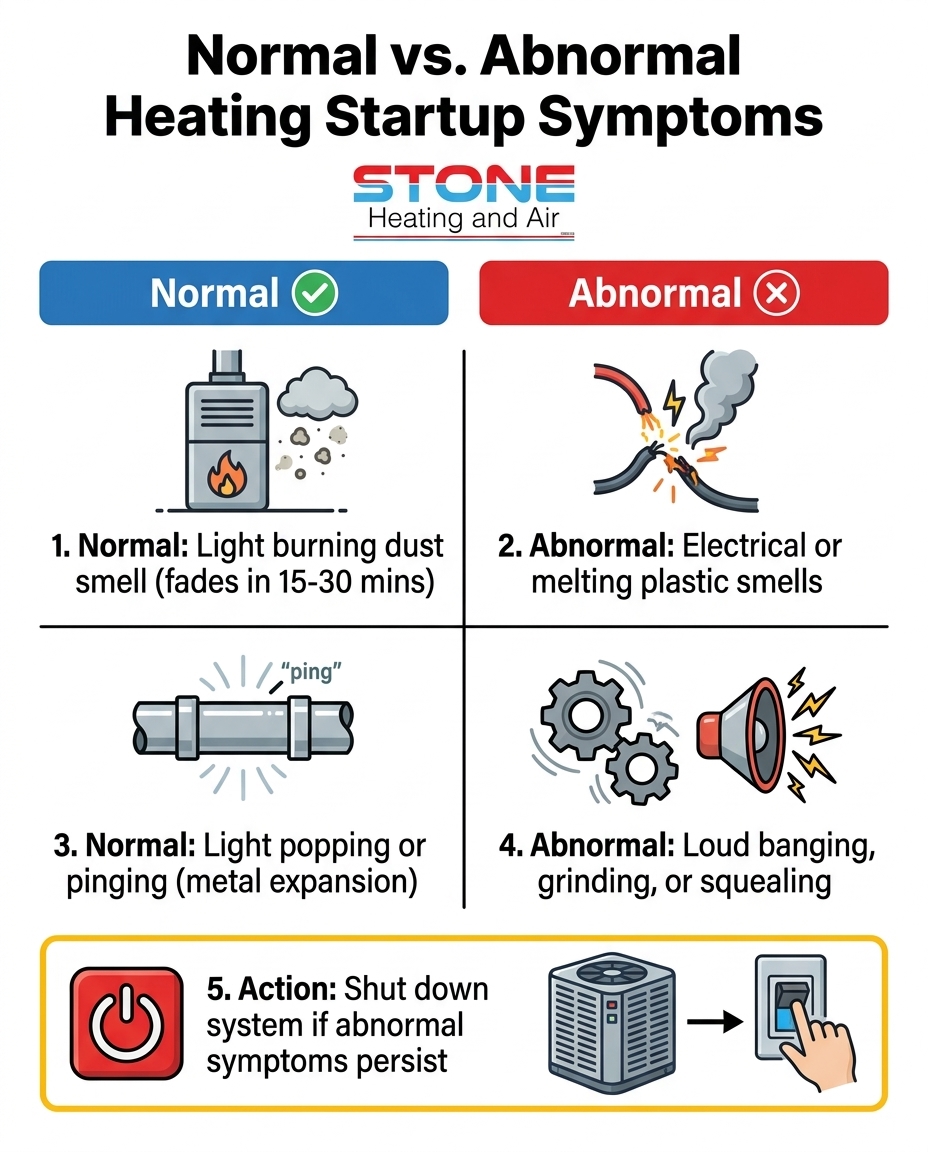
When that first heating cycle after 4-6 months idle kicks in, your nose is usually the first diagnostic tool to register a change. Our technicians at Stone Heating and Air always emphasize that distinguishing between harmless seasonal burn-off and a dangerous electrical failure is a critical skill for any homeowner. The "burning dust" smell is a perfectly normal symptom of a healthy system doing exactly what it was designed to do: rapidly generating heat.
This normal odor is often described as smelling like a hot clothes iron, toasted lint, or scorched earth. It happens because the dust sitting on the heat exchanger is being vaporized. Because the volume of dust is relatively small, this smell typically dissipates entirely within the first 15 to 30 minutes of the initial heating cycle. Once the dust is gone, the smell disappears, and it should not return for the rest of the winter.
Abnormal smells, however, indicate mechanical or electrical breakdown. If you smell melting plastic, acrid electrical smoke, or a sharp metallic friction odor, your system is experiencing a failure. These smells do not fade after 30 minutes; they often grow stronger the longer the system runs. An electrical burning smell usually points to a failing blower motor, a melting capacitor, or frayed wiring insulation that is actively overheating.
• Scorched dust / hot lint — Likely Source: Dust burning off the heat exchanger or heat strips — Duration: 15 to 30 minutes during first use — Required Action: Monitor; open windows for ventilation if needed
• Acrid electrical / fishy smell — Likely Source: Overheating wires, failing capacitor, or melting insulation — Duration: Persistent; worsens as system runs — Required Action: Shut off system immediately at thermostat
• Melting plastic or rubber — Likely Source: Foreign object in ductwork or failing motor belt — Duration: Persistent until object is removed or part breaks — Required Action: Turn off system; call for professional inspection
• Rotten eggs / sulfur — Likely Source: Natural gas leak near the furnace manifold — Duration: Constant, even when system is off — Required Action: Evacuate home; call gas company and HVAC professional
If you detect any abnormal smells, particularly electrical or gas-related odors, the immediate action is always to shut the system down completely. Do not wait to see if the smell improves, as continuing to run compromised electrical components can lead to severe damage to the entire HVAC system.
Decoding Furnace and Heat Pump Noises
Just as your nose detects changes in the system, your ears will pick up a new symphony of mechanical operations during the October / mid-fall heating startup. Homeowners often grow accustomed to the steady, low hum of their air conditioner over the summer. When the heating sequence begins, the system introduces new operational phases, each with its own distinct acoustic profile. Knowing what to listen for helps you identify when a component is struggling.
A pattern we see often during the first few weeks of fall is initial panic over normal expansion and contraction noises. As the metal heat exchanger and your home's galvanized steel ductwork receive sudden blasts of hot air, the metal physically expands. This thermal expansion creates light popping, ticking, or pinging sounds. These noises are harmless and simply indicate that the materials are responding to rapid temperature changes. If you have a heat pump, you may also hear a sudden "whoosh" sound occasionally during the winter; this is the normal reversing valve shifting the unit into its defrost cycle to clear ice from the outdoor coil.
However, louder, more aggressive noises are clear warning signs of mechanical distress. If you hear a loud banging or booming sound right as the furnace ignites, this often indicates a delayed ignition problem where gas builds up before catching a spark. High-pitched squealing usually points to a failing blower motor bearing or a worn-out fan belt. A harsh metal-on-metal grinding sound is a severe symptom, often caused by a loose blower wheel scraping against its housing. When you hear these aggressive mechanical sounds, the equipment requires professional AC repair and heating diagnostics to prevent the components from tearing themselves apart.
Why End-of-Summer AC Maintenance Prevents Fall Failures
It is easy to view your air conditioner and your heater as two separate appliances that take turns working. In reality, they are a single, interconnected climate control system. Bridging the gap between summer cooling and fall heating requires proactive, year-round care. When you neglect the system at the end of summer, you guarantee a rougher transition when that first heating cycle after 4-6 months idle finally arrives.
A comprehensive system check-up at the end of the cooling season does more than just prepare the equipment for winter; it actively prevents the alarming smells and noises that cause October panic. Our maintenance technicians follow a strict protocol to ensure every shared component is clean, calibrated, and ready for the thermal stress of the heating season.
1. Blower Motor Calibration and Cleaning: The technician removes the heavy buildup of summer dust from the blower wheel blades. A clean wheel pushes air more efficiently and prevents the motor from overheating or grinding when the heavy heating cycles begin.
2. Electrical Connection Torquing: Summer vibrations can loosen high-voltage electrical connections. By tightening and testing every wire and capacitor, technicians prevent the arcing and melting that cause abnormal electrical burning smells in the fall.
3. Heat Exchanger Inspection: Before the furnace fires up for the first time, the technician inspects the heat exchanger for cracks, rust, and excessive dust buildup, ensuring the ignition process will be smooth, odorless, and safe.
4. Safety Control Verification: The technician tests the limit switches and flame sensors to guarantee that if the system does overheat or fail to ignite properly, the built-in safety mechanisms will successfully shut the equipment down.
Entering the heating season with a freshly serviced system provides long-term cost savings by improving energy efficiency and reducing the likelihood of mid-winter breakdowns. Furthermore, utilizing comprehensive maintenance plans designed specifically for the unique demands of Southern Oregon's climate keeps your manufacturer warranties intact. We strongly recommend proactive care because most manufacturers explicitly state that warranties can be voided if a part fails due to a documented lack of routine maintenance. Exploring a professional HVAC maintenance plan is the most reliable way to protect that investment.
Objective Criteria for Shutting Down Your System
When you turn on your heater for the October / mid-fall heating startup and something seems off, the hardest part is deciding what to do next. Guessing is never worth the risk when dealing with high-voltage electrical components, combustible gas, or extreme heat. Having a neutral, non-alarmist framework empowers you to make the right call without second-guessing yourself.
If you experience symptoms that fall outside the boundaries of normal seasonal burn-off or thermal expansion, you must act decisively to protect your equipment and your home.
• Rule 1: Time the burning smell. If a burning dust odor lasts longer than 30 to 45 minutes, or if the smell suddenly intensifies instead of fading, shut the system down at the thermostat. Normal dust volume cannot sustain a burn for that long.
• Rule 2: Listen for consistency in loud noises. If loud banging, aggressive rattling, or metallic grinding occurs consistently during every single heating cycle, turn off the unit. Continuing to run a system with a loose blower wheel or failing bearing will cause catastrophic mechanical damage to the surrounding components.
• Rule 3: Respect the circuit breaker. If the HVAC system repeatedly trips your home's electrical circuit breaker upon startup, leave the breaker off. A tripped breaker is a safety device doing its job by stopping an electrical overload. Resetting it multiple times forces electricity into a failing component, which can lead to electrical fires.
• Rule 4: Trust your instincts on electrical odors. If you smell melting plastic, ozone, or fishy electrical odors at any point, shut off the power immediately. These materials only emit odors when they are actively melting or burning due to severe electrical resistance.
By following these objective rules, you remove the emotion and guesswork from the troubleshooting process. If your system violates any of these operational baselines, leave it off and contact a licensed professional for a thorough diagnostic evaluation.
Secure Your Comfort Before the Winter Chill
Understanding the difference between normal thermal expansion and abnormal mechanical failure gives you complete control over your home's climate systems. Proactive care removes the anxiety and guesswork from seasonal transitions, ensuring that your equipment is clean, calibrated, and ready for heavy use. Secure your comfort before the freezing temperatures arrive by scheduling professional AC maintenance in Central Point.
Frequently Asked Questions
Why does my heater smell like burning dust when I turn it on?
During the summer months, dust and airborne particulates settle on the dormant heating components inside your HVAC system. When you turn the heater on for the first time in the fall, the heat exchanger rapidly warms up and incinerates this accumulated dust. This process creates a distinct, temporary burning odor that circulates through your vents. It is a normal mechanical reaction to seasonal inactivity.
How long should the burning smell last when turning on the heater?
A normal dust burn-off smell should dissipate entirely within 15 to 30 minutes of the first heating cycle. Because the layer of dust is usually quite thin, it burns away rapidly once the system reaches its operating temperature. If the smell persists for more than 45 minutes, or if it returns on subsequent days, you should shut the system down and request a professional inspection.
What noises are normal for a furnace startup?
As the metal components of your furnace and ductwork rapidly heat up, they physically expand, causing light popping, ticking, or pinging noises. You will also hear the standard hum of the blower motor engaging and the rush of air moving through the vents. These thermal expansion sounds are completely normal and harmless during the initial weeks of the heating season.
Is a burning smell from the heater dangerous?
The standard burning dust smell is not dangerous and is simply a byproduct of the seasonal transition. However, if the smell resembles melting plastic, burning rubber, or an acrid electrical odor, it is highly dangerous and indicates a failing component. In the case of an electrical or chemical smell, you must turn off the system immediately to prevent further damage or fire hazards.
When should I schedule fall HVAC maintenance?
The ideal time to schedule fall maintenance is in late summer or early autumn, just before the first significant temperature drop requires you to use your heater. Having a technician clean and inspect the system while the weather is still mild ensures that summer dust is removed before it can burn off. This proactive timing also allows you to address worn parts before the heavy winter strain causes them to fail.
Does AC maintenance affect my heating system's performance?
Yes, because your air conditioner and heating system share critical internal components like the blower motor, indoor coil, and ductwork. If these shared parts are left dirty or strained at the end of the cooling season, your heating system will have to work harder to push air through the home. Routine maintenance ensures that the entire interconnected system operates efficiently, regardless of whether it is producing hot or cold air.