

The First Chilly October Morning: Is Your HVAC System Ready?
Here in Central Point, when you wake up to the first chilly October morning, turn the thermostat to "heat" for the first time, and suddenly realize you need some solid home maintenance tips and troubleshooting advice because your vents are blowing cold air or filling the house with a burning dust smell, it can be incredibly stressful. At Stone Heating and Air, we see how the sudden transition from summer cooling to crisp autumn mornings often catches homeowners off guard. You expect warm, comforting air to fill your living space, but instead, you are met with strange odors, unsettling noises, or drafts that feel decidedly lukewarm.
Knowing the difference between a normal seasonal quirk and a failing system is crucial for your peace of mind. When your system acts up during a mid-fall / October heating startup, you are immediately faced with a decision: do you wait it out and hope the smell dissipates, or do you call our professional team before the weather turns freezing? Proper transition care sets the foundation for safe winter heating. Before the cold sets in permanently, making sure your system is ready often starts by addressing leftover summer wear and tear through professional air conditioning services, or scheduling dedicated AC maintenance in Central Point to ensure a smooth, safe transition.
Why the First Heating Cycle is Always the Hardest
Our technicians know firsthand that HVAC systems are mechanical workhorses, and like any machine, they do not respond well to sitting idle. While your air conditioning has been working overtime all summer, your heating components—whether gas burners, heat exchangers, or electric heating coils—have been completely dormant. During this downtime, they are exposed to airborne particles, humidity fluctuations, and general environmental settling. When you finally demand heat, the system has to wake up, engage components that haven't moved in months, and immediately perform at a high level. This abrupt shift is exactly why our team typically sees underlying issues make themselves known during the first startup of the season.
Why Your System Smells Like Burning Dust After a Long Summer
In our years of serving the Central Point and Rogue Valley areas, one of the most common and alarming experiences we hear about from homeowners is the intense smell of burning dust when the heater kicks on for the first time. To understand why this happens, you have to look at what your system has been doing for the past several months.
During the hot, dry summers typical of the Rogue Valley, airborne dust levels are naturally higher. Even with a good air filter in place, microscopic dust, pet dander, and particulate matter settle heavily on the dormant heat exchangers and electric heating elements inside your HVAC cabinet. Because these components remain cold throughout the summer, the debris simply accumulates layer by layer.
The Burn-Off Process
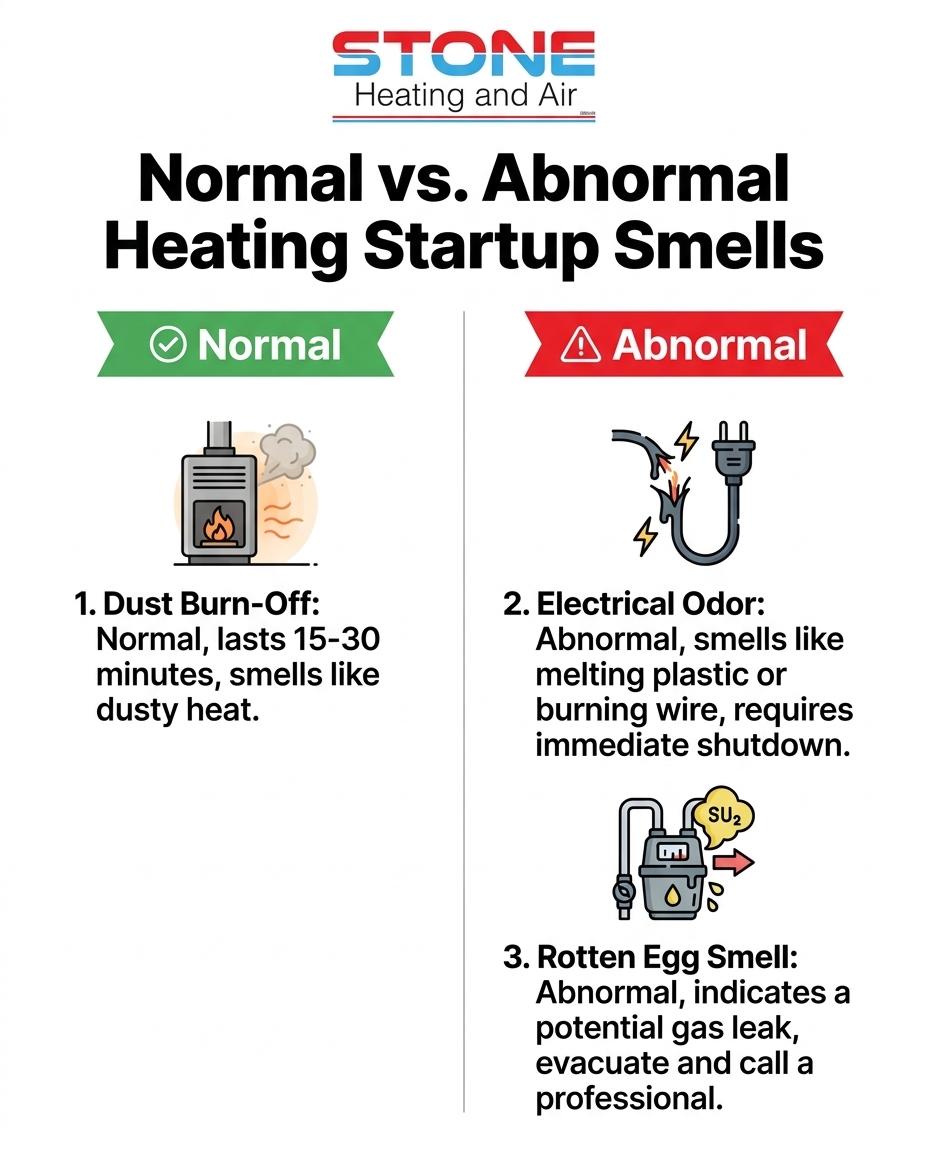
When the heating cycle engages for the first time in mid-fall, those metal components heat up rapidly. The accumulated debris on the surface literally burns off. The resulting odor is strong, distinct, and often spreads through the entire house within minutes. Fortunately, we can assure you this is typically harmless. A normal dust burn-off should dissipate within 15 to 30 minutes of continuous operation.
However, if the smell persists beyond an hour, or if the odor changes, it requires immediate professional attention. Knowing how to categorize the smells coming from your vents can save your equipment from severe damage.
• Dusty / Musty Burn — Likely Cause: Normal settling of summer dust on heating elements. — Required Action: Allow system to run for 30 minutes; open a window if needed.
• Melting Plastic — Likely Cause: Foreign object in the ductwork or melting wire insulation. — Required Action: Turn off the system immediately and call a professional.
• Electrical / Ozone — Likely Cause: Overheating blower motor or failing electrical capacitor. — Required Action: Shut down power at the thermostat and breaker; schedule service.
• Rotten Eggs / Sulfur — Likely Cause: Potential natural gas leak near the furnace. — Required Action: Evacuate the home, leave doors open, and call the gas company.
Heat Pumps vs. Furnaces: Diagnosing Lukewarm Air
Another frequent concern our technicians encounter during a mid-fall / October heating startup is a system that appears to be blowing cold or lukewarm air. If you have recently moved into a home with a heat pump, or if you just upgraded from a traditional gas furnace, this symptom can be incredibly confusing. Homeowners transitioning from traditional gas furnaces often mistake a heat pump's normal operation for a malfunction.
Understanding Delivery Temperatures
The confusion stems from the science of how different systems generate heat. A traditional gas furnace creates heat through combustion, producing air that typically exits the vents at 120°F or higher. This air feels hot and powerful against your skin.
A heat pump, on the other hand, absorbs ambient heat from the outside air and transfers it indoors. The air delivered by a heat pump usually hovers around 90°F to 95°F. Because normal human body temperature is 98.6°F, the air coming out of the vent is literally cooler than your skin. It feels lukewarm, or even slightly cool, but it is still more than warm enough to heat a room efficiently over a longer, sustained cycle.
When Lukewarm Air Indicates a Real Problem
While a mild temperature is normal for a heat pump, air that remains entirely cold is not. If your system is blowing distinctly cold air, or if it turns on and off repeatedly in a process known as short-cycling, our team typically traces the issue back to untreated summer wear and tear.
• Dirty Evaporator Coils: A summer's worth of dust can insulate the coils, preventing proper heat transfer.
• Refrigerant Issues: Heat pumps use the same refrigerant to heat and cool. A slow leak during the summer will cripple the heating cycle in the fall.
• Reversing Valve Failure: The component that switches the system from cooling to heating may be stuck.
Addressing these lingering summer issues through professional AC repair before winter sets in prevents total system failure during freezing weather. If your system is struggling to produce heat now, it will entirely fail when the overnight temperatures drop.
Recognizing the Danger Signs: When to Skip DIY Troubleshooting
While it is tempting to pull out a toolkit and search for online videos when your heater acts up, modern HVAC systems are complex, high-voltage machines. Opening a furnace cabinet without proper licensing exposes homeowners to severe electrical and combustion hazards.
Loud banging noises, persistent electrical odors, or a system that refuses to turn on at all are clear indicators of mechanical failure. A grinding noise often points to a failing blower motor bearing, while a sharp popping sound could indicate delayed ignition in a gas furnace—a situation where gas builds up before igniting, creating a dangerous mini-explosion inside the cabinet.
The Limits of Online Tutorials
Online DIY tutorials cannot safely diagnose a cracked heat exchanger or a failing blower motor. A heat exchanger separates the breathable air in your home from the toxic exhaust gases created during combustion. If it develops a hairline crack—which is nearly impossible to see without specialized diagnostic cameras—carbon monoxide can leak into your living space.
Relying on a professional service call ensures correct procedures are followed and the system operates at peak performance safely. For instance, our team recently helped a Central Point homeowner who reached out during the late summer because they were uncertain about proper system maintenance to ensure peak performance. During a routine service call, our technician explained exactly how to maintain the system correctly, ensuring performance stayed at its peak without the homeowner ever having to cross into dangerous DIY territory. This is the exact approach we recommend taking as fall begins in the Rogue Valley area: rely on experts for the heavy lifting.
What Comprehensive Professional Maintenance Actually Looks Like
When you hire a professional for a seasonal tune-up, you are investing in safety, efficiency, and longevity. A true professional tune-up goes far beyond a simple filter swap. At Stone Heating and Air, our technicians utilize thorough professional tune-up checklists that prioritize safety and precise diagnostics over generic, potentially dangerous DIY advice.
When a licensed Stone Heating and Air technician arrives for a mid-fall / October heating startup inspection, they follow a rigorous, step-by-step process we've perfected over years of local service to ensure every component is ready for the seasonal shift.
1. Comprehensive Electrical Inspection: Technicians check all wire connections, test the capacitors, and measure the amperage of the blower motor. Loose connections cause dangerous electrical arcing, and failing capacitors put immense strain on the system.
2. Combustion and Safety Sensor Testing: For gas systems, the technician inspects the burner assembly, cleans the flame sensor, and verifies that the safety limit switches are fully operational. These switches are designed to shut the system down if it overheats.
3. Heat Exchanger Evaluation: Using specialized tools, the technician inspects the heat exchanger for any signs of metal fatigue, rust, or hairline cracks that could pose a carbon monoxide risk.
4. Refrigerant Level Verification: For heat pumps, verifying the exact refrigerant charge is critical. Incorrect levels force the compressor to work harder, driving up energy usage and risking premature failure.
5. Thermostat Recalibration: Thermostats are recalibrated for the seasonal shift to ensure accurate temperature reading and efficiency, preventing the system from running longer than necessary.
Enrolling in a routine maintenance plan guarantees these critical safety checks happen automatically before severe winter weather arrives, taking the guesswork out of your seasonal transition.
Essential Fall Preparation Steps for Homeowners
While the internal mechanical work must be left to the professionals, we always tell our customers there are several safe, actionable steps homeowners can take to support their HVAC system without crossing into dangerous DIY territory. By handling the environmental factors around your system, you help it breathe easier and run more efficiently.
• Replace indoor air filters: This is the single most important task you can perform. A dirty filter restricts airflow, forcing the blower motor to work twice as hard and increasing the risk of overheating. Start the season with a fresh, high-quality filter.
• Clear outdoor debris: Over the late summer and early fall, fallen leaves, twigs, and overgrown vegetation can choke your outdoor heat pump unit. Maintain at least two feet of clear space around the entire unit to ensure proper ventilation.
• Open and clean all indoor vents: Closing vents in unused rooms actually disrupts the pressure balance in your ductwork. Ensure all supply and return vents are open and free of furniture or rugs.
• Test safety alarms: Test all household smoke and carbon monoxide detectors as the heating season begins. Replace the batteries to ensure they are ready for the months ahead.
For example, our crew recently worked with a customer new to the area who scheduled a winter service visit because they needed reliable routine equipment maintenance and filter upkeep. Our technicians arrived on time, were highly knowledgeable, and took care of changing the house filters, maintaining the system well beyond expectations. Partnering with a professional team for comprehensive HVAC care ensures that the entire system—both heating and cooling components—is evaluated by experts, while you handle the day-to-day upkeep safely.
Frequently Asked Questions About Fall Heating Transitions
Why does my furnace smell like it's burning?
When a furnace smells like it's burning during a mid-fall / October heating startup, it is usually due to dust and debris burning off the heat exchanger or heating elements. This dust settles on the components while the system is turned off all summer. The smell is typically harmless and should clear up on its own within 15 to 30 minutes of operation.
Why is my heater blowing cold air in the fall?
If you have a heat pump, it naturally blows air that is cooler than human body temperature (around 90°F to 95°F), which can feel cold compared to a gas furnace. However, if the air is genuinely cold, it could indicate a refrigerant leak, a dirty evaporator coil, or a malfunctioning reversing valve that failed to switch from summer cooling to winter heating.
How long should a furnace smell when first turned on?
A normal dust burn-off smell should last no longer than 15 to 30 minutes during the first continuous heating cycle of the season. If the smell lingers for more than an hour, or if it begins to smell like melting plastic or electrical burning, shut the system down immediately and call a professional.
Is it safe to run my furnace if it smells?
It is safe to run the furnace if the odor is clearly a dusty, musty smell characteristic of seasonal burn-off. However, if you detect the scent of rotten eggs (indicating a gas leak), electrical ozone, or burning wire insulation, it is absolutely not safe to run the system. Turn it off at the thermostat and contact an HVAC technician.
Can neglected summer AC maintenance affect my fall heating?
Yes, significantly. Heat pumps use the exact same internal components—including the compressor, coils, and blower motor—for both heating and cooling. If your system suffered from dirty coils, low refrigerant, or electrical strain during the summer, those unresolved issues will directly impact its ability to heat your home in the fall.
What is the best thermostat setting for the first fall heating cycle?
For the initial startup, set your thermostat just a few degrees higher than the current room temperature to engage the heating cycle gently. Once you confirm the system is producing warm air and any initial dust smells have dissipated, you can adjust it to your preferred comfort level—typically between 68°F and 72°F for optimal efficiency.
Ensure a Safe, Warm Transition This Season
In our experience, understanding normal startup quirks versus real malfunctions provides immense peace of mind as the temperatures drop across the Central Point and Rogue Valley area. While a brief dusty odor on the first chilly morning is completely normal, our team at Stone Heating and Air wants you to know that you should never hesitate to consult a local expert if an odor persists, the system makes aggressive noises, or it simply fails to heat your home properly. Taking proactive steps now prevents emergency breakdowns during the coldest nights of the year. Schedule your AC maintenance in Central Point today to seamlessly transition your system, clear out the summer wear and tear, and guarantee reliable, safe winter performance for your entire home.