

That First Chilly October Morning: Is Your Heater Ready?
You turn on your thermostat on that first cold morning of the season, expecting a rush of warm air, but instead, you are met with a strange burning smell and weak airflow—a scenario that often triggers a frantic search for reliable home maintenance tips and troubleshooting. That sudden drop in temperature is a hallmark of the mid-fall October heating startup, and it quickly exposes any underlying issues your system developed over the summer. When your furnace or heat pump struggles to wake up from its months-long hibernation, it is completely normal to feel a moment of panic. The immediate question becomes whether these strange odors and sounds are just temporary seasonal quirks or warning signs of a serious mechanical failure.
If you are dealing with a system that refuses to turn on or sounds unsafe, reaching out for professional HVAC services is the best way to protect your home. However, many common startup issues can be resolved with a few simple, safe checks before you make that call.
The transition from cooling to heating is one of the most stressful periods for your home's climate control system. During the long dormant period, dust settles on heat exchangers, moving parts lose their lubrication, and electrical connections can loosen. When the system fires up for the first time, all of these minor factors combine to create a jarring experience for the homeowner. By understanding exactly what happens inside your ductwork and furnace cabinet during this initial cycle, you can move past the initial worry and take practical, informed steps to evaluate your equipment.
Here is the thing: a successful mid-fall October heating startup relies entirely on how well the system was maintained during its off-season. If you know what to look for, you can easily distinguish between harmless dust burn-off and a genuine safety hazard that requires an expert technician.
The Rogue Valley Summer Effect on Your Heating System
To understand why your heating system struggles in the fall, you have to look at what it endured over the summer. In Central Point and throughout Southern Oregon, the hot, dry, and frequently dusty summer months take a heavy toll on HVAC equipment. Even if your furnace is technically turned off, the blower motor and ductwork are still working overtime to circulate conditioned air. As the season progresses, heavy particulate matter—including dry dust, pollen, and regional wildfire smoke—gets pulled into your return vents and settles deep inside the system.
If you recently required AC repair in Central Point due to a clogged filter or a struggling blower motor, your heating system is likely facing the exact same airflow restrictions. The blower motor is a shared component; the same fan that pushes cool air in July is responsible for pushing warm air in October. When a thick layer of Rogue Valley summer dust coats the internal components, it acts as an insulator. This forces the system to work harder, run hotter, and consume more energy just to reach the baseline temperature set on your thermostat.
How Summer Inactivity Stresses Your Furnace
While the blower motor works hard all summer, the actual heating components—the gas burners, the heat exchanger, or the heat pump's reversing valve—sit completely idle. This prolonged period of inactivity allows debris to settle directly onto the heating elements.
• Dry Dust & Pet Dander — Impact on Fall Heating Startup: Settles on the heat exchanger, creating a strong burning odor when the metal finally heats up.
• Wildfire Smoke Particulates — Impact on Fall Heating Startup: Clogs the air filter prematurely, severely restricting airflow and causing the system to overheat and shut down.
• Idle Mechanical Parts — Impact on Fall Heating Startup: Lubricants settle and bearings dry out, leading to squeaking or grinding noises during the first few cycles.
• Thermostat Inactivity — Impact on Fall Heating Startup: Dust inside the thermostat housing or dead batteries can prevent the signal from reaching the furnace control board.
Addressing your indoor air quality and system cleanliness during this seasonal shift is non-negotiable. The sharp transition from dry, dusty summers to chilly autumn nights means your equipment has zero time to ease into its new job. It goes from zero to maximum capacity overnight, making a clean, well-maintained system essential for reliable warmth.
Safe Homeowner Checks Before Calling for HVAC Repair Near Me
Before you schedule a service call for your mid-fall October heating startup, there are several safe, straightforward troubleshooting steps you can perform yourself. The golden rule of home maintenance is to handle the external factors while leaving the internal mechanics to licensed professionals. You should never open the furnace cabinet, attempt to clean the burners, or tamper with electrical wiring, as these actions carry severe risks of electrical shock, fire, or carbon monoxide exposure.
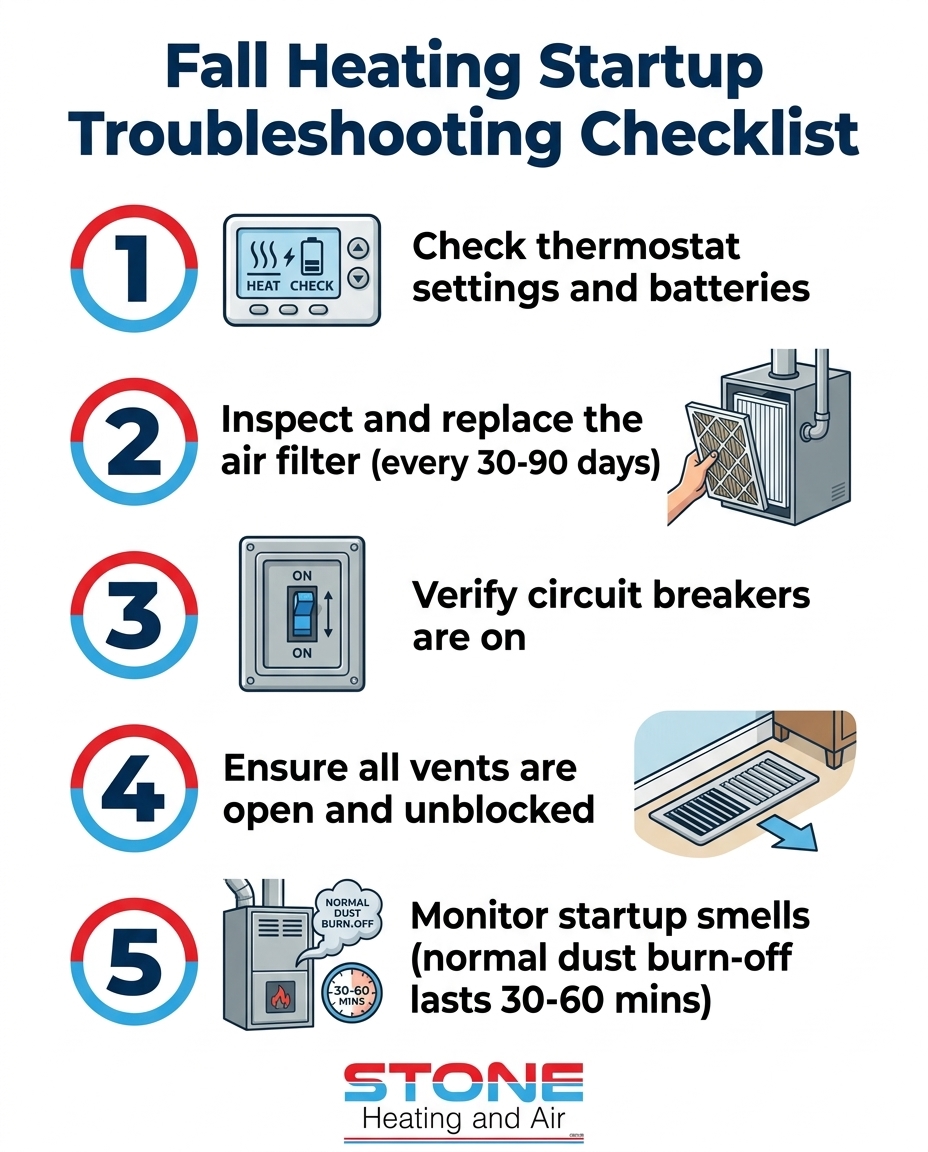
However, you can safely verify the external components that frequently cause startup failures. Start by checking these common culprits:
• Verify thermostat settings: Ensure the switch is explicitly set to "Heat" and that the target temperature is set at least five degrees higher than the current room temperature. Replace the batteries if the screen is blank or flashing.
• Check the circuit breakers: Locate your home's main electrical panel. Sometimes, the sudden power draw of a heating startup can trip a breaker. Look for a switch that has flipped to the middle position, firmly push it to "Off," and then snap it back to "On."
• Inspect external power switches: Most furnaces have a power switch mounted on or near the unit that looks exactly like a standard light switch. Ensure it has not been accidentally bumped to the "Off" position over the summer.
• Clear vents and registers: Walk through your home and ensure all supply and return vents are fully open. Move any furniture, rugs, or heavy curtains that might be blocking the airflow, as restricted vents will cause the system to overheat and shut down automatically.
The Importance of a Clean Air Filter
The single most common cause of a failed heating startup is a neglected air filter. Filters should generally be checked every 30 to 90 days, but the heavy dust loads of a Southern Oregon summer require an immediate replacement before you begin heavy winter use. A heavily loaded, dirty filter acts like a wall, restricting the airflow the furnace needs to breathe. When the system cannot pull in enough air, the internal temperature spikes. This triggers the high-limit safety switch, which shuts the burner off to prevent a fire. To a homeowner, this mimics a severe mechanical failure—the system blows cold air or shuts off after just a few minutes—but the solution is often as simple as sliding in a fresh, clean filter.
Normal Dust Burn-Off vs. Urgent Mechanical Failure
One of the most stressful parts of turning on the heat in Central Point or anywhere in Southern Oregon is the immediate sensory feedback. When the blower kicks on, it often brings strange smells and unusual noises. Learning to distinguish between harmless seasonal adjustments and dangerous mechanical failures will save you a tremendous amount of stress.
The infamous burning dust odor is the most common symptom of a fall startup. As dust settles on the heat exchanger over the summer, the first ignition cycle physically burns it away. This creates a distinct, smoky, dusty smell that filters through your vents. The timeline is the key indicator here: normal dust burn-off typically dissipates within 30 to 60 minutes of the first heating cycle. If you open a few windows to ventilate the house, the smell should clear out entirely and not return for the rest of the season.
However, not all odors are harmless. If you detect certain smells, you must shut off the system immediately at the thermostat and call for help.
• Smell of Burning Dust — Likely Cause: Normal accumulation burning off the heat exchanger. — Required Action: Monitor for 30-60 minutes. Ventilate the home.
• Smell of Melting Plastic or Electrical Ozone — Likely Cause: Failing blower motor, melting wire insulation, or a short circuit. — Required Action: Shut off system immediately. Call a professional.
• Smell of Rotten Eggs (Sulfur) or Exhaust — Likely Cause: Natural gas leak or a cracked heat exchanger leaking carbon monoxide. — Required Action: Evacuate home, call gas company, then call HVAC tech.
• Light Clicking or Gentle Whoosh — Likely Cause: Normal ignition sequence and gas burner activation. — Required Action: No action needed. Normal operation.
• Loud Banging, Grinding, or Screeching — Likely Cause: Delayed gas ignition (mini-explosion), failing motor bearings, or a broken fan belt. — Required Action: Shut off system immediately to prevent permanent damage.
Sound is just as important as smell. A mild clicking followed by a soft whooshing sound is just the gas valve opening and the burners igniting. But if you hear a loud boom or bang when the furnace starts, that indicates delayed ignition—gas is building up in the chamber before finally catching a spark, creating a small, dangerous explosion. Grinding or screeching sounds point directly to metal-on-metal friction, usually a failing blower motor bearing that will seize up completely if left running.
Red Flags That Require Immediate Professional Intervention
When basic troubleshooting fails to resolve the issue, or if you encounter any of the severe symptoms listed above, it is time to step back. Pushing a malfunctioning system to keep running will only turn a minor repair into a catastrophic, expensive replacement. There are specific red flags that indicate your mid-fall October heating startup has crossed the line from a routine maintenance issue into an active emergency.
Short cycling is a primary warning sign. If your heater turns on, runs for only two or three minutes, and then abruptly shuts off without actually warming the home, the internal safety sensors are tripping. This is often caused by a failing flame sensor, an overheating heat exchanger, or severe airflow blockages. The system is protecting itself from catching fire, and bypassing or ignoring this function is highly dangerous.
Blowing cold air is another clear indicator of mechanical failure. If the fan runs constantly but the air from the vents never gets warm, the system is failing to ignite. For gas furnaces, this usually points to a bad igniter, a faulty gas valve, or a clogged pilot tube. For heat pumps, it often indicates a stuck reversing valve or a low refrigerant charge that prevents the system from absorbing ambient heat.
Finally, complete unresponsiveness demands expert attention. If the thermostat calls for heat, you hear a click, but the system remains completely silent, you are likely dealing with a failed control board, a blown internal transformer, or a dead blower motor.
These issues require a licensed technician to diagnose and resolve safely. Our team understands how critical immediate response is. One local homeowner reached out to us during a severe summer heat wave when their AC stopped working on the hottest day of the year; our crew provided same-day service to diagnose and repair the unit, providing immediate relief. We apply that exact same urgency and dedication to our 24/7 emergency HVAC repair response for winter furnace failures, ensuring your family is never left in the freezing cold.
Protecting Your Home Before Peak Winter Hits
Navigating a stressful mid-fall October heating startup is a clear reminder of why proactive care matters. Catching minor issues during the fall transition prevents catastrophic failures during the freezing winter nights that follow. A system that struggles to start in October will undoubtedly fail when it is pushed to its absolute limits in January.
The benefits of early intervention go far beyond simply avoiding breakdowns. A well-tuned heating system operates with significantly higher energy efficiency. When burners are cleaned, airflow is optimized, and moving parts are lubricated, the furnace requires far less fuel and electricity to heat your home. Furthermore, professional cleaning directly improves your indoor air quality by removing the accumulated summer dust before it gets blown into your living spaces.
Sometimes, a pre-winter inspection reveals that a system is simply too old or compromised to operate safely. In one recent case, a homeowner discovered their aging system was beyond repair and needed a completely new HVAC unit installed; our technicians provided precise measurements, expert recommendations, and a clear estimate, completing the full installation within a week on the agreed-upon date. Whether you need a simple tune-up or a larger replacement, addressing the situation early gives you the luxury of time and choice.
The most effective way to handle seasonal transitions smoothly is through a preventative maintenance plan. Routine, scheduled inspections take the guesswork out of home ownership. A licensed technician can test safety controls, clean internal components, and identify worn parts long before they cause a sudden outage. Investing in maintenance now ensures absolute peace of mind when the severe cold arrives.
Frequently Asked Questions About Fall Heating Startup
If you are preparing for your mid-fall heating startup, you likely have questions about what is normal and what requires attention. For deeper insights into urgent situations, you can read our comprehensive guide on what to expect during an emergency HVAC call. Here are the most common questions homeowners ask during the autumn transition.
Why does my heater smell like burning dust when I turn it on?
The smell of burning dust is caused by the physical combustion of debris that has settled on your furnace's heat exchanger over the summer months. When the metal components heat up for the first time in fall, they literally incinerate the accumulated dust, pet dander, and pollen. This creates a distinct, smoky odor that gets pushed through your ductwork into your living spaces. While alarming, this is a completely normal part of the seasonal transition and does not indicate a fire hazard, provided the smell dissipates quickly.
How long should a furnace smell when first turned on?
A normal dust burn-off smell should last between 30 and 60 minutes during the very first heating cycle of the season. Once the initial layer of debris is burned away, the odor will fade and should not return for the rest of the winter. Opening a few windows to ventilate the home can help clear the air faster. If the burning smell persists for several hours, or if it changes to smell like melting plastic, electrical ozone, or sulfur, shut the system off immediately and contact a professional.
Why is my heater blowing cold air?
If your heater is blowing cold air, the blower motor is running but the heating elements are failing to ignite or transfer heat. In a gas furnace, this usually points to a dirty flame sensor, a broken igniter, or a gas supply issue that prevents the burners from lighting. In a heat pump system, it often indicates a malfunctioning reversing valve that is stuck in cooling mode, or a refrigerant leak. A heavily clogged air filter can also cause the system to overheat and shut down the burners as a safety precaution while the fan continues to blow.
What to check before calling HVAC repair?
Before calling for professional repair, always verify that your thermostat is set to "Heat" and that the set temperature is higher than the current room temperature. Next, check your electrical panel for any tripped circuit breakers and ensure the furnace's external power switch is turned on. Finally, inspect your air filter and replace it if it is dirty, as restricted airflow is a leading cause of system shutdowns. If you complete these safe checks and the system still fails to operate, it is time to call a licensed technician.
Can a dirty air filter stop my furnace from working?
Yes, a dirty air filter is one of the most common reasons a furnace will stop working entirely. The filter's primary job is to protect the internal components from dust and debris; when it becomes clogged, it severely restricts the amount of air the blower motor can pull in. Without adequate airflow, the heat exchanger rapidly overheats, which triggers the furnace's high-limit safety switch to shut down the burners and prevent a fire. Simply replacing a heavily soiled filter with a clean one can often restore normal operation instantly.
Restore Your Peace of Mind with Local Expert Support
While a brief burning smell or a minor startup quirk is often just a normal part of the seasonal transition, persistent issues demand expert attention. You do not have to spend your winter worrying about whether your heating system will make it through the night. Our local professionals in Central Point and Southern Oregon are ready to help you transition safely into the colder months. Do not wait for a complete breakdown—schedule a pre-winter inspection today or reach out for urgent repairs if your troubleshooting steps did not resolve the problem, and enjoy a warm, comfortable home all season long.