

Facing a Mid-Summer Breakdown: The High-Stakes Cooling Decision
Before the next July peak heatwave hits and pushes your aging equipment to the breaking point, you need to know exactly how single-stage vs. variable-speed AC units for Rogue Valley summers compare. At Stone Heating and Air, our team sees this panic every summer. A sudden system failure during peak heat leaves you scrambling for immediate relief. When indoor temperatures climb rapidly, the rush to restore comfort often leads to installing whatever equipment is available the fastest. However, this is a multi-year investment that dictates your daily comfort, your indoor air quality, and your monthly energy consumption for the next decade or more.
If you need immediate help with Air Conditioning, taking a moment to explore your options for an AC replacement is the best place to start. The core decision ultimately comes down to replacing your broken unit with a standard single-stage model or upgrading to advanced variable-speed technology. Understanding how these two distinct options perform under extreme local weather conditions is critical before you move forward with an installation.
The Urgency of AC replacement
Mid-summer breakdowns force rapid decisions because your home can quickly become unlivable. When it is over 100 degrees outside, every hour without cooling feels like an eternity. This intense pressure makes it tempting to point to the most basic replacement option and say, "Just put that one in."
We always advise taking a brief pause to evaluate the different technology types, as it prevents long-term buyer's remorse. A cooling system is not just a box that blows cold air; it is a complex mechanical system that must match the specific heat load of your house. If you rush the decision, you might end up with a unit that cools the house but leaves it feeling clammy, or a system that turns on and off so violently that it wakes you up at night. Evaluating your options right now ensures you get the exact performance you need.
Why the Local Climate Demands More from Your HVAC System
Southern Oregon summers are characterized by intense, triple-digit daytime highs. In our years of servicing Central Point OR and the surrounding Rogue Valley, we've found that when the sun is beating down on your roof at 2:00 PM, your cooling system is fighting massive heat gain just to maintain a comfortable indoor temperature. But the intense heat is only half of the story when it comes to our local climate.
Equally important is the rapid evening cool-down. This region experiences massive diurnal temperature swings—meaning the difference between the daily high and the daily low is extreme. A day that peaks at 105 degrees in the afternoon might drop into the low 60s by late evening. This creates a unique challenge for any mechanical cooling equipment.
Your HVAC system must handle maximum cooling loads during the afternoon peak, but it also needs to adapt to dramatically reduced cooling loads by 10:00 PM. Standard systems often struggle to adapt to these shifting demands. Because they cannot change their output, they end up blasting maximum cold air into a house that only needs a slight breeze to stay comfortable in the evening. This mismatch leads to inefficiency, uneven comfort, and unnecessary wear and tear on the equipment.
Single-Stage ACs: The All-or-Nothing Approach
Single-stage compressors operate strictly at 100% capacity whenever they are turned on. Our technicians often compare a single-stage unit to a car that only has two speeds: zero and full throttle. When the thermostat calls for cooling, the system roars to life, blows maximum cold air until the target temperature is reached, and then shuts down completely.
This all-or-nothing operation provides immediate blasts of cold air, which feels great when you first step inside during a July peak heatwave. However, it also leads to frequent on/off cycling. Every time the system turns on, it draws a massive surge of electricity to start the compressor. While they present a lower initial barrier to entry for an AC installation in Central Point, their operational rigidity can limit your overall comfort.
Advantages of Single-Stage Systems
Despite their limitations, single-stage units are still widely used for several practical reasons:
• Simpler mechanical design: With fewer moving parts and electronic sensors, the internal mechanics are straightforward.
• Lower upfront equipment costs: Because the technology is older and less complex, the initial investment is lower than advanced models.
• Standardized repairs: They use fewer proprietary parts, making routine maintenance relatively simple for technicians.
Where Single-Stage Falls Short
A pattern we see often during our mid-summer service calls is short-cycling, where the drawbacks of single-stage systems become glaringly obvious during the milder parts of the day. Because the system only runs at full capacity, it quickly cools the house and shuts off during cooler evening hours. This short-cycling causes noticeable indoor temperature fluctuations—often feeling too cold while the unit runs, and too warm right before it kicks back on.
Furthermore, this short running time ruins the system's ability to dehumidify your home effectively. An air conditioner needs to run continuously for an extended period to pull moisture out of the air. When a single-stage unit short-cycles, it leaves the air feeling cold but clammy. Finally, the constant starting and stopping creates higher energy spikes, driving up your monthly utility consumption.
Variable-Speed ACs: Adaptive Cooling for Temperature Swings
Variable-speed compressors utilize advanced technology to operate at capacities as low as 25% to 30%, adjusting their output in real-time based on exactly what your home needs. Instead of the "full throttle or nothing" approach, variable-speed technology acts like cruise control for your home's climate.
The Problem: During a mild evening in the Rogue Valley / Central Point OR area, a standard unit will blast 100% capacity air, overcool the house quickly, and shut off, leading to a clammy environment and rapid temperature swings. The Cause: Traditional compressors cannot step down their power output to match a lower cooling demand. The Solution: Variable-speed units run continuously at lower speeds to maintain a precise indoor temperature. Running at 30% capacity perfectly handles the mild evening cool-downs without overcooling the house, while still keeping 100% capacity in reserve for the brutal afternoon peak.
Homeowners who take the time to research their options often find this adaptive technology perfectly matches the fluctuating cooling demands of the area. For example, our team at Stone Heating and Air recently worked with a local customer who heavily researched their replacement options before moving forward. After reviewing multiple system designs with our experts, they chose a high-efficiency variable-speed setup because it offered the exact performance needed for the region's climate. The result was a highly satisfactory, custom-tailored cooling solution that adapted perfectly to both blazing afternoons and cool nights.
Continuous Circulation and Air Quality
The benefits of variable-speed technology extend far beyond just temperature control. Because these systems run almost continuously at a very low speed, they provide exceptional air quality benefits:
• Superior humidity control: Consistent, continuous operation pulls significantly more moisture out of the air, eliminating the sticky, clammy feeling indoors.
• Better filtration: Longer run times mean your indoor air passes through the system's filters much more frequently, capturing more dust, pollen, and allergens.
• Elimination of hot spots: Constant air circulation mixes the air throughout the house, preventing the second floor or distant bedrooms from becoming stagnant heat traps.
Head-to-Head: Performance During a Heatwave
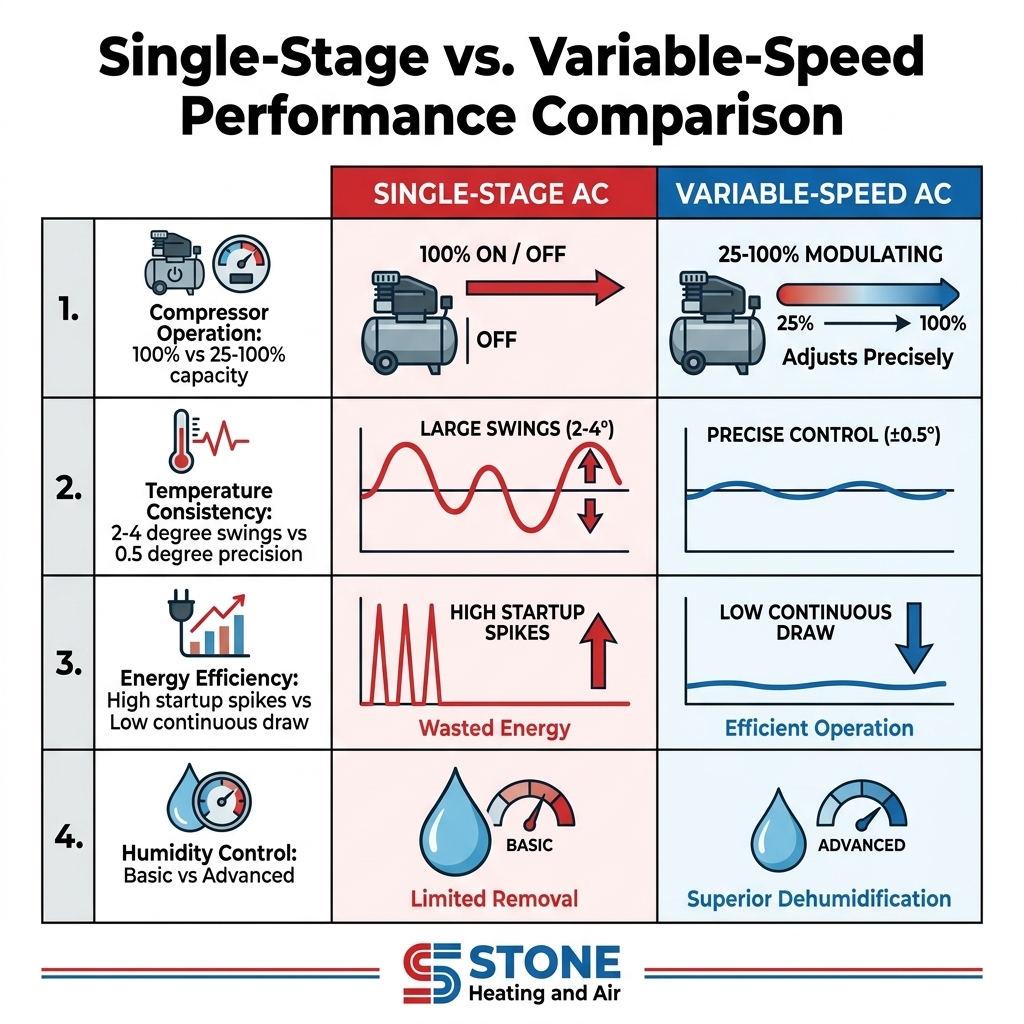
When a July peak heatwave settles over the valley, the differences between these two technologies become impossible to ignore. To make the best decision for your home, you need to look at how they stack up in real-world conditions.
• Compressor Operation — Single-Stage AC Unit: Strictly 100% capacity (on or off) — Variable-Speed AC Unit: Adapts continuously between 25% and 100%
• Temperature Consistency — Single-Stage AC Unit: Noticeable 2-4 degree temperature swings — Variable-Speed AC Unit: Holds temperatures within a half-degree of the thermostat setting
• Energy Efficiency — Single-Stage AC Unit: High energy spikes from constant startup cycles — Variable-Speed AC Unit: Consumes less power overall via low, continuous electrical draw
• System Noise — Single-Stage AC Unit: Loud startups and loud operation at full blower speed — Variable-Speed AC Unit: Operates significantly quieter since it rarely runs at maximum output
• Lifespan and Wear — Single-Stage AC Unit: High mechanical stress from constant starting and stopping — Variable-Speed AC Unit: Reduced cycling decreases mechanical stress on the compressor over time
The comparison clearly shows that while single-stage units get the basic job done, variable-speed systems are engineered to provide a drastically higher level of comfort and efficiency under heavy weather loads.
Navigating the Investment: Efficiency and Upfront Cost Solutions
Upgrading to a high-efficiency variable-speed system requires a larger initial investment than putting in a basic, builder-grade model. For many homeowners facing an unexpected breakdown, this upfront expenditure is the biggest hurdle. However, looking only at the initial equipment cost ignores the long-term financial reality of running an air conditioner in the Rogue Valley / Central Point OR region.
The long-term reduction in energy consumption helps offset this difference over the lifespan of the equipment. Because variable-speed units avoid the massive electrical spikes of constant starting and stopping, they consume significantly less power to cool your home. Furthermore, many high-efficiency systems may qualify for generic federal tax credits or local utility incentives, further bridging the gap between standard and premium equipment. (Always verify current incentive programs with your utility provider or a tax professional).
If you are dealing with a sudden failure, you do not have to settle for inferior technology just because you weren't planning for a major purchase. As local climate experts at Stone Heating and Air, we know how critical reliable cooling is here, which is why we offer flexible HVAC financing. This allows you to access premium, variable-speed comfort technology immediately without draining your emergency savings. During a recent summer, our team worked with a local homeowner who struggled with a failing, outdated AC unit. We quickly assessed the situation, sourced the right high-efficiency equipment, and successfully replaced multiple units to restore their comfort efficiently using flexible payment solutions.
Evaluating Long-Term Value
When you sit down to make your decision, you are balancing the upfront expenditure against seasonal energy efficiency. A variable-speed system pays dividends in comfort every single day.
• Unmatched peace of mind: Knowing your system can handle the hottest afternoons without breaking a sweat gives you confidence during extreme weather.
• Quiet operation: Because the system runs at lower speeds most of the time, you won't have to turn up the television every time the AC kicks on.
• Less mechanical wear: Fewer harsh startups mean the compressor experiences far less friction and stress over its lifespan.
Frequently Asked Questions About AC Upgrades
If you are currently researching How Much Does AC Replacement Cost in the Rogue Valley?, you likely have several other functional questions about how these different systems operate. Here are clear answers to the most common questions our technicians are asked during a July peak heatwave breakdown.
How does a variable-speed AC handle Rogue Valley temperature swings?
A variable-speed AC handles massive temperature swings by adjusting its cooling output to match the exact conditions outside. During a 105-degree afternoon, it will ramp up to 100% capacity to fight the intense heat. When the sun goes down and the outside temperature drops into the 60s, the system slows down to 25% or 30% capacity, providing just enough cooling to keep the house comfortable without freezing you out.
Is a variable-speed AC worth the investment during a heatwave?
Yes, our team highly recommends upgrading to a variable-speed system, as it is incredibly beneficial during a severe heatwave. Because these units run continuously at optimized speeds, they maintain a perfectly even indoor temperature and remove significantly more humidity from the air than standard units. The improved comfort, combined with lower energy consumption under heavy loads, makes the investment highly worthwhile for homeowners planning to stay in their house long-term.
Why does my single-stage AC struggle during peak summer heat?
Your single-stage AC struggles because it can only operate at one speed, and extreme heat pushes that single speed to its absolute limit. If the system is slightly undersized, it will run constantly at 100% but still fail to reach the temperature set on your thermostat. If it is oversized, it will cool the house too rapidly, shut off, and leave the indoor air feeling thick and humid while the house quickly heats back up.
Does a variable-speed AC run constantly?
Yes, a variable-speed AC is designed to run almost constantly during the summer months, but this is actually a major benefit. Instead of turning off and on, it runs continuously at a very low, energy-efficient speed. This constant circulation uses less electricity than the frequent high-amperage startups of a standard unit, and it keeps your indoor air filtered and dehumidified around the clock.
How long do variable-speed AC units typically last compared to single-stage?
Variable-speed AC units generally experience less mechanical wear and tear than single-stage units, which can positively impact their lifespan. The hardest part of an air conditioner's job is starting up from a dead stop. Because variable-speed compressors start slowly and run continuously at low speeds, they avoid the harsh, grinding starts that slowly degrade single-stage compressors over the years.
Can upgrading my AC improve indoor humidity control?
Upgrading to a variable-speed AC is one of the most effective ways to improve indoor humidity control. Air conditioners remove moisture by passing warm indoor air over cold evaporator coils. Because variable-speed systems run for much longer cycles at lower speeds, the air spends more time moving across those cold coils, allowing the system to extract significantly more moisture than a standard unit.
Secure Your Comfort for This Summer and Beyond
Choosing the right cooling system dictates your home's comfort, air quality, and energy efficiency for the next decade. As the comparison clearly shows, adaptive variable-speed cooling is drastically superior for managing the extreme diurnal temperature swings we experience in the Rogue Valley / Central Point OR area. The ability to run at 100% capacity during scorching afternoons and step down to 30% capacity during mild evenings provides a level of comfort that standard units simply cannot match.
Do not let a sudden breakdown force you into a suboptimal choice that you will regret every time your energy bill arrives. Contact the Stone Heating and Air team today to explore your options, discuss flexible financing, and secure a reliable, high-efficiency AC replacement that will keep your family comfortable for years to come.