

Facing a Duct Replacement Quote During Peak Cooling Season?
Are you staring at a major system estimate and asking yourself, "Do I Really Need to Replace My Ductwork When Getting a New AC?" You are not alone. In our years of helping Central Point homeowners, our team at Stone Heating and Air knows that as back-to-school season approaches and the heat remains relentless, having your cooling system fail is stressful enough. You call for a replacement, expecting a straightforward equipment swap. Instead, the technician hands you a quote that includes a complete overhaul of your home's duct system. It is completely normal to feel skeptical in this moment.
Is this an unnecessary recommendation, or a genuine technical requirement? When you are dealing with heavy August late-summer cooling loads, the last thing you want is to make a rushed, uninformed decision. However, ignoring a ductwork recommendation can lead to installing a brand-new, high-efficiency unit on a failing foundation, which guarantees poor performance. This guide will walk you through the transparent, technical realities of modern cooling systems, so you can make the best choice for your home's air conditioning setup without fear of unnecessary upgrades.
The Physics of Modern Airflow: Why New Units Demand More
To understand why a technician might recommend replacing your ducts, you have to look at how modern cooling equipment actually breathes. Airflow is not just about blowing cold air into a room; it is about managing resistance. In the HVAC industry, this resistance is called static pressure. You can think of static pressure like blood pressure for your home's ventilation. If the arteries (your ducts) are too narrow, the heart (your blower motor) has to work dangerously hard to push the air through.
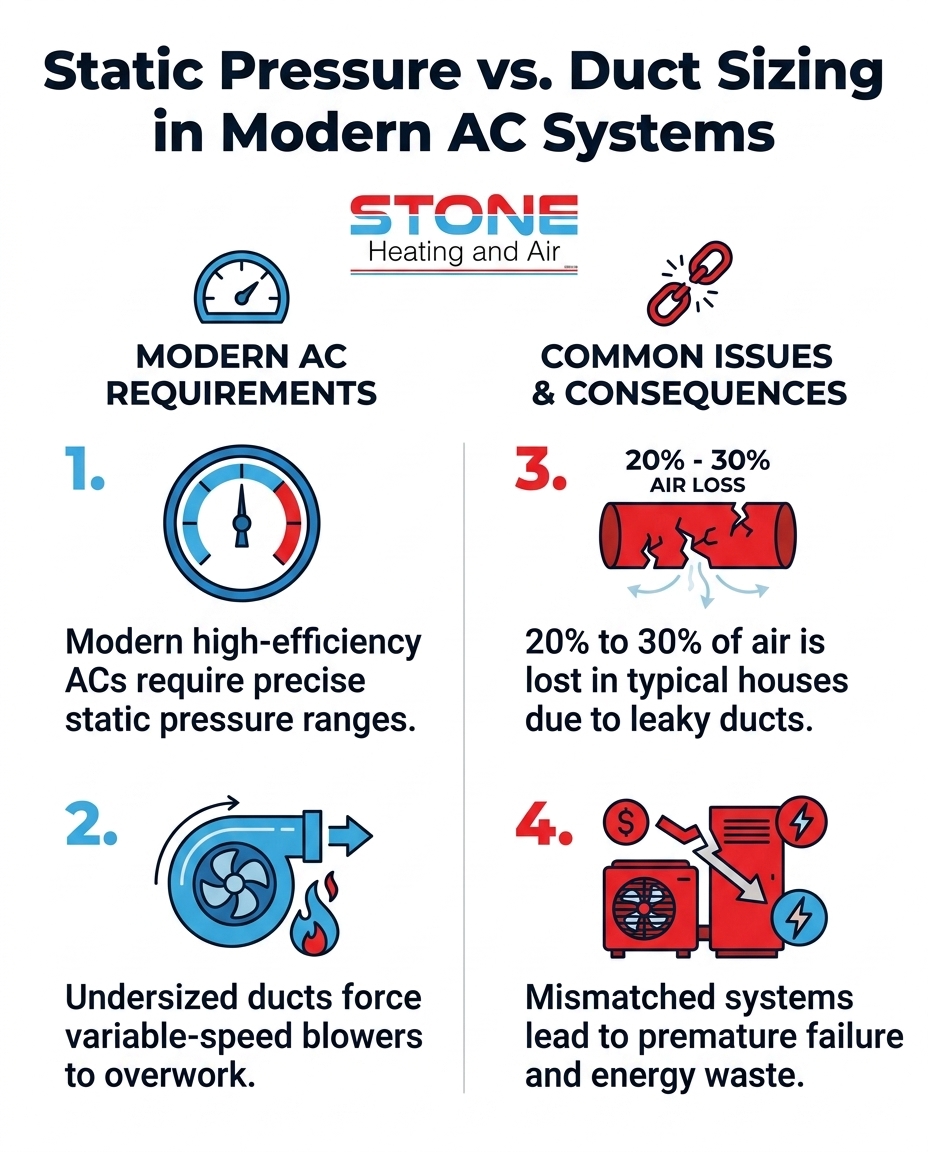
The static pressure requirements for modern high-efficiency ACs vs older units are drastically different. Equipment built fifteen or twenty years ago operated on simple, single-stage motors that pushed a consistent, lower volume of air. Today's high-efficiency systems move a higher volume of air to maximize energy savings and dehumidification. A pattern we see often is homeowners attempting to attach a modern, high-capacity system to a restrictive, outdated duct network, which causes the new equipment to physically choke.
• Blower Motor Type — Older AC Units (15+ Years Old): Single-speed (on or off) — Modern High-Efficiency AC Units: Variable-speed (adjusts continuously)
• Airflow Volume — Older AC Units (15+ Years Old): Lower, fixed cubic feet per minute (CFM) — Modern High-Efficiency AC Units: Higher, adaptive CFM for better efficiency
• Static Pressure Tolerance — Older AC Units (15+ Years Old): Forgiving of restrictive, undersized ducts — Modern High-Efficiency AC Units: Highly sensitive; requires precise pressure ranges
• Consequence of Bad Ducts — Older AC Units (15+ Years Old): Reduced comfort, slightly higher bills — Modern High-Efficiency AC Units: Premature motor failure, frozen evaporator coils
Variable-Speed Blowers vs. Restrictive Ducts
Most modern units feature variable-speed blower motors designed to adjust their output based on your home's immediate cooling needs. This is fantastic for energy efficiency—under normal conditions. However, if your ducts are too small, the variable-speed motor senses the resistance. To overcome that resistance and deliver the promised airflow, the motor ramps up its speed. It will pull excessive electricity, run louder, and eventually overheat. This fundamental mismatch completely negates the efficiency benefits of your new HVAC system, turning a premium investment into a constant source of mechanical failure.
Clear Signs Your Current Ductwork is Incompatible
Knowing the physics is helpful, but how do you know if your specific home falls into the danger zone? Our technicians typically see a few telltale signs when evaluating properties across the Rogue Valley. We look for objective, physical evidence that your existing infrastructure will fail to support a new unit. If any of the following conditions are present, attaching a new air conditioner to your current setup is a recipe for disaster.
• Undersized trunk lines: The main channel carrying air away from your furnace or air handler is often physically too narrow to handle the volume of air a modern system produces. This is the most common cause of static pressure issues.
• Severe air leakage: According to energy experts, typical houses lose 20 to 30 percent of the air moving through the duct system due to leaks, holes, and poor connections. A new, powerful blower will only force more expensive, conditioned air into your attic or crawlspace.
• Deteriorating or collapsed materials: Older flexible ducts often degrade over time. The inner lining can collapse, or the outer insulation can tear. A collapsed duct acts exactly like a kinked garden hose, completely choking off airflow to that zone.
• Mismatched capacity: If you are upgrading from a 2.5-ton air conditioner to a 3-ton unit to better cool your home, the existing ducts were sized for the smaller unit. Pushing 3 tons of airflow through a 2.5-ton duct system guarantees equipment failure.
Because the static pressure requirements for modern high-efficiency ACs vs older units are so strict, these flaws cannot be ignored. Addressing them through proper duct service or replacement is the only way to protect your new equipment warranty and ensure reliable cooling.
How Extreme Heat Exposes Hidden Duct Flaws
A common frustration for homeowners is that their old system seemed to push air just fine during mild spring weather. Why is the ductwork suddenly a catastrophic problem now? The answer lies in the environmental load placed on the equipment.
During mild weather, your air conditioner runs in short, gentle cycles. The system is not working at its maximum capacity, so the restrictive ducts are only a minor hindrance. However, Southern Oregon's intense late-summer heat, frequently reaching into the 90s in Central Point, changes the equation entirely. When the outdoor temperature spikes, the system must run continuously at full capacity to keep the indoor temperature comfortable.
In our experience, under heavy August late-summer cooling loads, a choked duct system simply cannot pull enough warm return air from the house to pass over the indoor evaporator coil. Without that constant flow of warm air, the refrigerant inside the coil drops below freezing. The moisture in the air turns to ice, completely freezing the system solid. Alternatively, the lack of airflow causes the system to short-cycle, turning on and off rapidly, which burns out the compressor. Extreme heat does not break your ducts; it simply exposes the physical limitations that were already there.
Transparent Diagnostics: How We Evaluate Your Ducts
A reputable technician will never guess about the condition of your ductwork. The recommendation to replace your infrastructure should always be based on objective, measurable data. At Stone Heating and Air, we believe in honest, transparent quotes—we only recommend duct replacement when the data proves the new unit will fail otherwise, actively avoiding unnecessary upsells. Here is exactly how our diagnostic process works:
1. Static Pressure Testing: We use specialized manometers to measure the exact resistance inside your current duct system. This gives us a baseline reading of how much pressure your current blower is fighting against.
2. Airflow Volume Calculations: We measure the cubic feet per minute (CFM) of air required by the proposed new air conditioner and compare it against the physical dimensions of your existing supply and return trunks.
3. Visual Integrity Inspections: We inspect the accessible ductwork in your attic or crawlspace to identify crushed sections, disconnected joints, or heavily degraded flexible lines that are bleeding air.
4. Manufacturer Specification Matching: Finally, we compare our findings against the strict static pressure requirements for modern high-efficiency ACs vs older units provided by the manufacturer. If the numbers align, your ducts stay. If they don't, we explain exactly why.
This data-first approach ensures you know exactly what you are paying for. One Central Point homeowner recently reached out needing unit measurements and a clear recommendation for a complex installation. Our technician arrived the next day, took precise measurements of the space and existing infrastructure, and provided a comprehensive, data-backed estimate within 24 hours. Because the diagnostics were clear and transparent, the installation was scheduled within a week and completed right on the agreed date with zero surprises.
Alternative Options if Duct Replacement Isn't Feasible
We understand that a full ductwork replacement is a major investment. Sometimes, due to budget constraints or the physical architecture of an older home, ripping out and replacing every duct simply isn't feasible. If you find yourself in this situation, our team can help you explore options that don't involve destroying a brand-new air conditioner.
First, partial modifications are often possible. If the main restriction is located at the return air drop or the main supply plenum, replacing just those central components can sometimes lower the static pressure enough to safely operate the new unit. Adding an additional return air vent in a central hallway is another common strategy we use to help the system breathe easier without a full tear-out.
If the existing central ductwork is entirely beyond saving and inaccessible, bypassing it completely is a highly effective strategy. Ductless mini-split systems operate without a centralized duct network, delivering conditioned air directly into individual rooms via wall-mounted air handlers. This completely eliminates the static pressure requirements for modern high-efficiency ACs vs older units, as there is no central ductwork to restrict the flow.
When full replacement feels overwhelming, having choices matters. Rather than pushing a single, stressful path, our technicians focus on figuring out the core airflow problem and presenting several choices for system replacement without any pressure. You can explore more about these localized solutions in our guide to cooling without ductwork.
Frequently Asked Questions About AC and Duct Integration
Can you put a new AC on old ductwork?
The short answer is yes, provided the old ductwork is properly sized, free of severe leaks, and capable of handling the airflow volume of the new unit. If your previous system was properly installed and the ducts remain in excellent condition, a new unit can often integrate seamlessly. However, our team always requires a static pressure test to confirm compatibility before installation.
Will a new AC work with undersized ducts?
No, it will not work efficiently or reliably. Undersized ducts restrict airflow, forcing the new unit's blower motor to work harder than designed. This leads to excessive energy consumption, loud operation, frozen evaporator coils, and premature failure of the blower motor and compressor.
How do I know if my ductwork needs replacing?
The most accurate way is through professional static pressure testing. However, warning signs you can spot yourself include significant hot and cold spots throughout the house, visible crushed or torn ducts in the attic or crawlspace, excessive dust blowing from vents, and a history of your AC unit short-cycling or freezing up.
How long does ductwork generally last?
Most residential ductwork lasts between 15 and 25 years, depending on the materials used and the environment where it is installed. Sheet metal ducts can last longer if properly sealed, while older flexible ductwork (especially those with plastic outer liners) tends to degrade, collapse, or become brittle closer to the 15-year mark.
Does a new HVAC installation automatically include ductwork?
No, standard HVAC replacement quotes typically only cover the mechanical equipment (the air conditioner, furnace, and indoor coil). Ductwork replacement or significant modification is almost always a separate line item, which is why it is crucial to have your ducts evaluated during the initial quoting process.
How does static pressure affect a new high-efficiency AC?
Static pressure dictates how hard the system must push to circulate air. The static pressure requirements for modern high-efficiency ACs vs older units are much tighter. If the pressure is too high due to restrictive ducts, the variable-speed motor will overwork itself trying to compensate, which destroys the efficiency you paid for and shortens the equipment's lifespan.
Make an Informed Decision on Your Cooling System
Navigating an unexpected system failure is difficult, especially when facing August late-summer cooling loads. But the next time you ask yourself, "Do I really need to replace my ductwork when getting a new AC?", you now have the technical knowledge to answer that question confidently. Understanding the relationship between static pressure, airflow volume, and modern variable-speed technology protects you from making a costly mistake.
Proper sizing and unrestricted airflow are the absolute cornerstones of a reliable cooling system. Do not settle for guesswork or high-pressure sales tactics. Demand transparent, data-backed diagnostics from your technician. If you are ready to evaluate your home's infrastructure and explore your options with a team that values honest data, reach out to Stone Heating and Air to discuss your AC replacement today. Your comfort, and the longevity of your new system, depend on it.