

The October Chill: Facing Your First Heating Startup of the Season
October in Southern Oregon brings a rapid, undeniable shift in the weather. One week you are seeking relief from the late-summer heat, and the next, you are waking up to crisp, 30- and 40-degree mornings. Navigating options comparisons for homeowners can feel overwhelming when that first sudden cold snap hits and you are forced to switch the thermostat over to "heat" for the first time in months.
If you are finally transitioning away from relying on your air conditioning services for the year, now is the exact moment to shift your focus toward winter reliability.
At Stone Heating and Air, we know that flipping that switch often comes with a subtle sense of anxiety. Will the system turn on? Will it smell like burning dust? Will it make that strange rattling noise again? A mid-fall / October heating startup is the most critical moment in your HVAC system's yearly cycle. Your equipment has been sitting dormant for half the year, gathering dust while the AC carried the load. Evaluating your system's health right now, before the deep winter freeze sets in across the Rogue Valley, gives you the time and clarity to make smart decisions about your home's comfort and safety.
How Summer Wildfire Smoke Masks Hidden HVAC Wear and Tear
To understand why a heating system might struggle in the fall, you have to look at what it endured over the summer. Central Point and the broader Rogue Valley experience intense summer heatwaves, which force your HVAC system to run nearly non-stop. However, the heat is only half the battle. Regional wildfire smoke introduces a heavy load of fine particulate matter into your home's air intake.
Many homeowners do not realize that their central air conditioner and their furnace share the same ductwork, the same air filter, and the same indoor blower motor. When wildfire smoke rolls in, your system's air filter works overtime, often clogging much faster than a standard 90-day cycle. As the filter clogs, airflow is restricted. The blower motor has to draw more power and run hotter just to push air through the house. This heavy summer strain accelerates wear on aging shared components, masking hidden damage that only reveals itself when you demand heat in October.
Just last season, our team at Stone Heating and Air answered a routine service call from a local homeowner who needed guidance on correct system maintenance for peak performance after a smoky summer. Our technicians arrived, thoroughly explained the maintenance requirements for clearing out that summer buildup, and ensured the system was set up to work at peak performance heading into winter. Catching these issues early is exactly why professional AC maintenance in Central Point and proactive heating inspections are so closely linked. A system that barely survived the summer heat is at an incredibly high risk of failing during the first cold snap if that hidden wear and tear is ignored. Relying on local expertise that understands how dual-climate extremes and regional smoke impact system performance is the safest way to protect your equipment.
Diagnosing the 10-to-15-Year-Old Gas Furnace
When evaluating options comparisons for homeowners, understanding the exact state of your aging furnace is the necessary first step. In our experience serving Central Point, standard gas furnaces are built to last roughly 15 to 20 years. However, once a unit crosses the 10-year mark—especially in a region with distinct, demanding seasons—its efficiency begins to drop, and the risk of component failure increases.
The Problem: Identifying the Warning Signs
An aging furnace rarely fails without warning. The symptoms usually start small but escalate quickly during a mid-fall / October heating startup. You might notice frequent, minor breakdowns that require service calls. The system might produce strange noises—like grinding from a worn blower motor or a loud bang when the burners ignite. You may also experience uneven heating, where the living room is sweltering but the bedrooms remain freezing.
The Cause: Wear, Tear, and Thermal Fatigue
These problems stem from years of thermal expansion and contraction. Every time your furnace cycles on, the metal heat exchanger heats up and expands; when it turns off, it cools and contracts. Over 10 to 15 years, this constant stress can lead to microscopic cracks. Additionally, the system's Annual Fuel Utilization Efficiency (AFUE) rating naturally declines as internal components wear down, meaning the furnace has to burn more gas to produce the same amount of heat it did a decade ago.
The Solution: Prioritizing Safety and Efficiency
The most pressing concern with an aging gas furnace is safety. A cracked heat exchanger is not just an efficiency problem; it is a serious hazard that can allow carbon monoxide to leak into your home's air supply. If your system is showing these symptoms, a professional diagnostic check is mandatory. Our trained technicians can measure the carbon monoxide levels, inspect the heat exchanger with a camera, and give you a clear picture of whether the system is safe to operate or if it is time to look at replacement alternatives.
The Modern Heat Pump Advantage for Southern Oregon Homes
If your gas furnace is showing its age, you do not necessarily have to replace it with another gas furnace. We frequently recommend modern, high-efficiency heat pumps as a highly viable and popular alternative for homes in the Central Point / Rogue Valley area.
Unlike a furnace that burns fuel to create heat, a heat pump uses electricity to transfer heat. Even when it is 35 degrees outside, there is still ambient thermal energy in the air. A heat pump extracts that heat, compresses it to raise the temperature, and transfers it inside your home. Because they move heat rather than generate it from scratch, modern heat pumps are incredibly efficient.
The moderate but chilly winters in the Rogue Valley represent the ideal climate profile for heat pump technology. While regions with prolonged sub-zero temperatures might require backup heating sources, Southern Oregon's climate allows a high-efficiency heat pump to operate in its "sweet spot" for the vast majority of the winter.
Key benefits of upgrading to a heat pump include:
• Year-round comfort: A heat pump provides robust heating in the winter and reverses its cycle to provide high-efficiency air conditioning in the summer, giving you a single system for all seasons.
• Lower energy consumption: High-efficiency heat pumps use significantly less energy than failing, older gas furnaces, which helps stabilize your monthly utility usage.
• Incentive opportunities: Generic federal tax credits and local utility rebates frequently apply to qualifying high-efficiency heat pump installations, making the initial upgrade more accessible. (Always verify current programs with your utility provider or a tax professional).
Repair vs. Replace: Your Pre-Winter Decision Framework
Making the call between fixing your current unit and investing in a new one is rarely simple. Just as prompt AC repair services are vital during a summer heatwave, making timely, well-informed heating decisions is critical in the fall. At Stone Heating and Air, we believe in providing honest, pressure-free advice to help you weigh your options based on comfort, reliability, and safety—not high-pressure sales tactics.
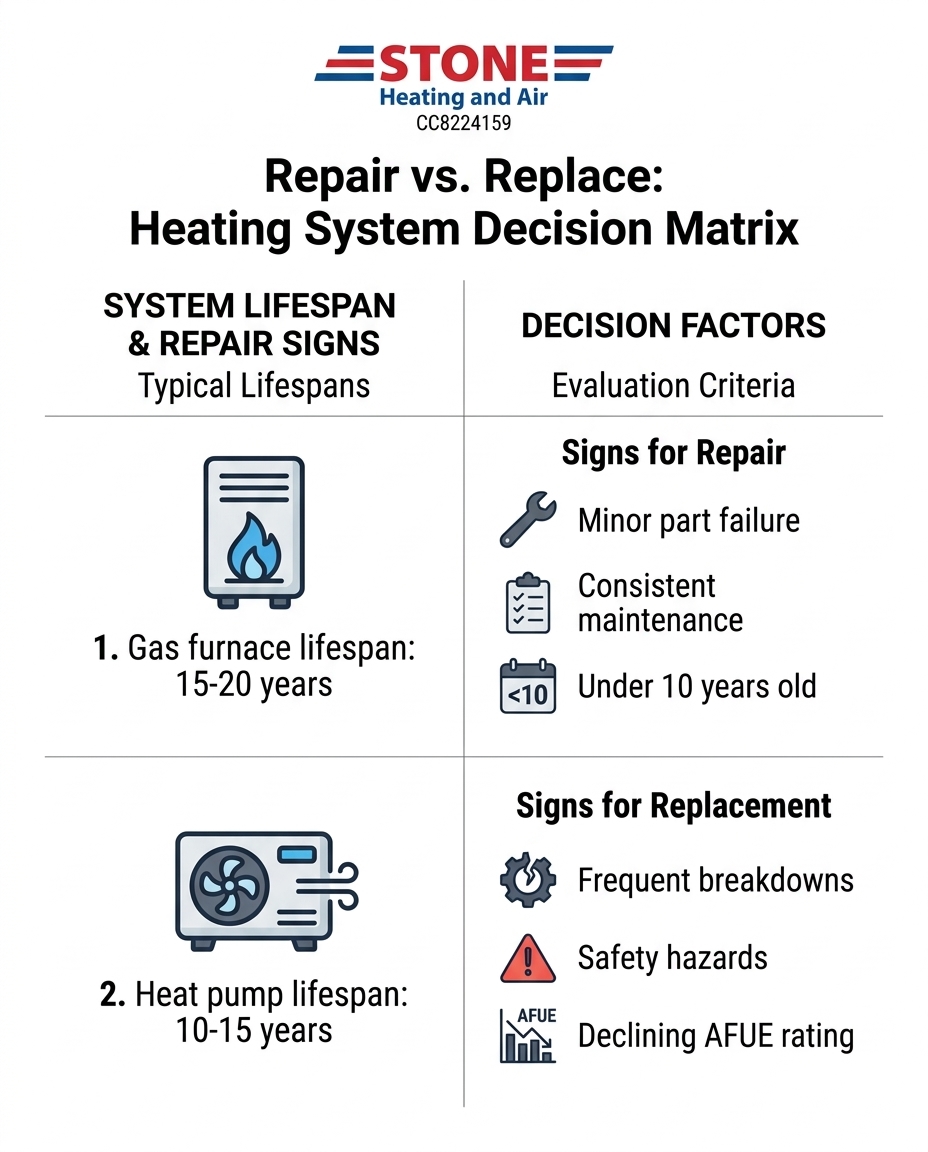
Here is a straightforward matrix we use to help you evaluate your mid-fall / October heating startup situation:
• System Age — Leaning Toward Repair: Under 10 years old — Leaning Toward Replacement: Over 15 years old
• Breakdown Frequency — Leaning Toward Repair: Rare; this is the first issue in years — Leaning Toward Replacement: Frequent; multiple calls in the past two seasons
• Safety Hazards — Leaning Toward Repair: None; heat exchanger is fully intact — Leaning Toward Replacement: Cracked heat exchanger; carbon monoxide risks
• Energy Efficiency — Leaning Toward Repair: Still heating evenly without major utility spikes — Leaning Toward Replacement: Declining AFUE; home feels drafty, bills are rising
• Maintenance History — Leaning Toward Repair: Consistent, yearly professional tune-ups — Leaning Toward Replacement: Spotty or completely skipped maintenance
When to Choose a Repair
A simple repair is usually the right path if your system has suffered an isolated component failure—like a bad capacitor or a worn flame sensor—but is otherwise in good health. If the unit is under 10 years old, still maintains high efficiency, and has no underlying safety hazards, fixing the broken part will likely restore full functionality for years to come.
When to Consider Replacement
Replacement becomes the smarter choice when safety is compromised. If one of our technicians finds a cracked heat exchanger, the system is no longer safe to operate. Additionally, if the unit is over 15 years old, parts may become obsolete or difficult to source. When your home comfort is consistently compromised and you are facing an expensive repair on a unit that is already past its prime, investing that money into a new, reliable system is the better long-term strategy.
The Role of Proactive Fall Maintenance in Extending Equipment Life
Whether you decide to repair your existing furnace or upgrade to a modern heat pump, proactive maintenance is the only way to protect that investment. After a smoky Central Point / Rogue Valley summer, starting the winter with clean filters and coils is absolutely non-negotiable.
A dirty evaporator coil or a clogged blower motor forces your heating system to work twice as hard to push warm air into your living spaces. This unnecessary strain is the leading cause of premature breakdowns. A comprehensive preventative maintenance plan catches these minor, hidden issues before they snowball into emergency winter failures.
Routine filter changes are a major part of this process, but they aren't always easy to handle on your own. For example, a new Central Point resident recently reached out to us because they needed help changing their home air filters, which were located in a difficult-to-reach spot. Our team arrived promptly and changed the filters in the house, ensuring the system had the airflow it needed and completing the job safely. Having a professional handle these tasks ensures they are done correctly without putting you at risk.
Similar to scheduling your AC service in Medford before the summer heat hits, fall heating maintenance ensures seasonal readiness. Many homeowners ask us, "Do maintenance plans save money over time?" The short answer is yes. By preserving your system's efficiency and preventing major mechanical failures, regular tune-ups easily pay for themselves in extended equipment life and stable energy usage.
Make Your Fall Transition Seamless and Stress-Free
The transition from summer cooling to winter heating does not have to be a source of stress. As you face your mid-fall / October heating startup, the most important step is simply taking action before the deep winter freeze arrives.
The right choice between repairing and replacing depends entirely on your home's unique comfort needs, the age of your equipment, and your safety requirements. Reviewing options comparisons for homeowners is much easier when you have the facts in front of you. We encourage you to consult with our local experts at Stone Heating and Air to thoroughly evaluate your system's health, explore your options, and ensure your home remains safe, warm, and comfortable all winter long.
Frequently Asked Questions
At what age should a furnace be replaced?
Most standard gas furnaces should be replaced between 15 and 20 years of age. Once a system reaches this window, internal components like the heat exchanger begin to suffer from thermal fatigue, increasing the risk of cracks and carbon monoxide leaks. Even if an older furnace is still running, its efficiency drops significantly, making replacement a safer and more reliable choice.
Should I replace my gas furnace with a heat pump?
Replacing a gas furnace with a heat pump is an excellent option for homes in moderate winter climates like Southern Oregon. Heat pumps provide both heating and cooling from a single unit and operate with incredible energy efficiency because they transfer ambient heat rather than burning fuel. If your furnace is failing and your AC is also aging, a heat pump can solve both problems at once.
Is it better to repair or replace a 15-year-old heating system?
It is generally better to replace a 15-year-old heating system rather than sink money into major repairs. At 15 years old, a furnace or heat pump is nearing the end of its designed lifespan, meaning replacement parts are harder to find and the system's efficiency is already declining. Investing in a new system provides better reliability, improved safety, and lower monthly energy usage.
How do I know if my furnace needs replacing?
You will know your furnace needs replacing if it requires frequent repairs, struggles to heat your home evenly, or is over 15 years old. Strange noises, such as loud bangs or grinding, and a noticeable increase in your monthly energy bills are also strong indicators of a failing system. Most importantly, if a technician discovers a cracked heat exchanger, the furnace must be replaced immediately for safety reasons.
How does summer wildfire smoke affect my fall heating startup?
Summer wildfire smoke introduces heavy amounts of particulate matter into your HVAC system, rapidly clogging your air filters and indoor coils. Because your AC and furnace share these components, this summer buildup restricts airflow and forces the blower motor to work harder. If the system is not cleaned before the fall heating startup, this restricted airflow can cause the furnace to overheat and short-cycle.
Are there tax credits available for upgrading to a heat pump?
Yes, generic federal tax credits and local utility rebates are frequently available for homeowners who upgrade to qualifying high-efficiency heat pumps. These incentive programs are designed to encourage energy-efficient home improvements and can help offset the initial installation costs. Because programs change frequently, you should always verify current availability and eligibility requirements with your local utility provider or a qualified tax professional.