


The Late Summer Hazard Hiding in Your Yard
August brings peak heat and dry vegetation, making protecting your outdoor HVAC unit from late summer debris an absolute priority. Here at Stone Heating and Air, our technicians notice a distinct pattern every August: as the temperatures climb and the rain stops, the grass in your yard dries out quickly. Routine yard chores like mowing, edging, and weed-whacking suddenly generate a massive amount of lightweight, airborne dust and clippings. While you are just trying to keep your lawn looking neat for the back-to-school transition, that airborne yard waste is often getting sucked directly into your air conditioner's outdoor condenser fins.
This creates a concrete problem for homeowners. The debris forms a restrictive barrier right when your system needs maximum airflow to survive the late-summer heat. The key to keeping your home comfortable is knowing how to safely manage the perimeter around your unit and knowing exactly when it is time to call our professionals for air conditioning services before a minor blockage turns into a major breakdown.
How Dry Debris Chokes Your AC Condenser
To understand why yard waste is so dangerous to your system, you have to look at how the outdoor unit actually functions. The large box sitting outside your home is called a condenser, and its primary job is to release the heat that the indoor unit absorbed from your rooms. It does this using a large fan that actively pulls outside air through the metal fins on the sides of the cabinet, blowing the hot air out through the top.
The Problem: In Central Point OR, late summer brings incredibly dry conditions. Our repair crews frequently find that grass clippings, early falling leaves, and loose dirt in your yard lose all their moisture and become virtually weightless. When you run a lawnmower near the house, this dry debris gets kicked up into the air.
The Cause: Because the condenser fan is incredibly powerful, it acts like a giant vacuum cleaner. It draws that lightweight, dry debris straight into the delicate aluminum fins. Over a few weeks of late-summer yard work, those clippings and leaves weave together, creating a thick, suffocating blanket over the intake areas.
The Solution: Preventing this buildup requires proactive awareness of your yard maintenance habits and scheduling routine AC maintenance in Central Point to clear out the debris that inevitably makes it past your defenses. This airflow restriction happens precisely when the system needs maximum cooling capacity to combat high outdoor temperatures, making timely intervention critical.
The Hidden Costs of Restricted Airflow
A blocked condenser does much more than just make your house feel a little warmer. According to data from the U.S. Department of Energy, and supported by what we see in the field every day, dirty or blocked condenser coils significantly reduce system efficiency and drive up your monthly energy consumption. When debris restricts the airflow, the entire mechanical process of cooling your home is thrown off balance.
The most immediate victim of restricted airflow is the compressor. The compressor is the heart of your air conditioning system, responsible for pumping refrigerant between the indoor and outdoor units. When the condenser fins are choked by August yard debris, the heat cannot escape. The compressor is forced to work much harder, running at higher temperatures and higher pressures just to achieve the same cooling results.
This added strain accelerates wear and tear on the internal components. The oil that lubricates the compressor can begin to break down under extreme heat, increasing the risk of overheating and premature mechanical failure. We have seen firsthand how what starts as a simple layer of grass clippings can quickly escalate into a catastrophic system breakdown right in the middle of the late-summer rush.
• Clean Condenser — Airflow Status: Unrestricted and steady — Compressor Strain: Normal operating pressure — Energy Consumption: Efficient and predictable
• Debris-Blocked Condenser — Airflow Status: Severely restricted — Compressor Strain: High heat and extreme pressure — Energy Consumption: Spikes significantly
The correlation between a blocked unit and increased energy use is undeniable. As the system struggles to breathe, it runs longer cycles, drawing more electricity from the grid while delivering less comfort to your living spaces.
Safe Perimeter Maintenance: Establishing Boundaries
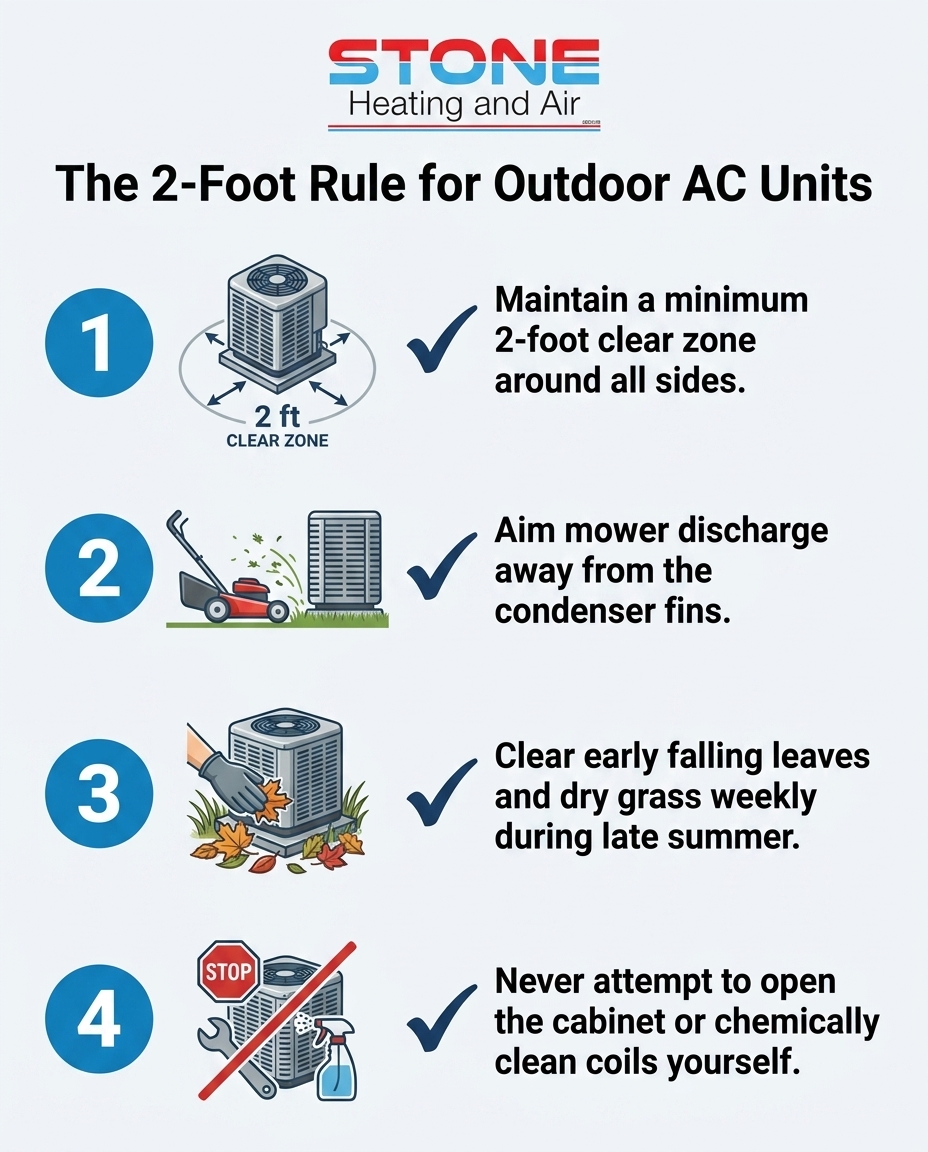
Homeowners play a vital role in keeping the air conditioner running smoothly, but it is crucial to understand the boundary between safe yard care and dangerous DIY repairs. The golden rule for outdoor units that we always stress to our customers is maintaining a clean, two-foot perimeter on all sides. This clear zone ensures the system has access to the air it needs to function properly.
Understanding the clearance your outdoor AC unit actually needs is the first step in preventative care. However, how you achieve that clearance matters just as much as the clearance itself.
What You Can Do Safely
Taking care of the immediate area around your unit in Central Point OR is perfectly safe if you follow a few basic guidelines. Always ensure the system is turned off at the thermostat before doing any work near the cabinet.
• Manage your mower discharge: Always aim the grass chute away from the air conditioner when mowing nearby. This simple habit prevents the majority of clippings from ever reaching the fins.
• Trim back vegetation: Cut back encroaching bushes, shrubs, and low-hanging branches so they remain at least two feet away from the metal casing.
• Rake the base: Gently rake away early fallen leaves, twigs, and dry grass from the concrete pad or dirt base surrounding the unit.
• Clear yard clutter: Ensure the area is completely clear of yard tools, hoses, children's toys, and patio furniture that might block the airflow.
What Requires a Professional
While clearing the yard is your job, cleaning the actual machine is not. The internal components hold high voltage electricity, and the aluminum fins are thinner than a credit card. One wrong move can cause costly damage or serious injury.
• Removing the outer casing: Never take off the metal grilles or panels to access the internal fins or fan motor.
• Straightening bent fins: Never use knives, screwdrivers, or makeshift tools to straighten crushed fins. This requires specialized fin combs and a delicate touch.
• Applying chemical cleaners: Never spray household cleaners, degreasers, or DIY chemical mixtures onto the coils. Improper chemicals will corrode the metal and destroy the unit.
Additionally, never cover the unit with a tarp or custom cover while it is running. Some homeowners attempt this to block leaves, but covering an active unit traps the heat inside, suffocating the system and almost guaranteeing a compressor failure.
Warning Signs Your AC Needs Professional Attention
Sometimes, despite your best efforts, August yard debris still manages to infiltrate the system. Recognizing the early symptoms of a suffocating air conditioner can save you from a complete breakdown. When our team is dispatched to late-summer breakdown calls, we usually find the system was showing warning signs for weeks. If you notice any of these signs, it is time to stop DIY troubleshooting and call for help.
1. Reduced cooling capacity: If your thermostat is set to your normal comfortable temperature, but the house feels warm and humid, the outdoor unit is likely failing to release heat. The air coming from your vents may feel lukewarm instead of crisp and cold.
2. Weak airflow from indoor vents: When the outdoor condenser is blocked, the indoor evaporator coil can actually freeze over. This block of ice stops air from flowing through your ductwork, resulting in a weak, barely noticeable breeze from your room registers.
3. Unusually long cooling cycles: An air conditioner should cycle on, cool the house, and cycle off. If you notice your system is running continuously for hours on end without taking a break, it is struggling to overcome an airflow restriction.
4. Strange noises from the outdoor cabinet: Listen to your condenser. If you hear loud buzzing, aggressive humming, or a rattling sound, the fan motor may be fighting against a blockage or the compressor is operating under extreme pressure.
If you experience these symptoms—especially right after a heavy day of late-summer yard work—the safest action is to turn the system off at the thermostat immediately. Continuing to run a suffocating unit will only cause further damage. Once the system is safely powered down, reach out to our team for professional AC repair to diagnose and resolve the blockage.
Why End-of-Season Maintenance Matters
As August winds down and the kids head back to school, your air conditioner has already been working tirelessly for months. The late-summer period is when systems are most vulnerable to breakdowns because the accumulated wear and tear of the season finally catches up with them. This is exactly why end-of-season maintenance is so critical.
Deep coil cleaning requires professional knowledge. Our technicians use specialized, non-corrosive foaming cleaners that push dirt out from the inside of the coils without damaging the delicate aluminum fins. We also check the electrical connections, test the fan motor amp draw, and ensure the refrigerant levels are exactly where they need to be to handle the final weeks of intense heat. (As a bonus, an efficient system can sometimes help you qualify for energy rebates or tax credits—check with your utility provider for current programs!)
At Stone Heating and Air, our team takes a highly proactive, preventative approach to system health. Our goal is to catch airflow issues before they escalate into late-night emergencies. We recently helped a local customer who experienced the value of this firsthand during a summer heat wave when their AC unit suddenly needed repair. Even after a grueling day of emergency calls, our technicians arrived, diagnosed the choked condenser, fixed the unit, and took the time to walk the homeowner through exactly how to maintain the system moving forward.
That level of education empowers homeowners to protect their investment. By enrolling in a routine maintenance plan, you ensure that an expert from our team is regularly checking your system, optimizing its performance for your specific property layout, and keeping those condenser coils free of suffocating debris year after year.
Frequently Asked Questions About Outdoor AC Protection
Can grass clippings damage an AC unit?
Yes, grass clippings can cause significant damage by restricting the airflow to the condenser coils. When dry clippings get sucked into the unit, they form a dense mat over the aluminum fins. This forces the compressor to work harder, which can lead to overheating, increased energy bills, and eventually a complete mechanical failure if left unaddressed.
How much clearance does an outdoor AC unit need?
An outdoor air conditioner requires a minimum of two feet of clear space on all sides to function efficiently. This includes keeping the area free from shrubs, tall grass, yard tools, and fencing. Additionally, there should be at least five feet of unobstructed clearance above the unit to allow the hot exhaust air to escape properly.
Should I cover my AC unit to protect it from leaves?
You should never cover your air conditioner while it is actively running during the cooling season. Covering an operating unit traps the heat inside and will quickly destroy the compressor. Even during the off-season, fully wrapping the unit in a tight tarp can trap moisture and encourage rust or pest infestations; it is better to use a specialized top-only cover if you must cover it at all.
How do you clean debris out of an air conditioner?
Homeowners can safely clean the exterior by gently brushing away loose leaves and aiming grass clippings away from the base. However, deep cleaning the internal coils requires a professional. Our technicians use specialized foaming chemicals and precise water pressure to push embedded dirt out of the delicate fins without bending or damaging the metal.
What happens if a condenser coil is blocked by dust?
When a condenser coil is blocked by dust or yard debris, the system loses its ability to transfer heat out of your home. The refrigerant stays hot, which means the indoor air cannot be cooled effectively. This causes the system to run constantly, spiking your electricity usage and putting immense strain on the fan motor and compressor.
When should I call a professional for late-summer AC maintenance?
You should call a professional if you notice your system running longer than usual, if the air coming from your vents feels weak or warm, or if you can visibly see a thick layer of debris trapped in the outdoor fins. Scheduling an inspection in late summer ensures your system can handle the final heat waves without suffering a sudden breakdown.
Keep Your Home Cool Through the End of the Season
Understanding exactly how debris harms your system is the very first step in protecting your outdoor HVAC unit from late summer debris. The dry conditions in Central Point OR mean that every time you mow the lawn or trim the hedges, your air conditioner is at risk of inhaling a suffocating layer of dust and clippings.
While establishing a two-foot clear zone and managing your yard waste is a great start, professional cleaning is the only way to restore true efficiency to a dirty system. Do not wait until the compressor overheats on the hottest day of the year. Take action now to ensure your home stays comfortable. Reach out to the team at Stone Heating and Air to schedule a thorough inspection and coil cleaning before the late-summer heat takes a toll on your equipment.