


The Reality of Late-Summer Heat in Uninsulated Heritage Homes
Your vintage windows are rattling from the strain of an oversized window AC, but the upstairs bedrooms still feel like a sauna. Addressing Cooling Inefficiencies in Historic Jacksonville Homes requires more than just buying bigger fans; it demands a strategic approach that respects century-old architecture. When the late-summer August heat settles over Southern Oregon, the intense, dry temperatures expose the complete lack of modern insulation in these beautiful heritage structures. In our years of retrofitting older properties, we've found that traditional cooling methods often fail to keep up with the thermal load, or worse, they require invasive construction that threatens delicate lath-and-plaster walls. If you are tired of sweating through the end of the season, exploring modern air conditioning solutions and planning for a proper AC installation in Jacksonville can transform your living space without compromising its historic charm.
Many homeowners assume that living in a century-old property means accepting a certain level of discomfort during the hottest months. However, the true issue lies in how older structures interact with modern climate demands. Homes built in the late 1800s or early 1900s were designed to breathe, relying on cross-ventilation, deep porches, and high ceilings to manage temperatures. While these passive cooling features worked for a different era, they offer little defense against sustained late-summer August heat waves. When exterior temperatures climb, the lack of wall cavity insulation allows heat to radiate directly into your living spaces.
A pattern we see often is homeowners attempting to force a standard central air system into a home that was never designed for one, which inevitably leads to frustrating compromises. Dropped ceilings, boxed-in soffits, and destroyed plaster are just a few of the casualties of poorly planned retrofits. To preserve the aesthetic integrity of Historic Jacksonville heritage properties, we highly recommend pivoting toward non-invasive modern climate control solutions. By understanding the unique thermal dynamics of your older home, you can select a cooling strategy that works with the structure rather than against it.
• Standard Forced Air — Impact on Historic Architecture: High risk of plaster damage; requires bulky soffits. — Performance in Extreme Heat: Excellent, but often impossible to route efficiently.
• Window AC Units — Impact on Historic Architecture: Damages original wood sashes; visually intrusive. — Performance in Extreme Heat: Poor; struggles to cool multiple rooms evenly.
• Non-Invasive Retrofits — Impact on Historic Architecture: Minimal impact; preserves original floor plans. — Performance in Extreme Heat: High efficiency; provides targeted, zoned cooling.
Navigating Structural and Preservation Challenges in Southern Oregon
Upgrading the climate control in an older home is rarely as simple as running a few ducts through the attic. The fragility of original building materials presents a significant hurdle. Lath-and-plaster walls, which are prevalent in Historic Jacksonville heritage properties, are notoriously brittle. Unlike modern drywall, which can be easily cut and patched, vibrating or cutting into plaster can cause widespread cracking that damages the structural integrity of an entire wall. Because standard ductwork requires large cavities, our team typically advises preservation-minded homeowners that a traditional installation is often a non-starter.
Beyond the physical limitations of the building materials, complex older floor plans require specialized attention during system design. Rooms added over decades, closed-off stairwells, and lack of traditional crawlspaces mean that ensuring proper airflow requires custom engineering. You cannot simply rely on a one-size-fits-all layout. Working with Stone Heating and Air means you are partnering with professionals who have specialized, first-hand expertise in carefully upgrading these delicate structures. We understand exactly how to thread modern technology through antique frameworks without damaging their architectural integrity or compromising your home's unique character.
Just last late summer, our installation team worked with a local homeowner working from home who experienced this exact challenge when they needed new ducts and vents installed. We presented clear options to optimize ventilation for their specific layout, then worked quietly and quickly to complete the job with minimal disruption to the home's historic footprint.
Understanding Local Preservation Rules
Because Jacksonville holds National Historic Landmark District status, any exterior modifications to your property are subject to strict scrutiny. This adds an additional layer of complexity to your cooling retrofit.
• Exterior Visibility: Modern equipment, such as large AC condenser units or thick line sets, cannot typically be placed where they are easily visible from the public right-of-way.
• Camouflage and Placement: Equipment must be discreetly placed behind existing fencing, integrated into landscaping, or painted to match exterior siding to meet aesthetic standards.
• Approval Processes: Navigating the Historic Architectural Review Commission (HARC) guidelines requires planning your installation meticulously before any equipment is purchased or placed.
Why Window Units and Traditional Ducts Fall Short
When the late-summer August heat peaks and the back-to-school transition begins, many homeowners resort to installing window air conditioning units in every bedroom. While this provides a temporary fix, our technicians will tell you it is a highly inefficient long-term strategy. Window units struggle against high heat loads because they are essentially fighting a losing battle against an uninsulated room. Furthermore, the sheer weight of these heavy units, combined with constant vibration and condensation runoff, can cause severe rot and warping to original, irreplaceable wood window frames.
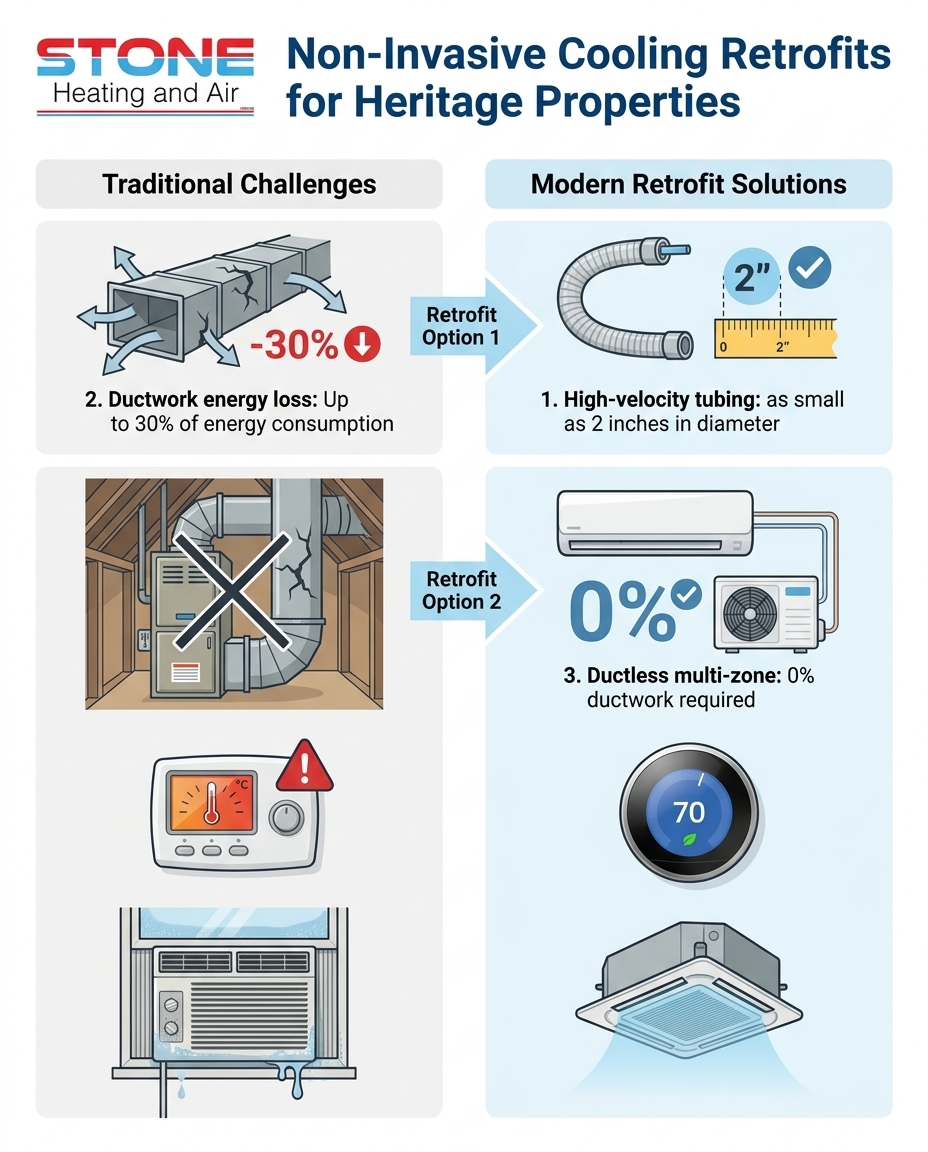
On the other hand, attempting to use traditional ductwork in a home that lacks proper sealing presents its own massive inefficiencies. According to the Department of Energy, ductwork can account for over 30% of energy consumption losses, especially if those ducts are routed through unconditioned spaces like hot attics or damp basements. In an older home, these losses are magnified. The air you are paying to cool often escapes before it ever reaches your living space.
The airflow restriction problem: Older homes simply were not designed for central forced air. The lack of return vents, tight wall cavities, and solid wood doors create severe airflow restrictions. When an HVAC system cannot breathe properly, it works twice as hard, driving up your utility bills and shortening the lifespan of the equipment. Understanding and diagnosing poor airflow in older homes is a critical step before investing in any new cooling technology. If you do not address how air moves through a compartmentalized vintage floor plan, even the most advanced equipment will underperform.
High-Velocity Systems: Cooling Without Compromising Plaster
If you want the seamless feel of central air without the destructive installation process, we often recommend high-velocity HVAC systems as a premier, non-invasive solution. Unlike traditional systems that rely on large, rigid metal trunks to move air, high-velocity systems utilize a principle called aspiration. They deliver conditioned air at a high speed through flexible, small-diameter tubing, creating a gentle mixing effect that cools rooms rapidly and evenly.
These mini-ducts, often as small as 2 inches in diameter, are the secret to preserving Historic Jacksonville heritage properties. Because they are so flexible and compact, our installers can thread them through existing wall cavities, route them behind closets, and slip them under floorboards without the need to tear down lath and plaster. This allows you to maintain your home's original aesthetic while enjoying modern comfort.
Key benefits of high-velocity retrofits include:
• Rapid Moisture Removal: The high-speed air delivery removes up to 30% more humidity than standard systems, making the home feel cooler even at higher thermostat settings.
• Discreet Outlets: Instead of large metal grilles, the air is delivered through small, circular ports that can be painted or finished in wood grain to blend seamlessly into ceilings or floors.
• Minimal Remodeling: By utilizing existing structural voids, these systems eliminate the need for dropped ceilings or bulky drywall soffits.
• Quiet Operation: Despite the "high-velocity" name, sound-attenuating tubing ensures the system operates at a whisper-quiet level.
When dealing with end-of-season heat, the rapid cooling capability of high-velocity air delivery is unmatched. If you are considering professional HVAC system upgrades, this technology represents one of the most effective ways to bridge the gap between historic preservation and modern climate control.
Ductless Mini-Splits: Zoned Comfort for Older Floor Plans
For homes where even small-diameter tubing is impractical, our team loves installing ductless multi-zone systems. They provide a highly effective retrofit option that entirely bypasses the need for internal ducting. A ductless mini-split system consists of an outdoor compressor connected to one or more indoor air-handling units via small refrigerant lines. These indoor units deliver conditioned air directly to specific rooms, providing targeted comfort exactly where you need it.
One of the greatest advantages of a ductless system is its inherent energy efficiency. By bypassing ductwork entirely, you eliminate the systemic energy loss that plagues traditional forced-air setups. Every ounce of cooling power is delivered straight into the room. This zoned approach is particularly beneficial for older floor plans, which often feature distinct, compartmentalized rooms rather than modern open-concept layouts. You can cool the sun-facing kitchen during the day and shift the cooling power to the upstairs bedrooms to combat the late-summer August heat at night.
Balancing aesthetics and performance: The primary concern homeowners express to us about ductless systems is the visual impact of the indoor units and exterior line sets. However, modern installations offer significant flexibility. Indoor units can be recessed into ceilings, mounted low on walls, or disguised as picture frames. On the exterior, line sets can be routed through discreet channels painted to match your siding, and the compact condenser units can be easily tucked behind landscaping to comply with strict historical aesthetic guidelines.
Additionally, because ductless heat pumps are incredibly efficient, generic energy rebates or utility incentive programs may apply to qualifying high-efficiency installations. While you should always verify current programs with your local utility provider or a tax professional, these incentives can help offset the initial investment of bringing your historic home into the 21st century.
Safe Removal and Retrofitting of Outdated Equipment
Before you can enjoy the benefits of a modern cooling retrofit, you must address the physical process of removing old, inefficient systems. At Stone Heating and Air, we frequently encounter Historic Jacksonville heritage properties burdened with vintage wall heaters, massive window shakers, or long-defunct gravity furnaces in the basement. Safely disconnecting and hauling away these outdated units without damaging the surrounding structure requires precision and care.
Diagnosing current system failures is always our first step before recommending a complete replacement. Sometimes, what appears to be a total failure is merely a symptom of poor airflow or an undersized unit. However, when vintage equipment has reached the end of its safe operational life, a clean removal is necessary. During a particularly hot end-of-season stretch last August, our crew helped a local family facing chronic trouble with a very old HVAC system that finally required a full replacement. After thoroughly assessing the situation, our technicians provided non-invasive options and efficiently replaced two AC units and two furnaces, leaving the customer happy with a modernized, reliable setup.
The preparation phase: Removing old equipment often leaves behind structural voids. Patching and preparing the space is critical before new, low-impact systems are integrated. Whether it involves sealing an old wall-heater cavity or repairing a window sill damaged by years of AC condensation, proper site preparation ensures your new system operates in a sealed, efficient environment. If your current vintage system is struggling, securing professional Jacksonville AC repair and assessment can help you determine the safest path forward for removal and retrofitting.
Frequently Asked Questions About Historic Home Climate Control
How do you put central air in a historic home?
The short answer is to use high-velocity HVAC systems or ductless mini-splits. Based on our experience, both technologies avoid the need for large, traditional ductwork. By using flexible 2-inch tubing or bypassing ducts entirely, you can add central cooling without tearing down original lath-and-plaster walls or dropping ceilings.
What is the best HVAC system for an older home without ductwork?
We typically recommend ductless multi-zone heat pumps for homes entirely lacking ductwork. They deliver conditioned air directly into individual rooms via wall, floor, or ceiling cassettes. This provides excellent energy efficiency and allows for customized temperature control in compartmentalized older floor plans.
Can you install ductless AC in a historic district?
Yes, you can install ductless AC in a historic district, provided you comply with local guidelines. The key is discreet placement. Exterior condenser units must often be hidden behind fencing or landscaping, and exterior line sets must be camouflaged or routed in ways that do not detract from the home's historic facade.
How do you cool an old house in the summer without damaging walls?
To avoid damaging fragile walls, avoid installing heavy window units or cutting large chases for standard forced-air ducts. Instead, rely on non-invasive technologies like high-velocity mini-ducts that snake through existing structural voids, ensuring the late-summer August heat is managed without compromising the architecture.
How do local Jacksonville preservation guidelines affect AC condenser placement?
Jacksonville's preservation guidelines typically require that modern mechanical equipment remains out of sight from the public right-of-way. This means your AC condenser cannot sit prominently in a side yard if it is visible from the street; it must be strategically located, screened, or integrated into the property's landscaping.
Expert Guidance for Your Historic Property Retrofit
Achieving modern comfort does not require sacrificing the historical charm that makes your property unique. While the late-summer August heat can make an uninsulated home feel unbearable, today's non-invasive cooling technologies offer elegant, highly efficient solutions. Whether you opt for the discreet delivery of a high-velocity system or the zoned precision of a ductless mini-split, the right technology can preserve your lath-and-plaster walls while providing absolute comfort.
Reiterating the importance of specialized knowledge cannot be overstated. Upgrading Historic Jacksonville heritage properties requires a deep understanding of both local climate demands and strict architectural sensitivities. A generic installation approach will almost always result in structural damage or aesthetic violations. At Stone Heating and Air, we encourage you to seek a professional assessment from our experienced team to determine the best non-invasive cooling solution for your specific layout, ensuring your heritage home remains a comfortable, beautiful sanctuary for decades to come.