

The Mid-Fall Heating Startup: Recognizing Normal vs. Abnormal Symptoms
You switch the thermostat from cool to heat for the very first time this October, expecting a rush of warm air, but instead, you are greeted by a sharp burning odor and a strange rattling noise. That alarming mid-fall heating startup moment makes many homeowners wonder if their furnace is failing or if it is just normal seasonal behavior. When it comes to local service expertise and area tips, knowing exactly what to look for can save you from a cold night without heat.
If you need immediate assistance with your system, explore our air conditioning services or schedule your AC maintenance in Central Point today.
The sudden shift in seasons: Wrapping up the cooling season is just as important as initiating the heating cycle. During the long summer months, your HVAC system works tirelessly to remove heat and humidity from your home. By the time autumn arrives, the internal components have accumulated layers of dust, pollen, and microscopic debris. When you finally demand heat, the system undergoes a significant mechanical transition. Acknowledging this shift helps you understand why the first cycle rarely smells or sounds perfect.
Establishing the decision point: The most critical choice a homeowner makes during this transition is distinguishing between harmless dust burn-off and a mechanical failure requiring professional intervention. A brief, singed-dust smell is a standard byproduct of dormant equipment waking up. However, acrid electrical odors, loud banging, or a system that repeatedly shuts itself off indicate severe friction or failing safety sensors. Understanding the boundary between normal operation and abnormal stress prevents unnecessary panic while ensuring you do not ignore a genuine hazard.
Connecting cooling care to heating safety: A safe heating startup is directly tied to how well you managed your end-of-season cooling care. If the blower motor was strained by a clogged filter during the final weeks of summer, that same motor will struggle to distribute warm air in the fall. Proper seasonal transition means ensuring the entire air handler is clean, calibrated, and ready for the thermal expansion that occurs when the burners ignite.
The Sequence of Operations During Seasonal Transition
To safely navigate the first heating cycle of the year, it is helpful to understand the technical sequence of operations that occurs inside your dormant HVAC system. When you switch the thermostat to heat, a precise mechanical chain reaction begins. Understanding this sequence prevents panic and promotes safer troubleshooting.
The Role of the Heat Exchanger and Igniter
The transition from cooling mode to heating mode involves shutting down the outdoor compressor and activating the indoor combustion or heat strip process. Here is the exact sequence that takes place:
1. Thermostat Call for Heat: The thermostat detects a temperature drop and sends a low-voltage signal to the furnace control board.
2. Draft Inducer Activation: Before any gas flows or heat is generated, the draft inducer motor turns on. This clears the heat exchanger of any lingering gases and ensures proper venting through the flue.
3. Pressure Switch Verification: The system checks the pressure switch to confirm the inducer motor is moving enough air safely. If the venting is blocked, the sequence stops here.
4. Ignition Sequence: The igniter (either a hot surface igniter or a spark igniter) glows red hot or sparks. Once the temperature is reached, the gas valve opens, and the burners ignite.
5. Heat Exchanger Warming: The flames heat the metal chambers of the heat exchanger. The toxic combustion gases remain safely inside these chambers, eventually venting outside.
6. Blower Motor Engagement: Once a built-in sensor confirms the heat exchanger is sufficiently warm, the main blower motor activates, pushing return air over the outside of the hot heat exchanger to warm your home.
Why Dormancy Causes Startup Friction
A system that has been sitting dormant for months naturally accumulates debris that impacts this initial startup cycle. Even in the cleanest homes, microscopic dust particles settle on the burners, the igniter, and the exterior of the heat exchanger.
1. Physical Accumulation of Dust: During the summer, the blower motor pushes air through the system, but the heating components remain cold. Dust and lint gather heavily on the heat exchanger's surface. When those metal chambers rapidly heat up for the first time in months, that settled dust instantly incinerates.
2. Lack of Lubrication Movement: Mechanical parts, such as the inducer motor bearings and blower fan belts, have sat in the same position for a long time. The lubricating oils may have settled, causing a brief period of mechanical friction. This is why you might hear a temporary squeak or groan during the first few minutes of operation.
3. Sensor Calibration Delays: Flame sensors and limit switches can become coated in a thin layer of oxidation or grime during the off-season. This can cause the system to hesitate slightly during the first ignition sequence as the sensors struggle to read the flame correctly.
Decoding Startup Odors: Normal Dust Burn-Off vs. Hazardous Smells
Educating yourself on exactly how to identify different odors during the first heating cycle is crucial for home safety. Using data and clear timeframes helps set realistic expectations for what you will experience when the heat kicks on.
The 30-to-60 Minute Rule
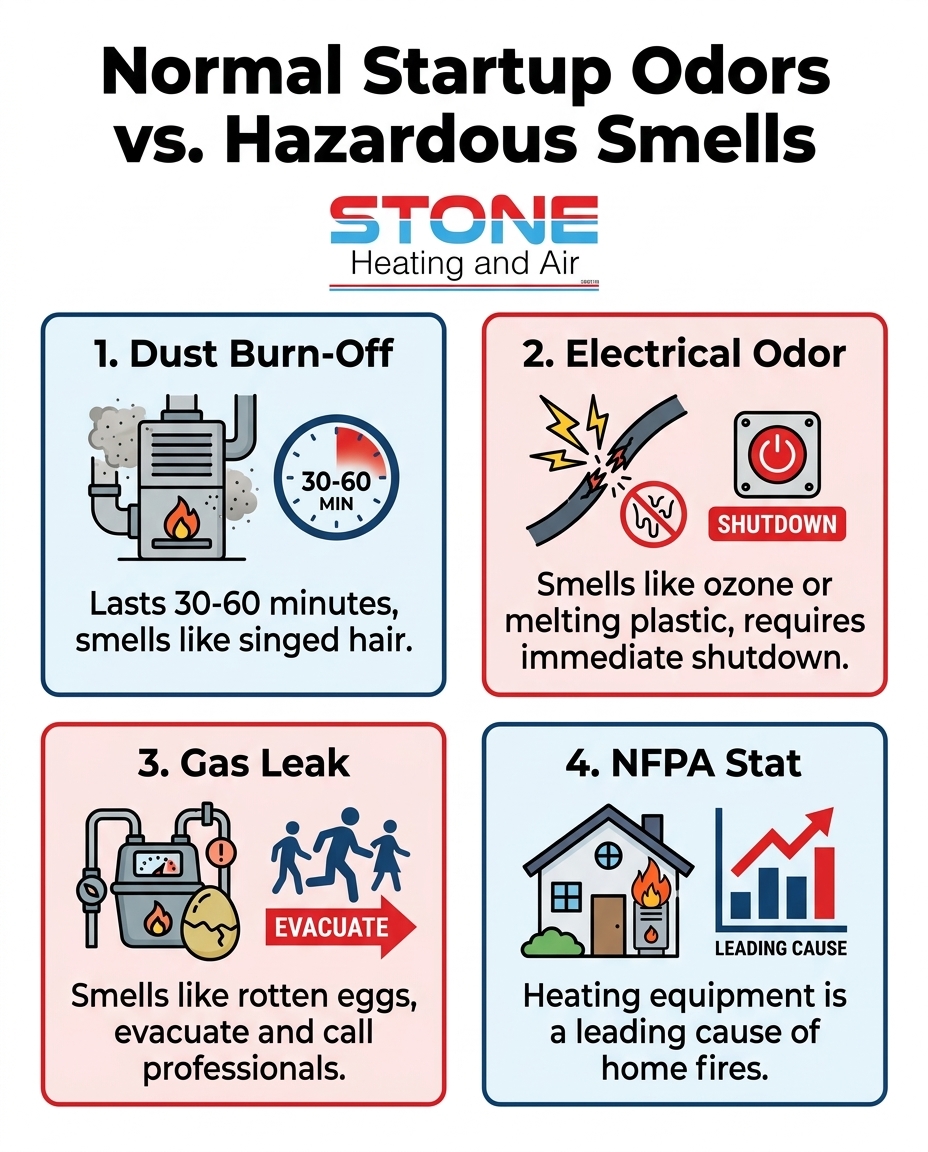
The standard "dust burn-off" smell is often described as resembling singed hair, toasted dust, or a very faint campfire odor. This is a normal part of the mid-fall heating startup.
• A strong, dusty burning smell fills the home immediately after the heat turns on. — The Underlying Cause: Months of accumulated household dust and lint are incinerating on the surface of the rapidly heating metal heat exchanger. — The Safe Solution: Apply the 30-to-60 minute rule. Open a few windows to ventilate the home. The smell should steadily dissipate within an hour of continuous operation.
If the smell lingers beyond the first 60 minutes, or if it returns every time the system cycles on over the next few days, it is no longer considered normal dust burn-off. Persistent odors indicate that debris is continually bypassing the filter, or that a component is operating outside of its safe temperature range.
Identifying Electrical or Plastic Odors
Contrasting normal smells with dangerous odors is essential. According to the National Fire Protection Association (NFPA), heating equipment is a leading cause of home fires, underscoring the importance of taking unusual smells seriously.
• The air smells like melting plastic, burning rubber, or sharp electrical ozone. — The Underlying Cause: Failing wiring, a seizing blower motor, an overheated capacitor, or an object lodged near the heating elements. — The Safe Solution: Shut the system down immediately at the thermostat. If the smell persists, turn off the power at the breaker panel. Do not restart the system until a professional inspects the wiring.
• A distinct rotten egg or sulfur smell near the furnace vents. — The Underlying Cause: A natural gas leak from a cracked heat exchanger, a faulty gas valve, or loose pipe fittings. — The Safe Solution: Evacuate the home immediately. Do not turn on lights or use electronics. Call your local utility company and emergency services from outside.
How Rogue Valley Summers Impact Fall Heating Performance
To fully grasp the importance of a mid-fall heating startup, you have to look backward. Hot, demanding summers put immense strain on the blower motor and air handler. By the time autumn rolls around in Central Point, OR, your system has already run a marathon. Contextualizing the maintenance discussion within our specific regional climate explains how summer conditions directly affect the fall startup.
Wildfire Smoke and Particulate Accumulation
Microscopic infiltration: Rogue Valley summer air quality events, particularly wildfire smoke, increase particulate accumulation drastically. Microscopic smoke particles and ash are incredibly fine—often smaller than 2.5 microns. These particles easily bypass standard fiberglass air filters, traveling deep into the ductwork and settling directly onto the dormant heating components.
Coating critical sensors: Heavy ash and smoke residue settle on the heat exchanger, the flame sensor, and the igniter. When the furnace attempts to fire up in the fall, this thick, baked-on layer of summer smoke residue makes the initial dust burn-off smell much more pronounced and acrid than normal household dust. Furthermore, a soot-coated flame sensor may fail to register that the burners have ignited, causing the system to shut down prematurely as a safety precaution.
The Compounding Effect on Airflow
Restricting winter efficiency: Summer debris buildup restricts winter heating efficiency. If your AC coils and blower motor fan blades became caked with dust and pet dander over the summer, that same motor now has to work twice as hard to push dense, warm air through the home. This relationship between poor airflow and overheating components is a primary reason why furnaces fail early in the season.
Proactive transitions: Connecting proactive end-of-summer care to smoother winter transitions is essential. Proper scheduling AC maintenance at the end of the cooling season ensures the blower assembly is clean and the filters are fresh, removing the summer's heavy particulate load before the intense heat of the furnace bakes it onto the internal machinery.
Homeowner Checklist: Safe Pre-Startup Troubleshooting
Before calling a technician for a minor hiccup, there are safe, non-professional steps a homeowner can take to resolve basic issues. One Central Point homeowner who was new to the area during a chilly winter stretch reached out concerned about their system's performance; a technician arrived promptly, discovered heavily clogged filters, and replaced them, instantly restoring airflow and exceeding the homeowner's expectations. This highlights how simple upkeep can solve major comfort issues.
Inspecting and Replacing Air Filters
Dirty air filters are a primary cause of short-cycling in HVAC systems. Before the first heating cycle, replacing the filter is non-negotiable.
• Locate the return vent or air handler cabinet: Check the existing filter. If you cannot see light through the media, it is completely blocked and must be discarded.
• Select the right MERV rating for fall: While high-efficiency filters (MERV 11-13) trap more dust, they also restrict airflow. Ensure your blower motor is rated to handle denser filters; otherwise, stick to a MERV 8 filter for a balance of airflow and protection.
• Check the directional arrows: Always install the new filter with the airflow arrows pointing toward the furnace unit, not away from it.
• Clear the surrounding area: Ensure the space around the indoor unit is free of stored boxes, laundry, or combustible materials that may have accumulated over the summer.
Verifying Thermostat Communication
Often, a system that fails to start is simply suffering from a communication error at the thermostat.
• Switch to the correct mode: Ensure the thermostat is explicitly set to "Heat" and not "Auto" or "Off." Set the temperature at least five degrees above the current room temperature to force a call for heat.
• Check the batteries: Many smart and programmable thermostats rely on internal batteries. If the display is blank or flashing a low-battery warning, replace them immediately.
• Verify the circuit breaker: Check your home's main electrical panel. Ensure the breaker labeled for the furnace or air handler has not been tripped. If it has, flip it fully off, then back on.
• Respect the DIY boundary: Reiterate the boundary between safe DIY checks and tasks requiring a licensed professional. You can change filters and batteries safely; you should never open the furnace chassis to inspect wiring or gas valves.
Identifying Mechanical Failures That Require Expert Intervention
Drawing a clear line on when to stop troubleshooting and call for emergency or routine repair services protects your home and your equipment. Some symptoms go far beyond normal seasonal transition quirks.
Recognizing Short-Cycling Patterns
The impact on the blower motor: Short-cycling occurs when the heating system turns on, runs for a brief minute or two, and then abruptly shuts off before the home reaches the target temperature. This rapid on-and-off sequence puts immense strain on the blower motor and the starting capacitors. If left unchecked, short-cycling will drastically reduce the lifespan of the equipment.
Safety limit switches: Short-cycling is rarely a glitch; it is usually a safety limit switch deliberately shutting the system down to prevent a fire. If the heat exchanger gets too hot—often due to a clogged filter or a failing blower motor—the high-limit switch cuts the gas supply. If your system is short-cycling, it is actively protecting itself from catastrophic overheating.
When to Shut Down the System Immediately
Cold air during a heating cycle: If the system blows cold air despite being set to heat, the burners are failing to ignite. This could be a dirty flame sensor, a broken igniter, or a tripped gas valve. Letting the system blow cold air endlessly wastes energy and stresses the fan motor.
Critical warning signs: The dangers of ignoring persistent electrical smells, grinding noises, or metal-on-metal screeching cannot be overstated. These indicate failing bearings or electrical shorts. If you observe sparks, continuous smoke, or loud banging during startup, shut off power at the breaker immediately. For these complex mechanical issues, relying on professional AC repair services and heating diagnostics is the only safe path forward.
Securing System Reliability with Professional Maintenance
Transitioning to the value of professional tune-ups emphasizes safety, efficiency, and proper procedure. One local homeowner scheduled a routine fall service call to ensure their system was ready for the cold; the technician walked them through the specific maintenance steps, verifying that the equipment was operating at peak performance before leaving. This structured approach prevents unexpected mid-winter breakdowns.
Comprehensive Component Cleaning
Removing summer particulate buildup: The exact steps a technician takes during a fall transition check-up are thorough. They begin by removing the heavy layers of summer dust, pet dander, and potential wildfire smoke residue from the heat exchanger and burner assembly. A clean burner ensures a safe, blue flame rather than a dangerous, rolling yellow flame.
Calibrating internal sensors: Technicians meticulously clean the flame sensor with specialized abrasives to ensure it correctly reads the ignition sequence. They check all electrical connections, tightening lugs that may have vibrated loose during the heavy summer cooling season, and test the safety limit controls to guarantee the system will shut down if overheating occurs.
Long-Term Efficiency Benefits
Lowering energy consumption: The long-term value of routine maintenance is evident in your monthly energy usage. A clean, well-maintained system operates with significantly less mechanical friction. When the blower motor doesn't have to fight through clogged coils and dirty fan blades, it consumes less electricity, and the heat exchanger transfers warmth more efficiently.
Protecting the equipment: Structured upkeep is vital for overall system longevity. Furthermore, highlighting thorough, professional check-ups by local experts who understand Southern Oregon's unique climate demands ensures your system is prepared for whatever the Rogue Valley weather brings. Routine professional oversight also protects the manufacturer's warranty, as most brands require documented annual maintenance to honor parts replacements. Exploring a comprehensive HVAC maintenance plan secures this reliability year after year.
Ensuring a Safe and Comfortable Winter Transition
A safe heating startup relies heavily on proper end-of-season care and a clear understanding of your equipment's sequence of operations. Knowing the difference between the temporary, singed smell of normal dust burn-off and the hazardous scent of melting electrical components empowers you to make smart, safe decisions for your home. By inspecting your filters, verifying your thermostat, and recognizing when a system is dangerously short-cycling, you protect your investment.
Act proactively before severe winter weather arrives. A clear checklist of what is normal versus what is dangerous, combined with safe, non-professional troubleshooting steps, gives you peace of mind. When it comes to local service expertise and area tips, relying on professional maintenance options ensures your transition from summer cooling to winter heating is as smooth and safe as possible.
Frequently Asked Questions
Why does my heater smell like burning dust when I turn it on?
A burning dust smell is a normal byproduct of a system sitting dormant for months. During the summer, household dust, lint, and microscopic debris settle onto the metal surfaces of the heat exchanger. When the furnace ignites for the first time in the fall, those metal chambers rapidly heat up, instantly incinerating the settled dust. This process creates a distinct, singed odor that should safely dissipate as the system continues to run.
How long should a furnace smell when first turned on for the season?
The standard timeframe for harmless dust burn-off is between 30 and 60 minutes during the initial heating cycle. Opening a few windows to ventilate the home can help clear the air faster. If the burning smell persists longer than an hour, or if it returns strongly every time the system cycles on over the following days, it indicates a deeper issue that requires a professional inspection.
What does an electrical fire in a furnace smell like?
An electrical fire or failing component produces a sharp, acrid scent that is very different from dusty burn-off. It typically smells like melting plastic, burning rubber, or electrical ozone. If you detect these odors, you should immediately shut down the heating system at the thermostat and turn off the power at the main circuit breaker to prevent a potential fire hazard.
Can a dirty air filter cause my heating system to short-cycle?
Yes, a dirty air filter is one of the most common causes of short-cycling. When the filter is clogged, it severely restricts the airflow moving over the heat exchanger. Without enough cool return air to absorb the heat, the internal temperature of the furnace spikes rapidly, triggering the high-limit safety switch to shut the system down prematurely to prevent catastrophic overheating.
Is it normal for the HVAC system to blow cold air during the first startup?
It is normal to feel a brief push of cool room-temperature air for the first minute as the blower motor clears the ductwork, but it should turn warm shortly after. If the system continues to blow cold air endlessly, it means the burners have failed to ignite. This is often caused by a dirty flame sensor, a faulty igniter, or a closed gas valve, requiring professional diagnostics.
How does summer wildfire smoke affect my heating system in the fall?
Microscopic smoke particles and ash from summer wildfires can bypass standard air filters and settle deep inside the HVAC cabinet. This heavy particulate buildup coats the heat exchanger, flame sensors, and blower motor blades. When the furnace turns on in the fall, this baked-on residue can cause a much stronger, more acrid burn-off smell and may even interfere with the sensors' ability to read the ignition sequence correctly.