

The Reality of Heating Applegate Valley Rural Properties Without Natural Gas
Your property is stunning, but as the temperatures drop, the reality of finding reliable heating solutions for off-grid or rural homes in the Applegate Valley becomes a pressing priority. Without access to a municipal natural gas line, you are left to navigate a unique set of infrastructural challenges. In our years of serving Central Point and the surrounding areas, we've seen firsthand how the damp, chilly microclimate of Southern Oregon winters makes high-efficiency, dependable heating non-negotiable. When the fog rolls in and the frost settles, a failing or inefficient heating system quickly turns from a minor inconvenience into a major disruption.
For many Applegate Valley rural properties, the primary decision point comes down to choosing between upgrading an aging propane furnace or transitioning to a high-efficiency electric system. Both paths require careful planning, specific infrastructure assessments, and an understanding of how your home retains heat. Making this choice before the severe winter weather sets in is critical, as cold temperatures and muddy roads complicate installation logistics and fuel deliveries.
If you are currently weighing your options, exploring professional heating solutions with our experienced team is the best way to ensure your property remains comfortable, safe, and energy-efficient throughout the coldest months of the year.
Evaluating Propane Furnaces for Off-Grid Infrastructure
Propane has long been the gold standard for rural properties that lack access to natural gas. It burns hotter and cleaner than heating oil, and it provides the robust, high-capacity heat necessary to warm larger homes quickly. Based on our assessments of local properties, if your home is already equipped with a leased or owned fuel storage tank and intact gas lines, upgrading to a modern propane furnace is often the most structurally straightforward path.
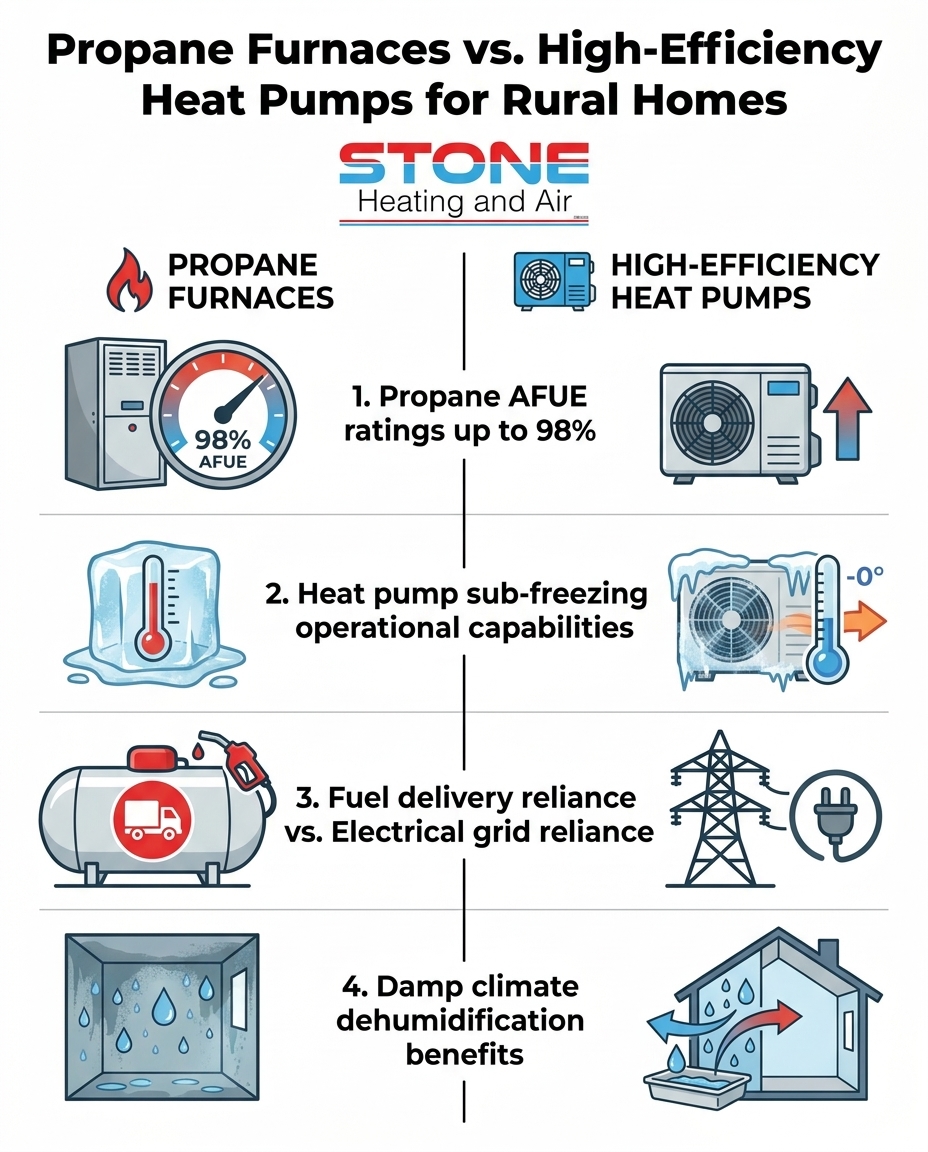
The efficiency leap: Modern high-efficiency propane furnaces are a far cry from the clunky, wasteful units of the past. Today's top-tier models can achieve Annual Fuel Utilization Efficiency (AFUE) ratings of up to 98%. This means that 98% of the propane consumed is converted directly into usable heat for your home, with only 2% lost through exhaust. For off-grid homes where every drop of delivered fuel counts, this level of efficiency drastically extends the time between tank refills.
To understand the difference an upgrade makes, consider the operational shifts between legacy and modern equipment:
• Heat Exchangers — Older Propane Furnaces (80% AFUE or less): Single heat exchanger; loses significant heat through the flue. — Modern High-Efficiency Furnaces (90-98% AFUE): Primary and secondary heat exchangers capture condensing heat.
• Blower Motors — Older Propane Furnaces (80% AFUE or less): Single-stage operation; blasts air at 100% capacity and shuts off. — Modern High-Efficiency Furnaces (90-98% AFUE): Variable-speed motors adjust airflow for consistent, even temperatures.
• Venting Requirements — Older Propane Furnaces (80% AFUE or less): Requires traditional metal chimney venting. — Modern High-Efficiency Furnaces (90-98% AFUE): Utilizes PVC piping for safe, low-temperature exhaust venting.
Managing Winter Fuel Delivery Logistics
The primary trade-off of relying on propane is the logistical reality of fuel delivery. Off-grid homes must carefully monitor their tank levels, as running out of fuel during a cold snap leaves the house entirely without heat. Pre-season tank fills are essential for Applegate Valley rural properties.
Rural road conditions in mid-winter can severely disrupt standard delivery schedules. Heavy rains, mud, and localized freezing often make steep or unpaved driveways impassable for heavy fuel trucks. By upgrading to a 98% AFUE furnace and scheduling bulk deliveries before late fall, you significantly reduce the risk of being stranded without fuel when the weather takes a turn for the worse.
High-Efficiency Heat Pumps in Damp, Chilly Microclimates
While propane remains a strong contender, our technicians have seen modern electric heat pumps emerge as a highly viable alternative for off-grid homes. Historically, early heat pump technology struggled in colder weather, leading to a misconception that they were only suited for mild climates. Today, cold-climate heat pumps are engineered with advanced inverter-driven compressors that allow them to operate efficiently even in sub-freezing temperatures.
The damp, chilly moisture of Southern Oregon winters presents a specific challenge. Unlike dry cold, damp cold penetrates deeply, making a 40-degree day feel much closer to freezing. Traditional wood stoves or older propane systems often produce a very dry heat, but they do little to actively manage the ambient moisture in the air. We consistently recommend heat pumps in this specific environment because they provide consistent dehumidification alongside heating. As the system conditions the air, it naturally pulls excess moisture out of your indoor environment, making the home feel significantly warmer and more comfortable at lower thermostat settings.
Key benefits of modern heat pumps for rural homes:
• No fuel deliveries: Eliminates the need to monitor tank levels or rely on delivery trucks navigating icy rural roads.
• Consistent comfort: Variable-speed technology provides a steady stream of warm air rather than the abrupt on/off cycles of traditional furnaces.
• Dual functionality: Operates in reverse during the summer to provide high-efficiency air conditioning from the exact same unit.
• Dehumidification: Actively manages indoor humidity, combating the damp chill characteristic of the local microclimate.
If your property lacks existing ductwork, or if you are looking to supplement a wood stove, ductless heat pump systems offer incredible flexibility. These systems deliver targeted, high-efficiency heating directly to individual rooms without the need for extensive retrofitting.
Overcoming Installation Challenges in Rural Properties
Installing new HVAC equipment in older, off-grid homes is rarely a straightforward swap. Rural properties often feature non-standard layouts, crawl spaces with limited access, or aging infrastructure that requires careful evaluation before new equipment can be safely integrated. Professional expertise is required to mitigate these physical and infrastructural challenges.
Our team at Stone Heating and Air recently helped a local homeowner face this exact scenario when needing a system installed in particularly difficult, tight areas of their older property. Our installation crew went above and beyond to navigate the challenging spots, taking the time to educate the customer on how the new setup would operate efficiently despite the spatial constraints. This level of dedication ensures that the system performs exactly as intended, regardless of the home's unique footprint.
Working with us means benefiting from specialized experience in designing and installing custom rural HVAC solutions tailored to non-standard property layouts. Our approach ensures that every hurdle is addressed systematically.
3 Steps to Assessing Rural Installation Feasibility:
1. Evaluating Ductwork Integrity: Older homes often have leaky, uninsulated ductwork that was designed for high-heat oil or wood furnaces. Heat pumps deliver a lower, more consistent air temperature, meaning existing ducts must be thoroughly inspected, sealed, or retrofitted to ensure proper airflow and efficiency.
2. Assessing Electrical Panel Capacity: Transitioning from gas or wood to an electric heat pump requires adequate electrical infrastructure. A professional must evaluate your main breaker panel. If your home operates on older 100-amp service, an electrical upgrade may be necessary to support the new system safely.
3. Optimizing Equipment Placement: Outdoor units must be placed where they are protected from heavy snow drift and roof runoff, while indoor air handlers need to be positioned for optimal air distribution in homes with vaulted ceilings or sprawling additions.
Navigating these complexities is why partnering with professionals for comprehensive HVAC services is critical for long-term reliability.
Transitioning from Legacy Systems to Modern Electric Heating
Making the leap from an old propane furnace or a manual wood stove to a modern electric heat pump involves weighing the upfront logistical transition against the long-term efficiency gains. Based on the many transitions we've managed for Applegate Valley residents, the initial phase requires planning—removing outdated equipment, upgrading electrical panels, and potentially modifying ductwork. However, the long-term payoff is a significant reduction in physical labor and logistical stress.
The peace of mind gained by reducing your reliance on physical fuel deliveries during the winter months cannot be overstated. You no longer have to chop wood, stack pellets, or watch the gauge on a propane tank as a winter storm approaches. Instead, your home maintains a consistent, comfortable temperature automatically.
If you are still weighing the pros and cons of different fuels, comparing gas furnaces vs. electric heat pumps can help clarify which system aligns best with your home's infrastructure and your personal comfort preferences.
Navigating Energy Rebates and Incentives
Upgrading to high-efficiency equipment often comes with the added benefit of financial incentives. General federal tax credits and generic energy rebates may apply to qualifying high-efficiency heat pump installations. These programs are designed to encourage homeowners to transition to cleaner, more efficient electric technologies.
Qualification for these incentives typically depends on the system's efficiency ratings, specifically the SEER2 (Seasonal Energy Efficiency Ratio) for cooling and HSPF2 (Heating Seasonal Performance Factor) for heating. Because these programs and their specific requirements change frequently, our team always advises homeowners to consult with an HVAC professional and a tax advisor to understand which generic tax credits your new system might qualify for.
Why the September Pre-Heating Season is the Critical Window for Upgrades
Timing is everything when it comes to rural infrastructure upgrades. The September pre-heating season is the critical window for taking action. Waiting until the first frost hits to evaluate your heating system is a recipe for emergency service calls, rushed decisions, and potential delays.
Early fall is the optimal time for an HVAC professional to visit your property, take accurate measurements, make tailored recommendations, and schedule installations. During this window, the weather is still mild enough to allow for complex outdoor work, electrical upgrades, and the safe removal of heavy legacy equipment.
During a previous fall season, a local homeowner reached out to us needing an old 1950s wall heater removed before they could upgrade their system. Our team quickly extracted the outdated unit and hauled it away, clearing the path for a modern, safe installation well before the winter freeze arrived. Addressing these heavy removals early prevents severe weather from halting the project.
The risks of waiting too long:
• Supply chain delays: High-efficiency units and specific replacement parts often see increased demand as winter approaches. Ordering in September ensures your equipment arrives on time.
• Compromised rural roads: Heavy installation trucks and equipment delivery vehicles struggle to navigate steep, muddy, or icy rural driveways in late November and December.
• Emergency scheduling: If your current system fails during the first hard freeze, you may be forced to wait for an installation slot during the busiest time of the year.
Having your new system fully tested, calibrated, and operational before the damp chill settles into the valley gives you total peace of mind for the season ahead.
Frequently Asked Questions About Rural Heating Without Natural Gas
What is the best heating system for a home with no natural gas?
The best heating system depends entirely on your home's existing infrastructure and your access to utilities. High-efficiency propane furnaces are excellent for homes with existing ductwork and fuel tanks, offering powerful, reliable heat. Alternatively, we highly recommend cold-climate heat pumps for homeowners looking to eliminate fuel deliveries and utilize electricity for both heating and dehumidification.
Are heat pumps effective for rural homes?
Yes, modern heat pumps are highly effective for rural properties. Advanced inverter technology allows cold-climate models to extract heat from the outside air even when temperatures drop below freezing. We find they are particularly beneficial in damp microclimates because they actively dehumidify the air, improving overall indoor comfort without relying on delivered fuels.
How do off-grid homes stay warm in winter?
Off-grid and rural homes typically rely on a combination of delivered fuels and electrical systems. Common methods include high-efficiency propane furnaces, wood or pellet stoves, and modern electric heat pumps. Success relies on ensuring the home is properly insulated and that fuel deliveries are scheduled well before winter weather impacts road access.
Can you run a heat pump on solar power?
Yes, you can run a heat pump using solar power if your solar array and battery storage system are sized correctly to handle the electrical load. Heat pumps are highly efficient, making them one of the best heating options to pair with renewable energy. An electrical assessment is required to ensure your inverter and batteries can manage the startup surge and sustained operation during winter months.
What are the electrical requirements for upgrading to a heat pump in a rural home?
Upgrading to a heat pump usually requires a dedicated 220-volt circuit and sufficient capacity in your main breaker panel. Many older rural homes operate on 100-amp electrical service, which may need to be upgraded to 200-amp service to safely support the new HVAC equipment alongside your other household appliances. A professional assessment will determine exactly what upgrades are necessary.
Securing Your Winter Comfort with Expert Rural HVAC Design
Satisfying your rural heating needs requires a careful balance of understanding your home's infrastructure, adapting to the local climate, and prioritizing long-term energy efficiency. Whether you determine that a 98% AFUE propane furnace is the most logical upgrade for your existing setup, or you decide it is time to transition to a cold-climate heat pump, matching the equipment to your specific property is the key to success.
The damp, chilly winters of the Applegate Valley demand systems that are robust, reliable, and professionally installed to handle non-standard property layouts. Don't wait until the first hard freeze compromises your comfort and complicates installation logistics. Take advantage of the September pre-heating season to schedule a comprehensive assessment with Stone Heating and Air, weigh your options with a local expert, and secure a custom heating solution before winter arrives.