

Why Is My AC Blowing Warm? The Temptation of a Quick Recharge
Is your cooling system running non-stop, but the vents are barely pushing out cold air? If you are sweating through the house right now, you might be wondering: can I just add refrigerant to my AC instead of fixing the leak? The short answer is no. A true fix always requires locating and sealing the physical leak first.
When the late August heat in Southern Oregon pushes indoor temperatures to uncomfortable levels, it is incredibly tempting to look for a quick fix. At Stone Heating and Air, our technicians frequently hear this exact question as families prepare for the back-to-school transition and want to ensure their homes stay comfortable through the end-of-season cooling period. Many homeowners operate under the misconception that an air conditioner simply needs a routine "recharge" or a quick top-off to get through the rest of the summer. When faced with a struggling system, you have to make a critical decision: pay for a temporary top-off to limp through the season, or authorize a proper leak search and repair.
Choosing the temporary bandage often leads to much larger mechanical failures. To protect your air conditioning system and ensure reliable comfort, you need a permanent solution. If you need professional AC repair in Central Point, sealing the leak is the only way to restore your system's efficiency and safeguard your equipment.
The Closed-Loop Reality: Why Air Conditioners Don't Consume Refrigerant
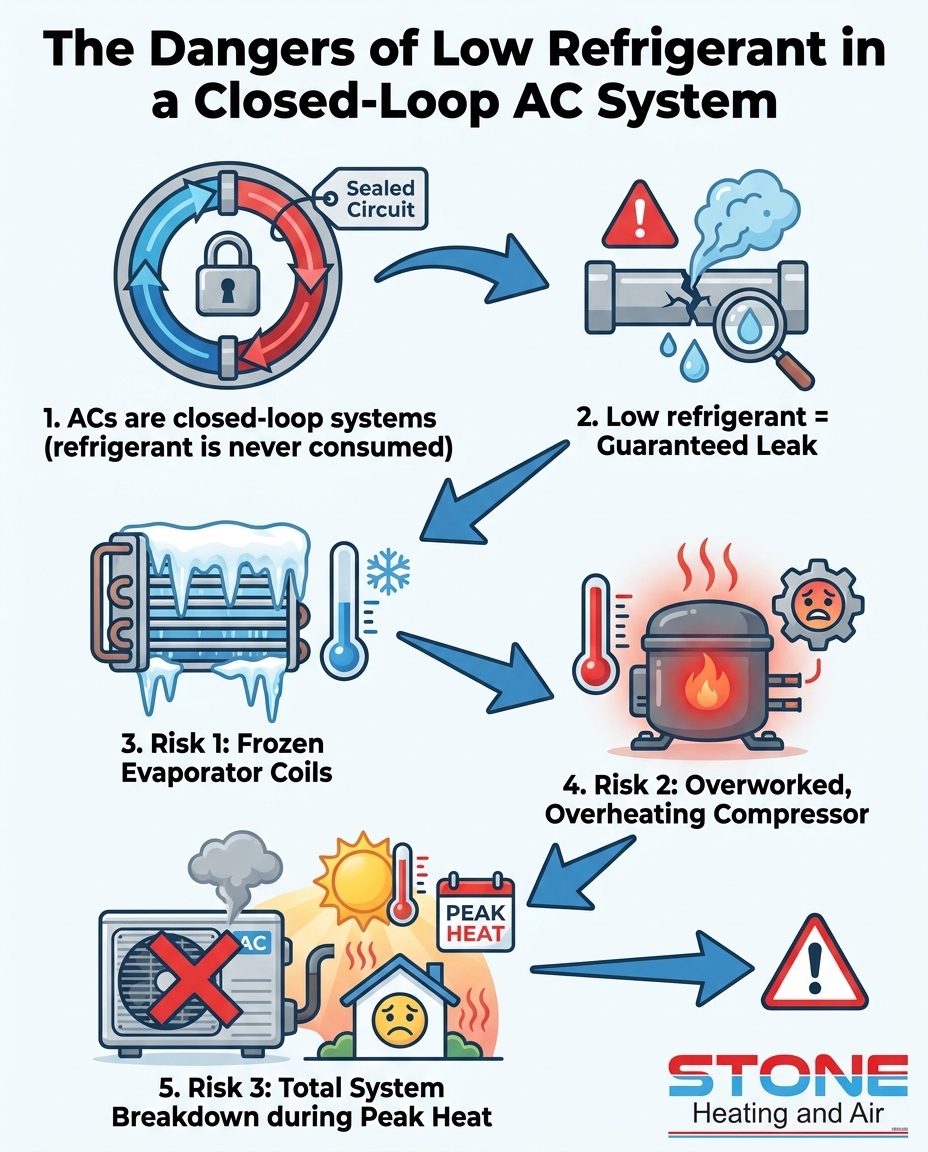
To understand why a simple recharge is a flawed strategy, it helps to understand how your cooling equipment actually works. An air conditioner operates as a closed-loop system. The refrigerant inside travels in a continuous, sealed cycle between the indoor evaporator coil and the outdoor condenser unit. As it cycles, it changes from a liquid to a gas and back again, absorbing heat from inside your home and releasing it outside.
Because this system is entirely sealed, the chemical refrigerant is never "used up" or consumed during the cooling process. This is a very different mechanism from how a vehicle operates.
• Car Gas Tank — Fuel / Coolant Behavior: Consumed continuously to generate power. — What Low Levels Mean: Normal operation; simply requires a refill.
• AC Refrigerant Line — Fuel / Coolant Behavior: Recycled continuously in a sealed loop. — What Low Levels Mean: A physical hole or crack exists in the system.
If your refrigerant levels are low, it is an absolute certainty that there is a physical leak somewhere in your copper lines, coils, or fittings. Adding more refrigerant without sealing that hole is exactly like pouring water into a bucket with a crack in the bottom. The new refrigerant will inevitably escape, leaving you right back where you started. For homeowners in Central Point, understanding this closed-loop reality is the first step in avoiding costly, repetitive service calls.
The Hidden Dangers of Running on Low Refrigerant
Ignoring a leak and running your system on low refrigerant is one of the fastest ways to destroy your cooling equipment. The intense late-summer heat of the Rogue Valley accelerates compressor burnout if an AC is limping along without the proper chemical charge. When your system lacks the correct volume of refrigerant, the entire cooling cycle is thrown off balance, creating a cascade of mechanical problems.
During a recent late-summer heat wave, a local homeowner reached out to Stone Heating and Air when their AC simply stopped cooling on one of the hottest days of the year. Our team provided same-day service to diagnose a leak, repair the damaged line, and restore the system permanently—avoiding what was rapidly becoming a catastrophic breakdown.
Compressor Strain and Overheating
The Problem: The compressor is the heart of your air conditioning system, responsible for pumping refrigerant through the lines. It relies on the returning cold refrigerant gas to cool its internal electrical motor.
The Cause: When refrigerant levels drop due to a leak, the returning gas is not cold enough to cool the motor. At the same time, the compressor has to run significantly longer cycles to try and reach the temperature set on your thermostat.
The Solution: Repairing the leak and restoring the exact factory charge ensures the compressor stays cool and operates within its safe design limits, preventing electrical failure or mechanical seizure.
Frozen Evaporator Coils
The Problem: You might notice ice building up on the copper lines outside or on the indoor indoor unit, accompanied by a severe drop in airflow from your vents.
The Cause: Counterintuitively, low refrigerant causes the pressure inside the indoor evaporator coil to drop. This pressure drop forces the temperature of the coil to fall below freezing. The natural humidity in your home's air condenses on this freezing coil and instantly turns to solid ice, blocking airflow entirely.
The Solution: Once the system is thawed, a professional must pinpoint the leak, seal it, and recharge the system. Running a system with a frozen coil risks severe water damage as the ice eventually melts, and it places immense strain on the blower motor.
Why Trustworthy Technicians Refuse the Band-Aid Top-Off
If you request a simple top-off, a reputable technician will strongly advise against it. This isn't an upsell tactic; it is an ethical stance based on protecting your long-term investment. The false economy of a "cheap" top-off quickly becomes apparent when the new refrigerant leaks out again a few weeks later, requiring another service call and another round of expenses.
Recently, a Central Point customer called us because their AC unit was not functioning correctly. Even after a long workday, our Stone Heating and Air technicians arrived to fix the system properly. Rather than just adding refrigerant and leaving, our team took the time to explain the underlying issue, locate the problem, and walk the homeowner through proper unit upkeep. Honest professionals prioritize finding and repairing the root cause rather than repeatedly charging you for temporary band-aid fixes.
Leaving a known leak unaddressed is considered unethical in the HVAC industry. When you work with dedicated HVAC professionals, you are paying for their expertise in diagnosing the structural integrity of your system, not just their ability to hook up a gauge and a tank.
Environmental Regulations and the True Cost of Leaks
Beyond the mechanical risks to your equipment, there are strict legal and environmental reasons why leaks must be properly repaired. Air conditioning refrigerants are heavily regulated chemicals due to their impact on the environment.
• The Clean Air Act: Section 608 of the federal Clean Air Act strictly prohibits the intentional venting of refrigerants into the atmosphere. Technicians are legally required to recover refrigerants safely and repair significant leaks.
• Environmental Impact: Modern refrigerants like R-410A are potent greenhouse gases. Allowing them to leak continuously into the atmosphere violates core principles of environmental stewardship.
• The R-22 Phase-Out: If you have an older system that uses R-22 (Freon), topping off a leak is not only environmentally irresponsible, but it is also practically impossible. R-22 has been completely phased out of production, making remaining supplies exceedingly rare and cost-prohibitive.
While a technician might legally be allowed to top off a very small, slow leak in certain specific residential scenarios, ignoring a known, significant leak is never the right choice for the environment or your wallet.
How Professionals Actually Find and Fix AC Refrigerant Leaks
At Stone Heating and Air, we always stress that handling refrigerant and diagnosing leaks requires specialized, calibrated tools and a licensed professional. This is never a DIY project. If you are experiencing signs your AC needs a recharge, our certified technicians follow a rigorous diagnostic process to locate the exact source of the problem.
1. Electronic Leak Detection: Technicians use highly sensitive electronic "sniffers" that can detect microscopic traces of refrigerant gas in the air. By running this wand along the copper lines, evaporator coil, and condenser unit, they can pinpoint the general area of the leak.
2. UV Dye Injection: For leaks that are exceptionally small or hidden within the coil fins, a specialized UV dye is injected into the system. As the system runs, the dye circulates with the refrigerant and seeps out at the leak site, glowing brightly when illuminated with a UV flashlight.
3. Nitrogen Pressure Testing: Once a leak is suspected or found, the remaining refrigerant is safely recovered into a sealed tank. The system is then pressurized with dry nitrogen—an inert gas that does not add moisture to the lines. The technician listens for the hiss of escaping gas or uses soap bubbles to verify the exact location.
4. Repair and Vacuum: After the damaged section of copper is brazed or replaced, the system is pressure-tested again. Finally, a vacuum pump removes all air and moisture from the lines before the precise factory weight of new refrigerant is added.
Protecting Your Equipment with Proactive Care
The best way to handle a refrigerant leak is to prevent it from happening in the first place. While some leaks occur due to natural corrosion over many years, others are caused by preventable issues like severe vibrations or lines rubbing against sharp metal edges.
Regular inspections can catch these minor vibrations and physical rubbing before they wear a hole through the thin copper tubing. Furthermore, keeping your coils clean and ensuring your airflow is unrestricted reduces the overall operating pressure and thermal stress on your system's components.
In our years of serving Central Point, we at Stone Heating and Air have found that investing in a routine maintenance plan provides the peace of mind that comes from knowing the AC is operating efficiently and safely. A comprehensive maintenance strategy extends the lifespan of the equipment and catches potential leak risks long before they turn into emergency breakdowns during the late August heat.
Frequently Asked Questions About AC Refrigerant and Leaks
Why does my AC keep losing refrigerant?
Air conditioners do not consume refrigerant during normal operation. If your system is losing refrigerant, there is a physical hole, crack, or loose fitting in the copper lines, coils, or connections. The system must be professionally leak-searched and sealed to stop the loss.
What happens if you run an AC with low freon?
Running an AC with low refrigerant forces the compressor to overwork and overheat. This condition leads to frozen indoor evaporator coils, warm air blowing from your vents, and eventual catastrophic compressor failure, which is often the most expensive repair on an HVAC system.
Is it worth fixing a refrigerant leak in an air conditioner?
Yes, fixing a leak is generally worth it if the system is relatively new, uses modern R-410A refrigerant, and is otherwise in good condition. However, if the system is very old, uses the phased-out R-22 refrigerant, or if the compressor is already severely damaged, a full system replacement might be more cost-effective.
How often does a home AC need to be recharged?
Ideally, a home air conditioner should never need to be recharged. A properly installed and sealed air conditioning system retains its original factory charge of refrigerant for its entire lifespan unless a physical leak develops.
Can I recharge my home AC myself?
No, you cannot recharge your home AC yourself. Handling HVAC refrigerants requires federal EPA Section 608 certification. Improper handling can cause severe physical injury, permanently damage your expensive cooling equipment, and violate federal environmental laws.
How long does a professional refrigerant leak repair take?
Depending on the location and severity of the leak, a professional repair can take anywhere from two to four hours. This timeline includes a thorough diagnostic search, recovering the old refrigerant, brazing the leak, performing a nitrogen pressure test, pulling a deep vacuum, and carefully weighing in the new charge.
Secure Your Comfort with a Permanent Cooling Solution
A warm-blowing air conditioner is frustrating, but rushing into a temporary top-off will only cost you more in the long run. A clear, authoritative diagnostic process is the only way to truly resolve cooling issues and protect the heart of your HVAC system. Remind yourself that investing in a real, permanent repair protects your home's comfort and prevents catastrophic equipment failures when you need cooling the most. If your system is struggling to keep up, schedule a professional inspection today to find the root cause and secure a lasting solution.