




The Sudden Silence: When Your Thermostat Dies in the Heat
If you have ever wondered what your thermostat is actually telling you when it goes blank on a sweltering afternoon, the answer might surprise you. You walk past your hallway wall, expecting to hear the familiar hum of your air conditioning, but instead, you are greeted by a completely dead screen. During the peak of August late-summer cooling, an unresponsive thermostat can instantly trigger a wave of panic. Your first thought is likely that your entire HVAC system has suffered a catastrophic electrical failure or that the expensive control board has completely fried.
Here is the thing: a blank screen is often a sign that your system is working perfectly to protect your home. Rather than a major electrical disaster, our team at Stone Heating and Air typically sees that this sudden silence is frequently an intentional shutdown triggered by a hidden safety mechanism. In most cases, the true issue lies deep inside your indoor unit, not the wall control itself. If you are dealing with a dead display right now, you can start by exploring professional thermostat services to get your system evaluated.
The 24-Volt Connection: How Your AC Powers the Screen
To understand why a mechanical issue causes an electrical symptom, you have to look at how your wall unit gets its power. While older models relied heavily on AA batteries, most modern smart and digital thermostats do not. Instead, they draw a continuous supply of 24-volt low-voltage power directly from your indoor HVAC unit.
The communication lifeline: A bundle of thin wires connects your indoor air handler to the thermostat on your wall. The "C-wire" (common wire) and "R-wire" (power wire) work together to deliver the steady electrical current needed to keep the digital screen lit and the Wi-Fi connected. This wiring acts as a direct lifeline between the heavy machinery in your garage or attic and the control panel in your hallway.
If the indoor unit intentionally cuts this 24-volt power supply, the thermostat goes blank instantly. This intentional power cut is very different from other common electrical issues. When troubleshooting, it helps to understand the difference between a deliberate safety shutdown and a standard malfunction. If you are experiencing other temperature control issues, there are many reasons your thermostat isn't reaching the set temperature, but a completely dead screen points directly to a loss of 24-volt power.
• Fading or flickering screen — Likely Cause: Failing backup batteries — System Status: System may still run intermittently
• Screen on, but no cool air — Likely Cause: Compressor issue or refrigerant leak — System Status: Fan runs, but air is warm
• Completely blank, unresponsive screen — Likely Cause: Interrupted 24-volt power supply — System Status: System shuts down entirely for safety
Heavy Condensation: The Hidden Byproduct of Cooling
To understand why your system would intentionally cut its own power, you need to look at what your air conditioner does besides blowing cold air. A central air conditioner is also a powerful dehumidifier. As warm, humid indoor air blows over the icy-cold indoor evaporator coil, moisture is pulled out of the air. This moisture drips down into a collection tray known as the condensate drain pan.
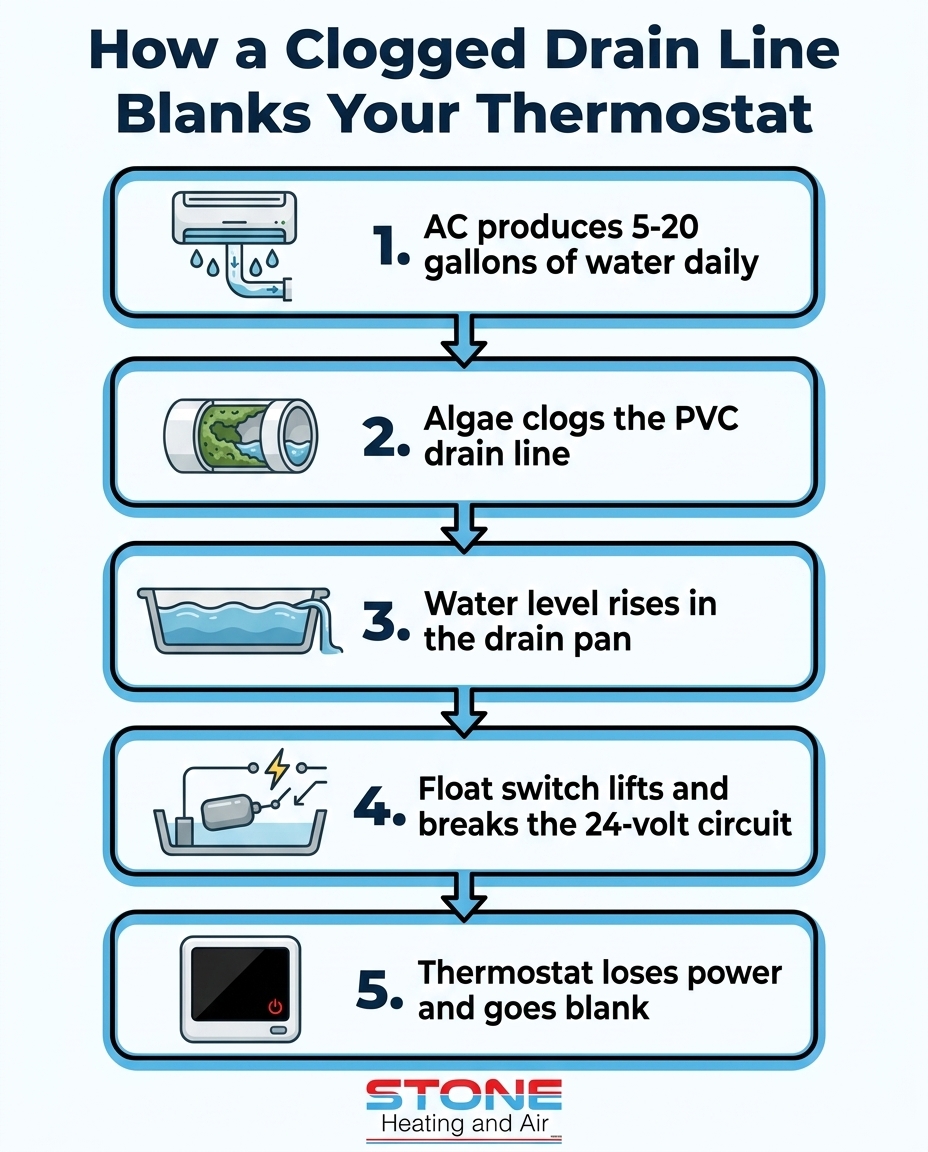
Most homeowners don't realize just how much water this process creates. A standard residential central air conditioner can produce 5 to 20 gallons of condensation per day during continuous operation. Central Point, OR experiences prolonged summer heatwaves exceeding 90 degrees, requiring continuous AC cycles that maximize daily condensation output. In our years serving Central Point, we've noticed that this late-summer stretch is prime time for drainage issues, making clogs highly likely by August.
• The drainage path: All of this water needs a place to go, so it flows out of the drain pan and through a white PVC pipe that leads outside your home.
• The biological buildup: Months of continuous operation allow algae, mold, and dust to build up inside the dark, damp environment of the PVC drain line.
• The late-summer bottleneck: By the time August late-summer cooling demands peak, this biological sludge can culminate in a complete blockage, preventing the water from draining away.
Meet the Float Switch: The Unsung Hero Saving Your Ceilings
When that PVC drain line clogs, the 5 to 20 gallons of water your AC produces daily has nowhere to go. It begins to back up into the drain pan. If left unchecked, this water would quickly overflow, spilling out of the air handler and destroying your ceilings, floors, drywall, and insulation. This is where a tiny, inexpensive device steps in to save the day.
The safety mechanism: The safety float switch is a small sensor located near the indoor evaporator coil's drain pan. It works exactly like the float inside a toilet tank. As water backs up from a clogged line, the water level in the pan rises, lifting the float switch along with it.
The moment of action: When the water reaches a critical level, the float trips. The moment it trips, it acts as a circuit breaker, severing the 24-volt electrical connection to your thermostat. The system immediately shuts down to stop producing condensation, and your thermostat goes blank. While a dead screen is frustrating, this intentional shutdown prevents gallons of water from causing thousands of dollars in structural damage to your home. If you suspect this has happened, professional AC repair in Central Point can resolve the blockage safely.
Visual Diagnosis: Safely Checking for Standing Water
If your screen is dead and you suspect a tripped float switch, there are safe ways to verify the issue without putting yourself at risk or attempting dangerous DIY repairs. Just recently, during a late-summer service call, our technicians at Stone Heating and Air fixed an AC unit and showed the customer exactly what went wrong, helping them understand how to spot the signs of a backed-up system. You can perform a similar visual inspection.
Step 1: Locate the Indoor Air Handler
Your first step is to find your indoor HVAC unit. Depending on your home's layout, the air handler is typically located in a utility closet, up in the attic, or out in the garage. Ensure the area is well-lit before you begin looking around. Do not touch any exposed wiring or attempt to open sealed electrical compartments.
Step 2: Inspect the Drain Pan Area
Without opening the unit, look at the base of the air handler. You should see a white PVC pipe exiting the bottom of the machine. Attached to this pipe, or sitting directly in the drain pan, you will find the float switch assembly (often a small cap with wires coming out of it). Look for a tripped float switch / standing water in pan. If you see water pooling in the secondary pan under the unit, or if the primary pan looks completely full, you have found your culprit.
Step 3: Call for Professional Extraction
A word of caution: Once standing water is confirmed, leave the system off. We strongly caution against using compressed air, high-powered vacuums, or harsh chemical drain cleaners without professional knowledge. Using the wrong amount of pressure can crack the PVC pipe, damage the delicate evaporator coil, or push the sludge clog deeper into the plumbing system. Contact a licensed technician who has the specialized extraction tools required to clear the line safely.
Honest Diagnostics: Why You Probably Don't Need a New Thermostat
When a thermostat goes blank, it is easy to jump to the worst-case scenario. A less thorough diagnostic approach might just look at the dead screen, assume the wall unit has failed, and recommend an expensive thermostat replacement. However, putting a brand-new thermostat on the wall won't fix the problem if the 24-volt power supply is still being blocked by a tripped safety switch.
Stone Heating and Air's commitment to honest, comprehensive diagnostics means we identify the true root cause—like a clogged drain—instead of unnecessarily replacing electrical components. A pattern we see often is that tracing the symptom back to the source reveals a tripped float switch / standing water in pan, and our technicians know exactly how to handle it safely.
The professional fix involves using specialized suction equipment to safely extract the dense algae and sludge from the drain line. Once the PVC pipe is clear and the water drains away, the float switch drops back down into its normal position. The moment the switch resets, the 24-volt circuit reconnects, and your original thermostat will power back on perfectly, with no replacement parts required.
Keeping the Lines Clear for the Rest of the Season
Dealing with a sudden shutdown in the middle of a heatwave is stressful, but it is also highly preventable. Transitioning from reactive repairs to proactive care is the best way to keep your system running smoothly. During a recent service call for a system not working at peak performance, our technicians explained how to ensure proper maintenance for optimal system function, focusing heavily on condensate management.
Routine maintenance directly prevents the sludge buildup that causes these late-summer shutdowns. When you schedule a tune-up, technicians do more than just check the electrical connections. They actively flush the condensate lines and treat them to prevent algae growth during the hottest months of the year. Scheduling routine AC maintenance before the peak heat hits ensures continuous comfort.
A well-maintained system rarely triggers its emergency float switch because the drain lines remain clear and water flows freely. By keeping up with seasonal check-ups, you ensure that your system can handle the heavy moisture removal required during August late-summer cooling without backing up into your home.
Restoring Power and Peace of Mind
The short answer is that a blank screen is actually a sign your home's safety mechanisms are working exactly as intended. While losing your air conditioning on a hot day is uncomfortable, it is vastly preferable to dealing with a flooded ceiling or ruined hardwood floors. Recognizing that the issue is likely a tripped float switch / standing water in pan allows you to take the right steps quickly.
If you have visually confirmed standing water or your screen remains unresponsive, it is time to bring in professional help to safely clear the line and restore your system's power. Do not hesitate to reach out for emergency HVAC service to get your home cooled down safely and efficiently.
Frequently Asked Questions
Why did my thermostat suddenly go blank?
A sudden blank screen usually means the thermostat has lost its 24-volt power supply from the indoor HVAC unit. This is most commonly caused by a tripped safety float switch, which activates when the condensate drain line clogs and water backs up. The system intentionally cuts power to the thermostat to stop the AC from running and prevent water damage to your home.
How do I fix a blank thermostat?
The first step is to check if your thermostat requires batteries and replace them if necessary. If it is hardwired, visually inspect your indoor air handler's drain pan for standing water. If the pan is full, the drain line must be professionally cleared so the float switch can reset and restore power to the screen.
Why is my thermostat blank but the breaker isn't tripped?
Your thermostat operates on a low-voltage (24-volt) circuit separate from your home's main electrical panel. When the AC's internal safety float switch detects standing water, it only breaks the low-voltage circuit to the thermostat, leaving your main circuit breakers completely untripped.
Where is the AC float switch located?
The float switch is typically located right next to the indoor evaporator coil, attached to the primary or secondary condensate drain pan. It often looks like a small PVC cap with two wires coming out of it, sitting near the base of your indoor air handler unit.
Can a clogged AC drain line ruin my thermostat permanently?
No, a clogged drain line will not permanently ruin your thermostat. The float switch simply interrupts the electrical current to turn the system off. Once a professional clears the clog and the water drains, the switch resets and the thermostat will power back on normally.
How much condensation does an AC produce in a single day?
During continuous operation on a hot, humid day, a standard residential central air conditioner can produce between 5 and 20 gallons of condensation. All of this water must flow through the PVC drain line, which is why clogs can cause the drain pan to overflow so rapidly.