


That Late-Summer Musty Breeze: What Is Your AC Trying to Tell You?
Late August is finally here, and as families in Central Point prep for the back-to-school transition, your cooling system has likely been running almost non-stop since the beginning of June. You walk into your living room, the thermostat clicks, the blower fan kicks on, and suddenly, you are hit with a sour, damp odor. If you are asking yourself, "Why does my AC smell musty after running all summer?" our team at Stone Heating and Air hears this question every single year. That unmistakable scent, which often resembles a pile of dirty gym socks, is a common frustration for homeowners as the cooling season drags on.
Here is the thing we always tell our customers: this odor is not a random mechanical breakdown. It is a highly predictable accumulation issue that happens after months of heavy cooling. As your system works overtime to keep your home comfortable, it gathers moisture and organic material. By late summer, that combination can turn the dark, damp interior of your unit into a thriving biological habitat.
When this happens, you face an important decision point. Many homeowners hope that a simple filter change will fix the issue, swapping out the old pleated filter for a fresh one and crossing their fingers. Unfortunately, when the odor is this strong, the root cause is usually buried deeper inside the system. Eliminating the source of the smell typically requires professional air conditioning services to access and clean the internal components safely. Staying proactive with AC maintenance in Central Point is the best way to ensure your system finishes the season strong, keeping your indoor air quality fresh and healthy.
The Biology of 'Dirty Sock Syndrome'
In the HVAC industry, that sour, damp odor has a very specific name: "Dirty Sock Syndrome." While the name sounds a bit comical, the reality of what our technicians see happening inside your ductwork is purely biological. Dirty Sock Syndrome refers to the biological growth of mold, mildew, and bacteria that takes up residence on your indoor evaporator coils and inside your condensate drip pan.
In our experience servicing units across the area, your air conditioning system provides the ultimate habitat for these microorganisms. The interior cabinet is completely dark, and because the system is constantly pulling moisture out of your indoor air, the environment remains incredibly damp. When you combine darkness, constant moisture, and the heat of late summer, you create a perfect incubator for biological contaminants.
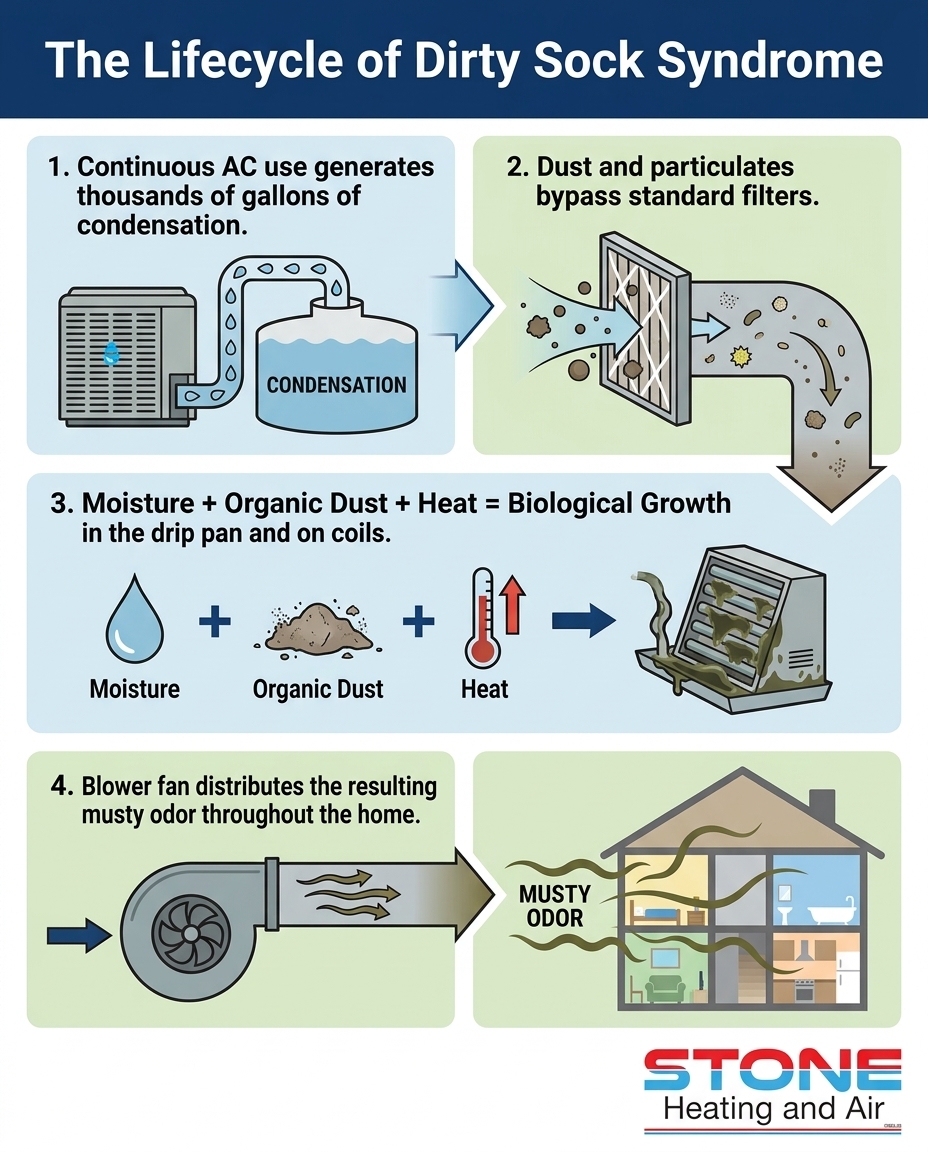
As these microorganisms multiply on the coils, they release volatile organic compounds (VOCs) as a byproduct of their lifecycle. When your blower fan engages to push cold air into your living spaces, it sweeps right over these contaminated coils, picking up those VOCs and distributing the sour odor into every room of your house. The Environmental Protection Agency (EPA) explicitly notes that biological contaminants thrive in standing water and unmaintained drip pans, making routine inspection a critical part of home air quality management.
What Exactly Am I Smelling?
When our technicians get called out for this issue, we explain that you are smelling a complex mixture of stale water, accumulated household dust, and microbial off-gassing. The odor is always most potent right when the system cycles on. During the "off" cycle, the moisture sits stagnant on the coils, allowing the gases to build up inside the confined cabinet. The moment the fan starts spinning again, it blasts that concentrated pocket of stale, musty air directly through your vents.
How Months of Condensation Create the Perfect Breeding Ground
To understand why this odor peaks in late August, you have to look at how your air conditioner actually works. Air conditioners do not just cool the air; they actively remove humidity from it. Warm indoor air holds a lot of moisture. As that warm air blows across the freezing cold evaporator coils, the moisture condenses into liquid water—just like droplets forming on the outside of a cold glass of iced tea on a hot afternoon.
Over a single summer, your cooling system generates thousands of gallons of condensation. With Central Point's hot summers requiring continuous, heavy AC use, our team consistently sees systems pulling massive amounts of moisture from the air. This high volume of condensation drips off the coils and falls down into the condensate drain pan. At the same time, microscopic dust particles, pet dander, and organic matter that manage to bypass your air filter get pulled into the system. These particles stick to the wet coils and wash down into the drip pan.
This creates a very specific formula for trouble we see all the time: Continuous Moisture + Organic Dust + Summer Heat = Biological Growth.
By the time late summer rolls around, that drip pan has been wet for months. If the drain line becomes sluggish or clogged with this organic sludge, the water sits stagnant. Understanding what it means if your AC is leaking water is critical here, as an overflowing or heavily soiled drip pan is often the primary source of that musty, swampy smell taking over your home.
Why a Fresh Air Filter Won't Cure a Sour-Smelling AC
When a strange smell comes from the vents, the first instinct for most homeowners we visit is to check the air filter. Changing your filter is an excellent first step for general maintenance, and a severely clogged filter can certainly cause airflow problems. However, a fresh filter cannot cure Dirty Sock Syndrome.
The Problem: A pattern we see often is a homeowner replacing the dirty filter with a brand-new, high-quality pleated filter, only to find the musty smell continues to blast through the vents every time the system turns on.
The Cause: Air filters are designed to catch dry particulate matter—like dust, lint, and pet hair—before it enters the system. They act as a barrier to protect the internal blower motor and coils. However, a standard filter does nothing to treat the air that has already passed through it, and it certainly cannot eliminate existing mold, mildew, or bacterial growth that has already taken root on the wet evaporator coil.
The Reality: Once biological growth is established deep inside the cabinet, the air filter is powerless to stop the odor. The fan pulls air through the clean filter, but that air still has to pass over the contaminated, slimy coils before it reaches your rooms.
• Air Filter — Primary Function: Traps dry airborne dust and debris before it enters the equipment. — Impact on Musty Odors: Cannot remove odors caused by existing biological growth inside the unit.
• Evaporator Coil — Primary Function: Removes heat and humidity from the indoor air. — Impact on Musty Odors: The primary source of Dirty Sock Syndrome when coated in organic buildup.
• Condensate Pan — Primary Function: Catches and drains liquid condensation away from the system. — Impact on Musty Odors: Causes severe odors if the drain line clogs and water becomes stagnant.
This brings us back to the main decision point: hoping for a quick fix versus addressing the actual root cause. A deeper, professional intervention is necessary to physically remove the biological growth from the metal surfaces.
The Risks of DIY Cleaning on Delicate AC Coils
Realizing that the coils are the source of the smell, some homeowners head to the local hardware store in Central Point, OR, looking for a quick fix. You will find plenty of DIY foaming coil cleaners on the shelves promising to eliminate odors and restore efficiency. However, our technicians have had to rescue far too many systems because taking the DIY route on your evaporator coils carries significant technical risks.
First and foremost, evaporator coils are not solid blocks of metal. They are made up of hundreds of incredibly fragile, paper-thin aluminum fins. These fins are designed to maximize surface area for heat transfer. Because they are so thin, they can be easily crushed, flattened, or bent by the slight pressure of a scrub brush or even a strong spray of water. When these fins get bent, they block the airflow through the coil, causing the system to suffocate, freeze over, and potentially burn out the compressor.
Furthermore, reaching the inner coils often requires dismantling sealed system components. The evaporator coil is usually housed inside a sealed sheet metal plenum above your furnace or air handler. Opening this up without proper training can compromise the airtight seal of your HVAC system, leading to massive efficiency losses.
Finally, there is the chemical risk. Many over-the-counter foaming sprays contain harsh acids or heavy alkaline chemicals. If these are not neutralized and flushed away perfectly, they will sit on the aluminum and slowly eat away at the metal. Over time, we have seen this improper chemical use corrode coils, leading to microscopic holes and expensive, system-killing refrigerant leaks.
How Expert Deep Coil Cleaning Restores Fresh Air
The definitive solution to a sour-smelling air conditioner is a professional deep coil cleaning. This is not a surface-level wipe down; it is a meticulous process designed to safely eradicate biological growth and restore the system to peak operating condition.
The professional process begins with safe access. Trained technicians carefully open the coil cabinet without damaging the surrounding ductwork seals. Once inside, they apply specialized, non-corrosive biocides that are specifically formulated for HVAC equipment. These enzymatic cleaners break down the tough, slimy biological growth without harming the delicate aluminum fins or copper tubing. After the cleaner has done its job, the technicians gently flush the coils and completely clear out the condensate drain line, ensuring that future moisture flows freely out of the house instead of pooling in the pan.
A clean coil does more than just eliminate the late-summer smell. It actually restores the system's energy efficiency. When a coil is coated in a layer of biological slime, that slime acts as an insulator, making it harder for the system to absorb heat. Once cleaned, the AC can cool your home faster and use less electricity for the remainder of the cooling season.
At Stone Heating and Air, our trusted local technicians focus on providing expert, thorough deep coil cleaning rather than relying on temporary spray fixes. We believe in taking the time to do the job right. A pattern we see often during these late-summer service calls is that a surface-level spray just masks the odor for a few days. We apply the exact same level of thorough, diagnostic care to late-summer AC odors as we do to major system breakdowns. We do not just mask the smell; we eliminate the root cause.
To prevent these issues from sneaking up on you, enrolling in a routine HVAC maintenance plan ensures your coils are inspected and cleaned by professionals before odors ever have a chance to develop.
Long-Term Solutions to Keep Your AC Smelling Clean
Once our team has professionally cleaned your system and the air in your Central Point, OR home is smelling fresh again, you want to keep it that way. Preventing Dirty Sock Syndrome requires a proactive approach to managing dust and moisture before they can combine inside your unit.
Here is a checklist of long-term solutions we recommend to protect your indoor air quality:
• Manage indoor humidity levels: Keep your home's humidity between 30% and 50%. If your home feels excessively muggy, run exhaust fans while cooking or showering to reduce the moisture load on your AC.
• Keep up with regular filter changes: Check your air filter every 30 days. A clean filter minimizes the amount of organic dust, pet dander, and skin cells that manage to reach the wet evaporator coils, cutting off the "food source" for biological growth.
• Install UV germicidal lights: One of the most effective advanced prevention methods we install is integrating home air purification solutions directly into your ductwork. UV germicidal lights can be mounted inside the coil cabinet, shining continuously on the evaporator coil to neutralize mold spores and bacteria before they can multiply.
• Schedule preventative spring maintenance: Do not wait for late August to think about your AC. Having a professional inspect, clean, and tune up the system in the spring ensures you start the heavy summer usage period with a spotless, fully draining system.
Frequently Asked Questions About Musty AC Odors
Why does my AC smell like mildew?
In our experience, an AC smells like mildew due to biological growth on the indoor evaporator coil and inside the condensate drip pan. As your air conditioner removes humidity from the home, that moisture mixes with household dust that slips past the filter. Over months of summer use, this creates a dark, wet breeding ground for mold and mildew, which release a strong odor every time the blower fan turns on.
How do I get the musty smell out of my air conditioner?
The most effective way to remove a musty smell is through a professional deep coil cleaning. A technician will safely open the sealed cabinet, apply specialized antimicrobial cleaners that will not damage the delicate aluminum fins, and thoroughly flush the condensate drain line. Installing UV germicidal lights over the coil can also prevent the biological growth from returning in the future.
Is a musty smelling AC dangerous?
While often just a nuisance, a musty AC can aggravate allergies and asthma by circulating mold spores and bacteria throughout your living spaces. The volatile organic compounds (VOCs) released by this biological growth lower your indoor air quality and can cause respiratory irritation. We highly recommend prompt professional cleaning to protect your home's air quality and your family's comfort.
Can a dirty filter cause my AC to smell?
Yes, a heavily soiled filter can contribute to odors, but we rarely find it to be the sole cause of a strong musty smell. A dirty filter allows excess dirt and organic dust to bypass the barrier and reach the wet evaporator coils, which accelerates the biological growth causing the odor. Changing the filter is important, but it will not remove the mold already growing inside the unit.
How do professionals fix dirty sock syndrome?
As local HVAC professionals, we fix dirty sock syndrome by safely accessing the evaporator coil, applying specialized antimicrobial cleaners, and flushing the entire condensate system. We carefully remove the biological slime without bending the fragile cooling fins or using corrosive chemicals. We also check the pitch of the drain pan to ensure proper drainage, preventing future standing water from accumulating.
Breathe Easier with Professional Late-Summer AC Care
Dealing with a sour, musty smell in late August is a clear sign that your air conditioning system has been working incredibly hard all summer and is in desperate need of a deep clean. While it can be alarming to have your home smell like dirty gym socks, Dirty Sock Syndrome is a very common and entirely solvable issue when handled by trained professionals. Do not settle for masking the odor or hoping a new air filter will magically fix the problem. Schedule a thorough inspection and professional coil cleaning today to eliminate the biological growth at its source, restoring fresh, healthy, and efficient cooling to your home for the rest of the season.