

Navigating Drastic Temperature Swings Without Damaging Your Equipment
September early fall transitions in Southern Oregon are just around the corner, bringing a very specific weather pattern to the region. You might be asking yourself: Can I Use My AC and Furnace on the Same Day During Fall? When you wake up to a chilly 45-degree morning, turning on the heat feels like a necessity. But by 3:00 PM, the sun is beating down, the house is sweltering, and you are reaching for the cooling controls. At Stone Heating and Air, our team knows that dealing with 30-to-40-degree daily temperature swings is a common reality in Central Point, and it puts many homeowners in a tough spot regarding their indoor comfort.
If you have ever stared at your thermostat, wondering if flipping back and forth between heating and cooling in a 24-hour period will cause permanent damage to your equipment, you are not alone. The fear of breaking an expensive system is a valid concern. The central decision point usually comes down to this: should you manually toggle the system back and forth as the day warms up, or should you rely on a properly configured auto-changeover feature?
To learn more about keeping your equipment running efficiently, you can explore our comprehensive services for heating systems.
The Dilemma of the Shoulder Season
During the peak of winter or the dead of summer, your thermostat strategy is simple. You set it to heat or cool, and you forget about it for months. However, the shoulder seasons—spring and fall—require a different approach. The mornings demand warmth to take the edge off the cold floors, while the afternoons require active cooling to keep the indoor humidity and temperature manageable.
In our years of servicing HVAC systems across Southern Oregon, we often see homeowners try to manage this by turning the system completely off in the middle of the day, opening windows, and then manually turning the air conditioner on later. While this hands-on approach works, it is incredibly inefficient and often leads to uncomfortable temperature spikes inside the home. Establishing a reliable, automated strategy is the best way to maintain comfort without babysitting your thermostat all day.
The Short Answer: Is It Safe to Run Both Systems on the Same Day?
Yes, it is perfectly safe to use both your air conditioner and your furnace on the same day. Modern HVAC equipment is specifically designed to handle these exact environmental transitions, provided the systems are not forced to fight each other. The key to safety depends entirely on having a built-in time delay or a properly set auto-changeover function on your thermostat.
The danger does not lie in the act of heating and cooling in the same 24-hour window. The danger lies in immediate, manual switching without allowing the system to rest and equalize. When modern thermostats are configured correctly, they act as the brain of your home, safely orchestrating the transition between your furnace and your air conditioner without putting undue stress on the mechanical components.
Understanding Automated Safety Mechanisms
Your HVAC system operates using pressurized refrigerant, electrical contactors, and heavy-duty blower motors. When you switch modes, these components need a moment to reset. Safe, automated transitions guarantee that:
• Pressures equalize: The refrigerant lines have time to balance out before reversing the heat transfer process.
• Electrical loads drop: The heavy draw of the compressor stops completely before the furnace ignites.
• Airflow clears: The blower motor clears the residual hot or cold air from the ductwork before introducing the opposite temperature.
As long as these automated delays are respected, running both systems on a Tuesday in late September is exactly what your equipment was built to do.
What is a Thermostat Deadband and Why Does It Matter?
To truly understand how your system safely manages dual operation, you need to understand a concept called the thermostat deadband. This is the mechanical reality that protects your home's climate control systems from destroying each other.
The Problem: Systems Fighting for Control
If you set your desired heating temperature to 70°F and your desired cooling temperature to 70°F, your system will become confused. The furnace will heat the house to 70°F, but the moment it overshoots to 71°F, the air conditioner will immediately kick on to cool it back down. Once the AC drops the temperature to 69°F, the furnace fires back up. This creates an endless, destructive loop of rapid switching.
The Cause: A Missing Temperature Buffer
This rapid switching occurs when there is no mandatory temperature gap between the heating setpoint and the cooling setpoint. The industry standard requires a gap to prevent the furnace and AC from running simultaneously. Without this gap, the system experiences short-cycling—turning on and off rapidly as the room temperature fluctuates slightly. Short-cycling is one of the fastest ways to burn out a blower motor or ruin a compressor.
The Solution: A 5-Degree Deadband Configuration
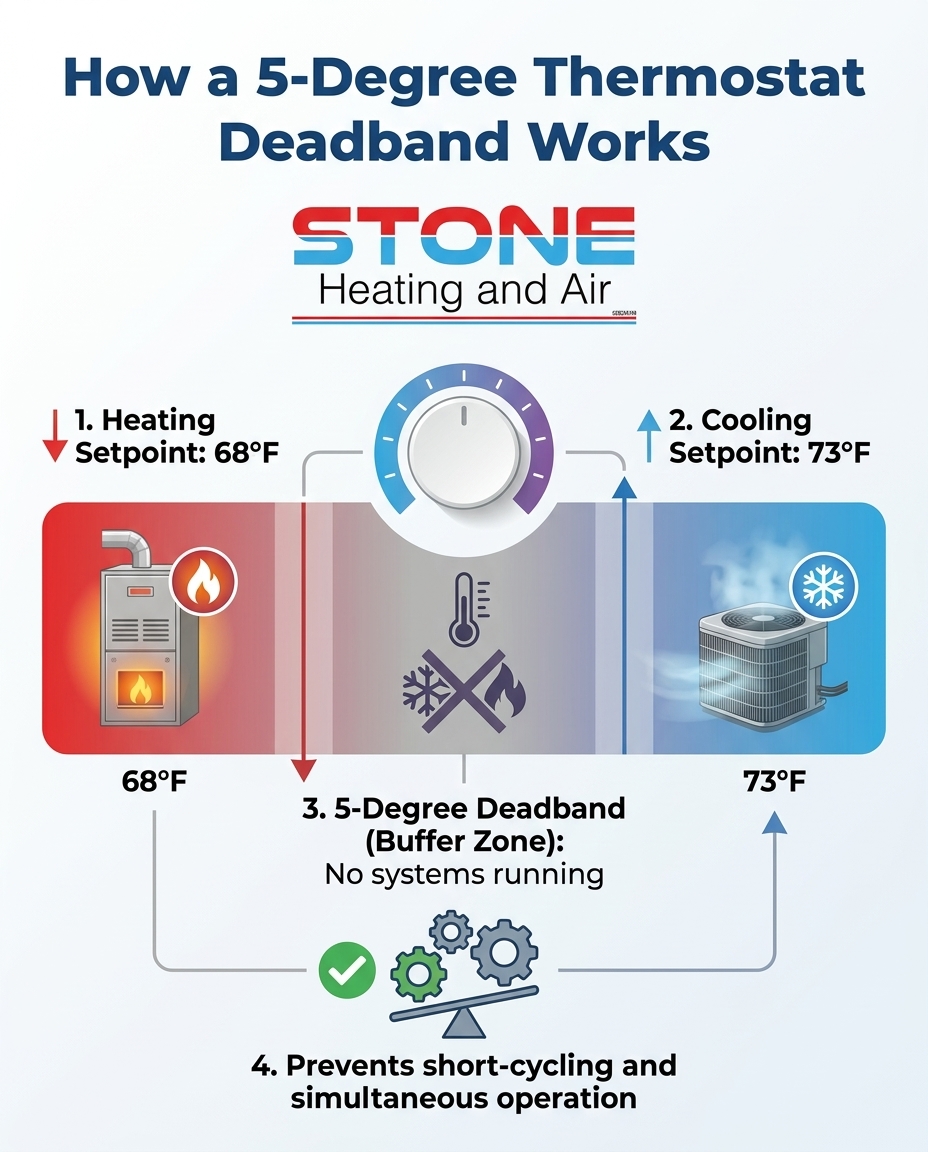
A deadband is a programmed buffer zone where neither heating nor cooling is active. At Stone Heating and Air, we generally recommend a 5-degree deadband configuration as the standard for our customers' homes. If you want your house comfortable, you might set your heating to kick on at 68°F and your cooling to kick on at 73°F. The 5 degrees in between (69°F to 72°F) is the deadband.
When the indoor temperature floats within this 5-degree window, the system simply rests. This automated buffer stops short-cycling entirely. It provides significant energy savings and robust equipment protection, allowing you to rely on the technology rather than making constant manual adjustments.
• No Deadband (Matching Setpoints) — How It Operates: Furnace and AC constantly trigger each other, running back-to-back. — Impact on Equipment Life: Severe wear and tear, high risk of premature compressor failure.
• Narrow Deadband (1-2 Degrees) — How It Operates: System switches frequently as normal sunlight warms the room slightly. — Impact on Equipment Life: Moderate strain, leading to higher energy bills and frequent cycling.
• Proper Deadband (5+ Degrees) — How It Operates: System rests comfortably in the buffer zone during mild afternoon hours. — Impact on Equipment Life: Maximum protection, lower energy costs, and smooth daily transitions.
The Mechanical Risks of Immediate Manual Toggling
While automated delays are safe, manually forcing your system from cool to heat without a delay poses serious mechanical risks. Every fall, our technicians respond to service calls where a homeowner, in a rush to warm up a cold house, walked over to the thermostat, flipped it aggressively from "Cool" to "Off," and immediately over to "Heat." This is a dangerous practice for your air conditioning and heating components.
Compressor Lock-Up and Refrigerant Pressures
When your air conditioner is running, the compressor is actively pumping refrigerant through the lines at very high pressures. If you shut the system off and immediately try to turn it back on (or switch modes rapidly), that highly pressurized refrigerant has not had time to equalize. The compressor tries to start against a wall of high pressure. This often results in a compressor lock-up. The motor strains, overheats, and refuses to turn.
Electrical Strain and Blown Fuses
When a compressor tries to start against unequalized pressure, it draws a massive amount of electricity—a phenomenon known as locked rotor amps. This sudden spike in electrical current is often enough to blow fuses in your disconnect box or trip the main breaker on your electrical panel. It puts an enormous amount of stress on the system's electrical contactors and capacitors.
The 5-Minute Rule
To avoid these electrical and mechanical disasters, a mandatory 5-minute wait time is required anytime a system is turned off before it is turned back on. This brief window allows the high and low-pressure sides of the refrigerant cycle to equalize. Modern digital thermostats enforce this 5-minute delay automatically, flashing a "wait" or "delay" message on the screen. Contrasting the severe stress of immediate manual toggling with the smooth, protected operation of automated delays highlights exactly why you should let the thermostat do the work.
How Modern Auto-Changeover Features Work
Educating yourself on proper thermostat use is the best way to handle the fall transition. Older, manual thermostats featured a simple physical switch labeled "Heat - Off - Cool." You had to make the choice. Today, the technology is much smarter.
Recently, our team at Stone Heating and Air helped a local homeowner who needed a new heating and cooling setup during a period of severe supply chain problems. By working closely with them to secure the right equipment and providing frequent updates, we were able to install a responsive new system. The most impressive part of their new setup was the modern thermostat, which handled the wild spring and fall temperature swings flawlessly without any manual input.
Here is exactly how the "Auto" function on modern smart thermostats manages your home's climate:
1. Continuous Temperature Monitoring: The thermostat constantly reads the ambient indoor temperature, comparing it against both your heating and cooling setpoints.
2. Entering the Buffer Zone: As the morning sun warms the house, the indoor temperature naturally rises above the heating setpoint (e.g., 68°F) and enters the deadband. The thermostat shuts the furnace down.
3. Crossing the Threshold: By mid-afternoon, the house temperature climbs past the cooling setpoint (e.g., 73°F). The thermostat registers this change.
4. Enforcing the Delay: Before activating the AC, the thermostat verifies that the furnace has been off for at least 5 minutes, ensuring all pressures are equalized.
5. Activating the Secondary System: The thermostat seamlessly decides to activate the cooling unit, bringing the house back down to a comfortable level.
If you need guidance on configuring these steps, reading up on transitioning your thermostat settings for fall will give you a head start. The auto-changeover feature is specifically designed for shoulder seasons with rapid temperature shifts. Trusting the technology to manage these transitions safely is far better than constantly adjusting the dial yourself.
Signs Your Systems Might Be Fighting
Even with smart technology, incorrect settings can cause your heating and cooling units to work against each other. If your deadband is too narrow, or if a sensor is malfunctioning, your equipment will waste a tremendous amount of energy. Helping homeowners identify if their HVAC system is improperly configured is an important part of our fall preparation services.
If you notice any of the following symptoms, your systems might be fighting:
• Frequent short-cycling: The system turns on, runs for only two or three minutes, and then shuts right back off, repeating this cycle endlessly. This is a classic sign of a missing deadband.
• Unexpectedly high energy bills: If your utility costs spike during mild early fall weather, it often indicates that the furnace and AC are competing against each other, consuming double the energy.
• Constant fan operation: If the blower motor never seems to stop running, the thermostat might be rapidly switching modes before the fan has a chance to complete its cool-down cycle.
• Uneven indoor temperatures: One room feels like a sauna while another feels like an icebox, usually because the system isn't running long enough in either mode to properly circulate the air.
The quick fix: Check your thermostat settings and verify that there is at least a 5-degree gap between heat and cool. If the settings look correct but the system is still short-cycling, it is time to have a professional evaluate the overall health and configuration of the setup.
Preparing Your Equipment for Daily Dual Operation
Connecting the safe operation of dual systems to the necessity of routine seasonal maintenance is vital. While auto-changeover is inherently safe, it requires both the heating and cooling components to be in top condition. Switching modes every single day puts a specific type of wear on your equipment that running a single mode does not.
For example, a Central Point homeowner recently reached out to our Stone Heating and Air team for a comprehensive fall tune-up to ensure their equipment was running at peak performance. Our technician provided thorough service, explained exactly how to maintain the filters and settings, and left the system operating flawlessly. This kind of proactive care is what keeps dual-operation smooth.
The Role of Routine Maintenance
Routine maintenance ensures that the temperature sensors in your thermostat are accurate and that the automated safety delays function correctly. If a sensor is covered in dust, it might misread the room temperature, triggering the wrong system at the wrong time.
Furthermore, dirty air filters or failing electrical contactors can severely exacerbate the stress of daily temperature shifts. A restricted filter forces the blower motor to work harder, and switching from heat to cool with a strained motor increases the risk of overheating.
Working with a dedicated local team like ours provides professional insight on smart thermostat configuration, which actively prevents premature wear and high energy bills. A professional tune-up ensures that the ignition sequence on the furnace is clean and that the AC compressor is healthy enough to handle afternoon heat spikes before extreme winter weather arrives.
Keep Your Home Comfortable and Your Equipment Safe This Fall
As the Central Point weather shifts, you do not have to sacrifice comfort for fear of breaking your equipment. A definitive "yes" applies to running both your heating and cooling systems on the same day, provided you let modern thermostats handle the transitions automatically.
Remember that a 5-degree buffer is necessary to protect the equipment from short-cycling and mechanical strain. By relying on auto-changeover features and keeping up with seasonal maintenance, you can enjoy a warm morning and a cool afternoon without a second thought. If you need help configuring your thermostat or want to make sure your system is prepped for the season, reaching out to Stone Heating and Air for a professional tune-up is always a smart move. Can I Use My AC and Furnace on the Same Day During Fall? Absolutely—just let the system do the heavy lifting.
Frequently Asked Questions
Is it safe to switch from AC to heat in the same day?
Yes, it is entirely safe to switch between cooling and heating on the same day. Modern HVAC systems are built to handle these transitions, especially during the spring and fall shoulder seasons. The most important factor is ensuring there is a proper time delay between shutting one system off and turning the other on to allow refrigerant pressures to equalize.
What is a thermostat deadband?
A thermostat deadband is a programmed temperature gap between your heating setpoint and your cooling setpoint. For example, setting your heat to 68°F and your AC to 73°F creates a 5-degree deadband. This buffer zone prevents the furnace and air conditioner from fighting each other and stops the system from turning on and off rapidly.
How long should I wait between turning off the AC and turning on the heat?
You should always wait at least 5 minutes before switching from air conditioning to heating, or vice versa. This brief waiting period allows the highly pressurized refrigerant in the AC compressor to settle and equalise. Modern digital thermostats usually enforce this 5-minute delay automatically to protect your equipment from electrical spikes.
Is it bad to switch from AC to heat on the same day?
It is not bad for the system as long as you do not manually force the switch without a delay. Using an auto-changeover feature on a smart thermostat is the best way to handle this safely. Rapid, manual switching without waiting can cause compressor lock-up or blow a fuse due to sudden electrical strain.
Can you run AC and heat at the same time?
No, a standard residential HVAC system cannot run the air conditioner and the furnace at the exact same time. They share the same ductwork and blower motor, so operating them simultaneously would cause them to fight each other, wasting massive amounts of energy and potentially damaging the internal components.
Why does my system keep turning on and off rapidly during early fall?
Rapid turning on and off, known as short-cycling, usually happens because the thermostat setpoints for heating and cooling are too close together. If there is no deadband buffer, the system gets confused by minor temperature fluctuations. Adjusting your settings to include a 5-degree gap usually solves this problem.