

Is Your Furnace Refusing to Stay Lit This September?
Are you standing in front of your heating system right now wondering, what should I do if my pilot light won't stay lit? You press the gas valve button, hold a flame to the pilot assembly, and wait patiently for the burner to catch. But the second you release your thumb, that tiny blue flame vanishes, leaving you in the cold. During the September early fall transition, this is one of the most frustrating experiences a homeowner can face. After months of sitting dormant over the summer, older furnaces often struggle to fire up on the first try.
If you need professional help right away, explore our heating services or request emergency heating repair.
With the abrupt shift to brisk autumns in Southern Oregon, a minor furnace quirk quickly transforms into an urgent comfort issue. As evening temperatures drop, the temptation is to just keep clicking the igniter or holding a lighter to the assembly until it forces the system to run. However, repeatedly tampering with a gas appliance is never a safe long-term solution. A failing pilot light is usually a symptom of a triggered safety mechanism, not just a stubborn burner. Before you attempt another relight, it is critical to understand the mechanical components at play, specifically the thermocouple, to ensure you are not inadvertently creating a dangerous situation in your home.
The Brain Behind the Flame: Understanding Your Thermocouple
To understand why your pilot flame keeps dying, you first need to understand the mechanical "why" behind the system's design. Older furnaces rely on a standing pilot light, which means a small flame burns continuously to ignite the main burners when the thermostat calls for heat. But raw gas cannot simply flow unchecked into your home. That is where the thermocouple comes in.
What Exactly Is a Thermocouple?
The thermocouple is a simple, highly effective thermoelectric safety sensor found in many traditional gas heating systems. It sits directly in the path of the pilot flame. This device operates entirely independently of your home's main electrical grid, which is why older furnaces could sometimes still be lit during a power outage. Its entire purpose is to monitor the presence of a flame and fail safely—meaning if something goes wrong, its default action is to shut off the gas supply completely.
The Thermoelectric Safety Cycle
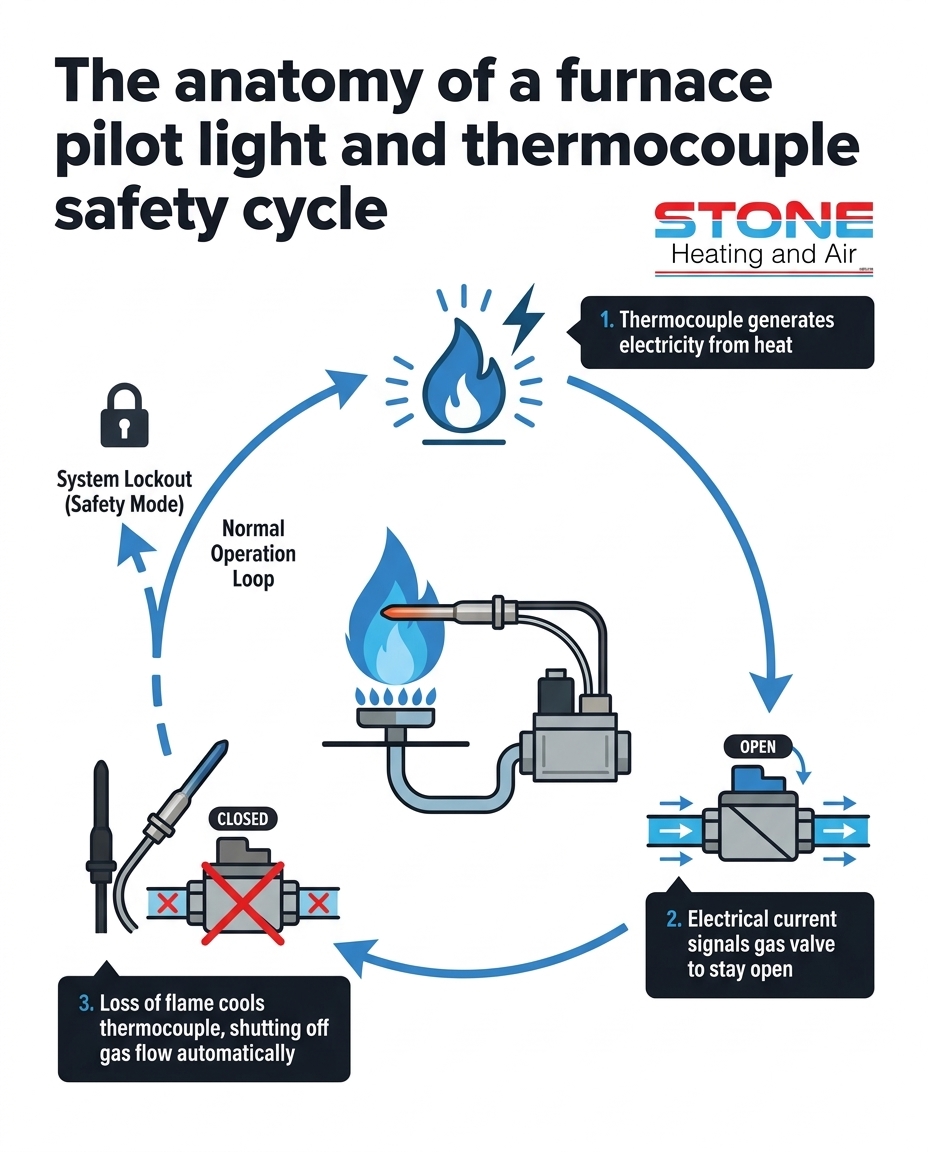
The science behind the thermocouple is fascinating and critical to your family's safety. The device is constructed from two dissimilar metal wires joined at one end. Here is exactly how the cycle operates to protect your Central Point, OR home:
• Heat creates voltage: When the pilot flame engulfs the tip of the thermocouple, the heat causes a reaction between the two different metals, generating a tiny electrical current (measured in millivolts).
• Voltage holds the valve open: This small electrical current travels down the copper tubing to an electromagnet inside the main gas valve. As long as the current flows, the magnet stays energized, holding the gas valve open so fuel can reach the pilot assembly.
• Loss of heat snaps the valve shut: If a draft blows the flame out, or if the pilot tube gets clogged, the thermocouple cools down rapidly. The electrical current stops flowing, the electromagnet loses its charge, and a heavy spring slams the gas valve shut.
This rapid shutdown prevents raw, unburned gas from leaking into your utility room. If you are wondering why your furnace turns off after a few seconds of releasing the pilot button, it is almost always because the thermocouple is not generating enough voltage to keep that magnetic valve open.
• Strong Blue Flame — Thermocouple Status: Heated (generating millivolts) — Gas Valve Action: Electromagnet energized (open) — Result: Pilot stays lit, furnace runs normally
• Weak Yellow Flame — Thermocouple Status: Partially heated (low voltage) — Gas Valve Action: Electromagnet fails to hold — Result: Pilot dies upon releasing button
• No Flame — Thermocouple Status: Cold (zero voltage) — Gas Valve Action: Spring snaps shut — Result: Gas flow stops completely
How Many Times Is It Safe to Try Relighting a Pilot Light?
When the house is freezing during a September early fall cold snap, the psychological temptation to keep clicking the igniter is incredibly strong. You might think, "If I just hold the button a little longer this time, it will finally catch." However, forcing a gas appliance to operate when its safety sensors are failing is highly dangerous.
The Risk of Invisible Gas Buildup
The National Fire Protection Association (NFPA) strictly warns against repeated attempts to ignite gas appliances that fail to catch. Every time you press that pilot button, you are manually overriding the safety valve and releasing raw gas into the combustion chamber. If the flame does not catch, or if it immediately dies, that uncombusted gas can pool in the bottom of the furnace cabinet or spill out into your utility room. Repeatedly sparking a lighter or clicking an electronic igniter in a gas-rich environment can lead to a sudden, hazardous flashover.
The critical safety step: Always wait at least five full minutes between relighting attempts. This pause allows any pooled, unburned gas to safely dissipate and ventilate out of the area before you introduce another spark.
The "Three Tries" Rule for Homeowners
To protect your home and your family, establish a strict "three tries" rule. If the pilot will not hold after three proper attempts, you must stop trying.
1. Attempt One: Follow the manufacturer's exact instructions printed on the furnace door. Turn the dial to "Pilot," press and hold the button, and light the flame. Hold the button for the recommended time (usually 30 to 60 seconds) to allow the thermocouple to heat up.
2. Attempt Two: If the flame dies upon release, wait five full minutes for gas to clear. Try again, ensuring you are holding the button down firmly and for slightly longer (up to a full minute) to ensure maximum heat transfer to the sensor.
3. Attempt Three: Wait another five minutes. Make one final, careful attempt. If the flame goes out again the moment you release the dial, the absolute limit has been reached. Do not try a fourth time. The system requires professional diagnostics.
Beyond the Thermocouple: Other Reasons Your Pilot Light Won't Stay Lit
While a worn-out thermocouple is the most common culprit behind a dying flame, it is not the only potential failure point within your broader HVAC system. Several other mechanical and environmental factors can disrupt the delicate balance required for a standing pilot light to function properly.
Dirty Pilot Tubes and Weak Flames
Over the long summer months, dust, pet dander, and even small spiders can find their way into the tiny orifice of the pilot tube. When this opening gets clogged with soot or debris, the flow of gas is restricted. The result is a weak, lazy flame that fails to properly engulf the thermocouple.
The visual test: A healthy pilot flame should be strong, steady, and bright blue, with perhaps a tiny tip of yellow. It must physically wrap around the top third of the thermocouple probe. If the flame is entirely yellow or orange, it indicates incomplete combustion, usually caused by a dirty pilot tube. This weak yellow flame simply does not burn hot enough to generate the required millivolts, causing the safety valve to shut off the gas.
Drafts and Airflow Issues
Sometimes, the pilot light assembly is working perfectly, but environmental factors are physically blowing the flame out. Drafts and airflow issues are common in older homes and aging equipment.
• Improperly sealed utility rooms: A drafty basement or a poorly sealed attic can allow sudden gusts of wind to travel down the flue pipe or across the burner assembly, snuffing out the small flame.
• Cracked heat exchangers: This is a severe safety hazard. If the heat exchanger has a crack, the blower fan can force air into the combustion chamber, altering internal drafts and blowing out the pilot.
• Venting interference: Blocked or damaged exhaust flues can cause backdrafts, pushing exhaust air back down into the furnace and suffocating the pilot flame of necessary oxygen.
Dealing with aging equipment often reveals multiple layered issues. One Central Point homeowner recently reached out about trouble with a very old heating and cooling system that simply refused to run reliably. Our team assessed the situation thoroughly, provided clear options for replacement rather than endless patch repairs, and ultimately installed two new furnaces and AC units to permanently resolve the safety and comfort issues.
The Exact Threshold for Calling 24 Hour Furnace Repair
Knowing when to stop tinkering and call for help is the most important part of troubleshooting a gas appliance. Homeowners should never attempt to replace a gas valve or a thermocouple themselves. These components require proper calibration, leak testing, and adherence to strict safety regulations that only a licensed professional can ensure.
Recognizing the Warning Signs
If you experience any of the following during a September early fall start-up, stop immediately, turn the gas valve to the "Off" position, and call for professional 24/7 furnace repair:
• The smell of rotten eggs: Natural gas is odorless, but utility companies add a chemical called mercaptan to give it a distinct rotten egg smell. If you smell this, you have an active gas leak. Evacuate the area and call for help.
• Hissing sounds: A faint hissing sound near the gas line or the valve assembly indicates gas is escaping under pressure without combusting.
• Soot buildup: Heavy black soot around the burner compartment is a clear sign of incomplete combustion and potential carbon monoxide risks.
• Physical damage: If the copper line leading from the thermocouple looks kinked, frayed, or heavily corroded, it cannot safely transmit the electrical signal.
The Value of Professional Diagnostics
Because heating emergencies rarely happen during convenient business hours, 24/7 emergency service availability means you never have to choose between freezing overnight and attempting a dangerous DIY repair. During a previous winter cold snap, a local customer found their heater was not working at all during a period of severe weather. Our team arrived promptly, safely diagnosed the underlying mechanical failure, offered clear choices for system replacement, and reinstalled the heating system so their comfort was restored quickly and efficiently.
Licensed technicians carry specialized multimeters designed to test the exact millivolt output of a thermocouple while it is under load. We can determine instantly whether the sensor has failed, if the gas pressure needs adjustment, or if the internal electromagnet inside the main gas valve has completely seized. Proper calibration ensures your entire assembly is legally and safely compliant.
Preventing Pilot Light Failures Before the Freezing Winter Nights Arrive
The best way to handle a failing pilot light is to prevent it from happening in the first place. The abrupt transition from brisk Central Point, OR autumns to freezing winter nights leaves very little room for error. If your heating system is forced to jump from completely dormant to running constantly, any minor weakness in the ignition assembly will immediately reveal itself.
Early-season checkups are critical for older furnaces. Scheduling routine heating maintenance before the deep freeze sets in acts as a bridge to reliable winter comfort. During a professional tune-up, a licensed technician performs several vital safety checks:
• Cleaning the sensors: We carefully remove soot and oxidation from the thermocouple probe to ensure maximum heat transfer and voltage generation.
• Clearing the pilot tube: We clear out any dust or debris from the pilot orifice to guarantee a strong, hot, blue flame.
• Testing the gas valve: We verify that the internal electromagnet is responding correctly to the millivolt signal and that the spring snaps shut decisively when the flame is removed.
• Checking safety switches: We test all limit switches and rollout sensors to ensure the furnace will shut down safely if airflow is ever restricted.
By addressing these components proactively, you avoid the stress of waking up to a freezing house and a furnace that refuses to cooperate.
Frequently Asked Questions About Furnace Pilot Lights
Why does my pilot light go out immediately after I release the button?
The short answer is a failing thermocouple. When you release the pilot button, the system relies on a small electrical current generated by the thermocouple to hold the gas valve open. If the thermocouple is dirty, out of alignment, or completely burned out, it cannot generate enough voltage. Without that electrical signal, the safety mechanism triggers, and the gas valve instantly snaps shut, killing the flame.
How do I know if my furnace thermocouple is bad?
You can usually tell a thermocouple is bad if the pilot flame is strong and blue, but the burner still won't stay lit. If the flame is properly engulfing the top third of the metal probe, but the gas valve shuts off the moment you release the primer button, the sensor is likely failing to send the required millivolt signal. A licensed technician can confirm this by testing the electrical output with a specialized multimeter.
Is it dangerous if the pilot light goes out on a furnace?
Generally, it is not immediately dangerous because of built-in safety features. Modern and traditional furnaces are designed with a fail-safe mechanism (the thermocouple) that automatically shuts off the flow of gas if it detects that the flame has gone out. However, it becomes dangerous if you repeatedly try to force the system to light, or if you attempt to bypass the safety valve, which can lead to hazardous gas buildup.
How many times is it safe to try relighting a pilot light?
You should adhere to a strict "three tries" rule. Attempt to light the pilot following the manufacturer's instructions, waiting five full minutes between each attempt to allow any unburned gas to safely dissipate. If the pilot light still refuses to stay lit after the third proper attempt, stop immediately. Continuing to spark the igniter risks a dangerous flashover, and it is time to call a professional.
Can a dirty pilot tube cause the flame to go out?
Yes, a dirty pilot tube is a very common cause of flame failure. Dust, soot, and debris can clog the tiny opening where the gas escapes, resulting in a weak, yellow, or lazy flame. Because this weak flame does not burn hot enough to properly heat the thermocouple, the safety sensor assumes the flame has died and shuts off the gas supply as a precaution.
Do modern furnaces still have standing pilot lights?
Most modern furnaces no longer use standing pilot lights. Today's high-efficiency heating systems utilize electronic ignition systems, such as hot surface igniters or intermittent pilot lights that only spark when the thermostat calls for heat. This modern design saves energy by not burning fuel continuously and relies on advanced flame rectification sensors rather than traditional thermocouples.
Get Safe, Professional Help for Your Furnace Today
When dealing with gas appliances, safety must always come first. A pilot light that refuses to stay lit during the September early fall transition is not just a nuisance; it is a clear mechanical signal that your system's safety sensors are doing their job by shutting down a compromised unit. Instead of risking your home's safety by repeatedly clicking the igniter or tampering with the gas valve, trust the experts. Contact a local, licensed professional to properly diagnose the thermocouple, restore your heat safely, and ensure your home is ready for the long winter ahead.