

Why Boiler Maintenance in Talent, OR Matters for Your Home
Boiler maintenance in talent, or is essential for keeping your home safe, warm, and energy-efficient throughout the heating season. When temperatures drop in Southern Oregon, the last thing you want is a heating system that fails when you need it most. Regular boiler maintenance prevents dangerous carbon monoxide leaks, reduces energy bills, extends your equipment's lifespan, and catches small problems before they become expensive emergencies. Whether you have a steam or hot water boiler system, professional annual inspections combined with simple homeowner checks keep your system running reliably all winter long.
Quick Answer: Essential Boiler Maintenance Tasks
• Annual professional inspection - Schedule before the heating season (typically fall)
• Check boiler pressure - Should be between 1-1.5 bars for most systems
• Bleed radiators - Remove trapped air for even heating
• Inspect for leaks - Check around the boiler and all visible pipes
• Monitor pilot light - Should burn bright blue (for older gas boilers)
• Listen for unusual noises - Banging, whistling, or gurgling signals trouble
• Test safety controls - Carbon monoxide detectors and pressure relief valves
For comprehensive heating services in Talent, OR, or to schedule a boiler maintenance appointment, our experienced technicians are ready to help.
Most homeowners in Talent face a common dilemma: wait until something breaks, or invest in preventative care? The evidence is clear. Annual boiler maintenance reduces the risk of mid-winter breakdowns, keeps your family safe from combustion hazards, and typically pays for itself through lower energy bills and avoided emergency repairs. A well-maintained boiler can last 15-20 years, while a neglected one might fail in half that time.
The shift from reactive repairs to proactive maintenance isn't just smart—it's essential for the safety and comfort of your home. Regular inspections catch issues like cracked heat exchangers, faulty pressure relief valves, and improper combustion before they lead to dangerous situations or costly system failures.
Why Regular Boiler Maintenance is Non-Negotiable
We understand that maintaining your home's heating system might not always be top of mind, especially when it seems to be working perfectly. However, regular boiler maintenance in Talent, OR, is truly non-negotiable for several compelling reasons, impacting your safety, your wallet, and the overall comfort of your home.
Firstly, let's talk about safety. Boilers, particularly gas-fired units, involve combustion, which means there's a risk of carbon monoxide (CO) leaks. Carbon monoxide is an odorless, colorless gas that can be deadly. Annual heating inspections are crucial because they ensure your system is properly vented and free from cracks in the heat exchanger that could allow CO to escape into your living space. These inspections start with meticulous safety checks for gas leaks and proper venting, protecting you and your family from combustible equipment and deadly exhaust. As we've seen from the Energy Trust of Oregon, three tips for maintaining your furnace, these critical safety checks are paramount for any combustion heating system.
Secondly, efficiency improvements are a direct result of consistent maintenance. Just like a car needs regular tune-ups, your boiler benefits from annual servicing to run at its peak. Over time, dirt, soot, and wear can accumulate, forcing your boiler to work harder to produce the same amount of heat. This not only stresses the equipment but also leads to increased energy consumption. A clean, well-adjusted boiler uses less fuel, directly translating to lower energy bills for your home in Talent, OR. Annual boiler maintenance can indeed save you money on energy bills, making it a wise investment.
Thirdly, longevity of equipment is significantly extended with preventative care. Think of it as an "annual physical" for your boiler. By catching minor issues early, you prevent them from escalating into major, costly breakdowns. This proactive approach ensures your boiler can comfortably reach and often exceed its expected lifespan, delaying the need for expensive replacements. Preventative maintenance programs are designed to save you money in the long run, not just on energy but on repair costs and premature system replacement.
Finally, regular maintenance helps ensure compliance with safety standards. Adhering to manufacturer guidelines and local regulations for boiler operation isn't just about avoiding penalties; it's about guaranteeing your system operates within safe parameters. A comprehensive maintenance checklist, similar to what you'd find on an Energy Star maintenance checklist, covers all the bases to keep your boiler running safely and efficiently.
The Risks of Neglect
Ignoring your boiler's needs is a gamble with high stakes. The potential risks and costs associated with neglecting boiler maintenance in Talent, OR, are substantial and can range from minor inconveniences to severe hazards.
One of the most immediate consequences is increased energy consumption. A neglected boiler, bogged down by dirt and wear, has to work much harder to heat your home. This inefficiency means it’s burning more fuel than necessary, directly driving up your utility bills. Imagine a dirty filter in a furnace restricting airflow and causing the blower to work harder, using more electricity; a similar principle applies to an unmaintained boiler.
Beyond efficiency, neglecting maintenance drastically increases the likelihood of unexpected system failure. No one wants their heating system to break down in the middle of a cold Southern Oregon winter, but without regular checks, components can wear out or malfunction without warning. This often leads to the need for emergency boiler maintenance, which can be stressful and costly.
Moreover, neglect can lead to potential for water damage. A water-logged expansion tank, for example, can cause the pressure in the heating system to increase beyond safe levels, potentially leading to leaks or even burst pipes. This could result in significant water damage to your home, requiring extensive repairs.
Fire hazards are another serious concern. Faulty gas or oil connections, improper combustion, or electrical issues can all pose a risk of fire if left unaddressed. These dangers are often identified and corrected during routine maintenance.
The health risks associated with a neglected boiler are perhaps the most alarming. As mentioned, a cracked heat exchanger or improper venting can lead to carbon monoxide leaks. This silent killer can cause severe illness or even death, making annual safety checks absolutely vital for any home with a boiler.
Neglecting maintenance significantly reduces your equipment's lifespan. What could have been a 15-20 year investment might only last half that time, forcing you into an premature and expensive boiler replacement.
Key Benefits of Preventative Care
Investing in preventative boiler maintenance in Talent, OR, offers a wealth of advantages that extend far beyond simply keeping your home warm. We've seen how a proactive approach can transform home comfort and safety.
Here's a list of the key benefits:
• Improved Safety: Regular checks for gas leaks, proper venting, and carbon monoxide ensure your home and family are protected from dangerous hazards. This peace of mind is invaluable.
• Optimal Efficiency: A well-maintained boiler operates at its peak, converting fuel into heat with maximum effectiveness. This means less wasted energy and lower utility bills.
• Extended Lifespan: By addressing minor issues before they become major problems, preventative maintenance helps your boiler last longer, delaying costly replacement.
• Consistent Heating Performance: You can rely on your system to deliver steady, comfortable heat throughout your home, without unexpected cold spots or breakdowns.
• Improved Indoor Air Quality: While primarily a concern for forced-air systems, a clean boiler system contributes to a healthier indoor environment by preventing the circulation of dust and debris.
• Reduced Environmental Footprint: An efficient boiler burns cleaner and uses less fuel, lowering your home's greenhouse gas emissions.
• Avoidance of Emergency Repairs: Preventative programs catch potential failures early, allowing for scheduled, less stressful, and often less expensive repairs.
• Compliance Assurance: Regular servicing ensures your boiler meets all local safety regulations and manufacturer warranty requirements.
These benefits collectively provide peace of mind, knowing that your heating system is reliable, safe, and cost-effective. While some might question the immediate return on investment for preventative measures, the long-term savings and safety assurances speak for themselves.
Key Boiler Components and Telltale Signs of Trouble
To truly understand the importance of boiler maintenance in Talent, OR, it helps to know a little about what's inside that trusty heating unit. Boilers, whether they produce steam or hot water, rely on a network of components working in harmony. Each part plays a crucial role, and recognizing their normal function, as well as the signs of trouble, is key to preventing major issues.
Let's look at the essential components that require regular attention:
• Heat Exchanger: This is where the magic happens – heat from combustion is transferred to the water. Cracks in the heat exchanger are extremely dangerous as they can allow carbon monoxide to mix with your indoor air. Soot buildup on the heat exchanger can be a sign of incomplete combustion and potential cracking.
• Burners: These are responsible for igniting the fuel (natural gas or oil) to create the heat. Clean burners ensure efficient combustion.
• Pilot Light (for older gas boilers): This small, constant flame ignites the main burners. It should be a strong, consistent blue. A flickering, yellow, or frequently extinguishing pilot light indicates a problem with the gas supply or burner.
• Pressure Gauge: Boilers rely on precise pressure to operate efficiently. The ideal pressure level for most residential boilers is typically between 1 and 1.5 bars. Consistently low or high readings can signal problems.
• Expansion Tank: This tank absorbs the expanding water as it heats up, preventing pressure from building excessively. If it becomes "water-logged," meaning it's full of water instead of air, the system pressure can rise beyond safe limits, potentially leading to leaks or system shutdowns.
• Circulator Pump: Found in hot water systems, this pump circulates the heated water through your radiators or radiant floor system. Older models may require periodic lubrication, while modern ones are often self-lubricating.
• Condensate Drain (for high-efficiency boilers): High-efficiency condensing boilers produce acidic condensate, which is channeled away through a drain. This drain can become clogged, leading to water backup and system shutdown.
The influence of boiler age and type significantly impacts its maintenance schedule and needs. Older boilers, for instance, might require more frequent checks due to wear and tear, and may have components like pilot lights that modern, high-efficiency units (which often use electronic ignition) do not. Steam boilers have different considerations than hot water boilers, particularly concerning water levels and steam traps. Understanding these nuances is part of what makes a professional maintenance service invaluable. The Ultimate Boiler Maintenance Checklist for Homeowners from HVAC.com offers a good overview of what to look for.
Signs Your Boiler Needs Immediate Attention
Your boiler usually gives you hints when something is amiss. Paying attention to these telltale signs can save you from a complete breakdown and ensure timely boiler maintenance in Talent, OR. We encourage homeowners to be vigilant about these indicators:
• Unusual Noises: Boilers are generally quiet workhorses. If you start hearing banging, whistling, gurgling, or clunking sounds, it's a clear sign of trouble. Banging can indicate air in the system or low water pressure, while whistling might point to limescale buildup. Gurgling often suggests trapped air.
• Leaks or Dripping Water: Any visible water around your boiler or its pipes is a red flag. Even a small leak can lead to significant damage over time, cause rust, and impact pressure levels. Check for damp patches or puddles beneath the unit.
• Pilot Light Issues: For older gas boilers, a healthy pilot light is a steady, bright blue flame. If you notice it flickering, turning yellow or orange, or repeatedly going out, it could indicate an issue with incomplete combustion, a gas supply problem, or even a draft issue. This is a critical safety concern.
• Low Boiler Pressure: Your boiler's pressure gauge should typically read between 1 and 1.5 bars. If the pressure consistently drops below 1 bar, it could signal a leak in the system, a problem with the expansion tank, or a need for repressurizing.
• Radiators Not Heating Up Evenly (or at all): If some radiators are cold at the top and warm at the bottom, or if they're not heating up at all, it often means there's air trapped inside them. This reduces their effectiveness and indicates the system needs attention.
• Higher Than Normal Energy Bills: If your heating costs suddenly spike without a corresponding change in usage or weather, your boiler is likely working inefficiently. This could be due to dirt buildup, a faulty component, or a lack of proper combustion, all of which professional maintenance can address.
• Smell of Rotten Eggs or Harmful Fumes: If you smell rotten eggs, it indicates a gas leak, which requires immediate attention. Harmful fumes, similar to formaldehyde, also signal a serious problem. In either case, vacate the area and call for emergency service immediately.
If you observe any of these signs, it's crucial not to ignore them. Prompt action can prevent further damage, ensure your safety, and potentially save you from a much larger, more expensive repair down the line.
The Professional Boiler Maintenance Process in Talent, OR
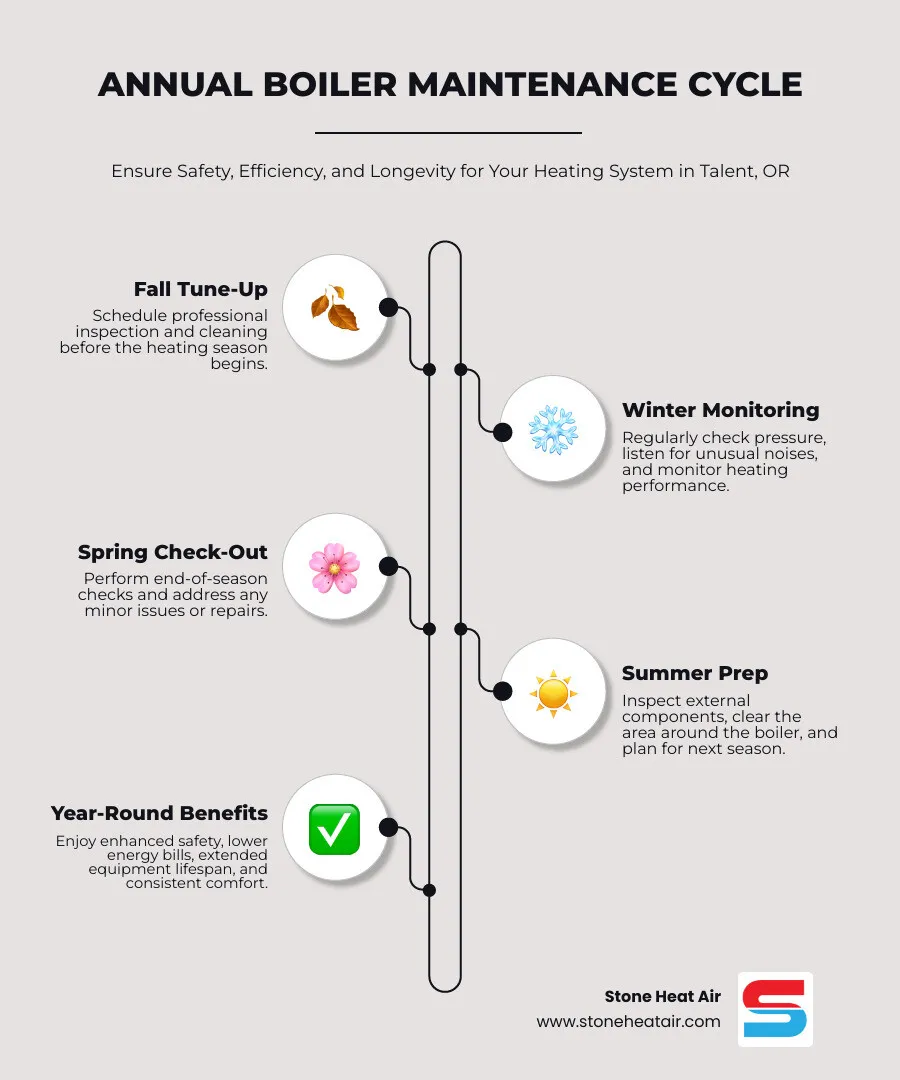
When it comes to your home's heating system, an ounce of prevention is worth a pound of cure. That is why annual professional boiler maintenance in Talent, OR is so important. This pre-season check-up, ideally scheduled in the fall before the cold weather truly sets in, is a comprehensive service designed to help ensure your boiler is safe, efficient, and ready to keep your home warm all winter long.
Here is what a typical professional maintenance visit involves, and how it compares to what you can do yourself:
• Safety Checks — Professional Boiler Maintenance: Inspect gas connections, venting, and flue for leaks or blockages; test carbon monoxide levels; verify operation of pressure relief valve and other safety controls — DIY/Homeowner Maintenance: Test carbon monoxide detectors regularly; ensure combustion area is clear of storage and debris
• System Inspection — Professional Boiler Maintenance: Check heat exchanger, burners, ignition system, expansion tank, circulator pump, and wiring for wear, corrosion, or damage — DIY/Homeowner Maintenance: Look for visible rust, corrosion, or loose fittings on accessible pipes and around the boiler cabinet
• Cleaning — Professional Boiler Maintenance: Clean burners, combustion chamber, and heat exchanger surfaces; clear condensate trap and drain on high-efficiency models — DIY/Homeowner Maintenance: Gently dust exterior surfaces; keep intake and exhaust terminations free of leaves, snow, or debris
• Performance Testing — Professional Boiler Maintenance: Measure gas pressure, combustion efficiency, and temperature rise; adjust burner and controls for optimal operation — DIY/Homeowner Maintenance: Monitor system performance during the season; note any unusual noises, smells, or frequent cycling
• Pressure & Water Levels — Professional Boiler Maintenance: Verify system pressure is within manufacturer specifications; check expansion tank operation; inspect for hidden leaks — DIY/Homeowner Maintenance: Check pressure gauge periodically (typically 1–1.5 bars for many residential systems); top up system only as instructed by a professional
• Radiators & Distribution — Professional Boiler Maintenance: Inspect distribution piping, valves, and air vents; balance the system for even heating — DIY/Homeowner Maintenance: Bleed radiators that are cold at the top and warm at the bottom; confirm all radiator valves are set correctly
• Documentation & Recommendations — Professional Boiler Maintenance: Document system condition, highlight any concerns, and recommend repairs or upgrades if needed — DIY/Homeowner Maintenance: Keep a simple maintenance log of dates, pressure readings, and any issues you notice
Visual inspections, internal cleaning, and safety testing during a professional visit work together to reduce the risk of breakdowns and improve comfort. Homeowner tasks support this work by keeping the system clean, monitored, and free of obvious issues between annual appointments.