

The Reality of Fall Preparation: Why a Basic Filter Change Isn't Enough
You turn on your furnace for the first chilly morning of the year, expecting a rush of warm air, but instead, you are left wondering what actually happens during a professional heating maintenance visit. Many homeowners mistakenly believe that a quick DIY filter swap in the hallway is sufficient preparation for the incoming winter weather. While changing your air filter is a vital homeowner task for basic airflow, modern heating systems are complex machines that require rigorous internal safety and performance audits to operate securely.
Understanding exactly what a licensed technician does during a comprehensive September pre-heating-season tune-up reveals the true value of the service. At Stone Heating and Air, we believe in radical transparency—showing you exactly what goes on behind the metal cabinet of your furnace so you know your home is protected. To learn more about our comprehensive heating services, explore our professional heating maintenance plan today.
The Critical Safety Audit: Testing Furnace Safety Switches
According to the National Fire Protection Association, heating equipment is a leading cause of home fires. This sobering statistic is exactly why technicians do not just look at your system; they actively test its critical safety mechanisms. In our experience serving Central Point OR, where furnaces run heavily throughout the winter, verifying that these fail-safes are fully operational is non-negotiable. We know that transparent communication about these safety mechanisms gives homeowners the ultimate peace of mind. You should never have to guess whether your furnace is safe to operate while your family sleeps.
High-Limit and Rollout Switch Verification
Your furnace is equipped with several built-in safety switches designed to cut the power and gas supply immediately if something goes wrong. Technicians do not just assume these switches work; they actively test them.
• High-Limit Switch — Primary Function: Shuts down the furnace if the internal temperature exceeds safe operating limits, preventing catastrophic overheating. — Professional Testing Method: Technicians temporarily induce a test state to ensure the switch trips correctly at the exact manufacturer-specified temperature.
• Flame Rollout Switch — Primary Function: Detects if flames are burning backward out of the combustion chamber instead of drafting properly up the flue. — Professional Testing Method: Visual inspection of the switch circuit alongside verification of proper draft inducer operation and flame alignment.
• Pressure Switch — Primary Function: Ensures toxic exhaust gases are being safely vented out of the home before allowing the gas valve to open. — Professional Testing Method: Using a manometer to verify the exact negative pressure required to close the switch circuit safely.
The professional difference: We always emphasize that this testing is strictly a professional process. Bypassing or improperly testing these switches can lead to severe equipment damage or dangerous safety hazards. A professional audit guarantees these invisible guardians are ready to act if a malfunction occurs.
Preventing Short-Cycling: The Flame Sensor and Burner Cleaning Process
A dirty flame sensor is the number one cause of furnace short-cycling—a frustrating issue where the system turns on for a few seconds, ignites, and then abruptly shuts off. During a September pre-heating-season visit, our technicians focus heavily on the combustion assembly to prevent this exact scenario. Just recently, the Stone Heating and Air team responded to a local customer whose system was simply not working at peak performance. Our technician provided a thorough service call, explained the mechanics of routine maintenance to keep the system working optimally, and meticulously cleaned the internal components. Today, that system is back to providing consistent, reliable warmth.
Optimized burner performance reduces fuel waste and improves heat output, ensuring you get the most out of every therm of natural gas. This detailed level of care extends the lifespan of the equipment and is a critical step on any comprehensive fall furnace tune-up checklist.
Why Flame Sensors Fail
Carbon buildup naturally occurs over months of inactivity. When a furnace sits idle from spring through late summer, microscopic debris settles on the flame sensor. When the furnace fires up, this debris bakes onto the metal rod. If the sensor cannot feel the flame due to this insulating layer of carbon, it assumes the gas is not igniting and shuts the system down to prevent a dangerous gas buildup.
Here is how a professional safely restores this component:
• Total Isolation: The technician begins by cutting all electrical power and gas supply to the unit to ensure a safe working environment.
• Careful Extraction: They carefully remove the delicate sensor rod, taking special care not to bend the mounting bracket or strip the securing screws.
• Precision Polishing: Using specialized abrasive materials, the technician strips away the microscopic carbon buildup without scratching the sensor's delicate metal surface. Scratches can actually attract more carbon in the future.
• Signal Recalibration: After reinstalling the component, the technician uses a multimeter to test the microamp signal, verifying that the sensor is sending an accurate, strong reading to the control board.
Securing the Electrical Network and Motor Calibration
Vibration from regular use naturally loosens electrical connections over time. A furnace is essentially a vibrating metal box, and in our years of servicing homes across Central Point OR, we frequently see how the wiring harnesses, terminal blocks, and control board connections can slowly back out of their secure positions. Our service technicians see this pattern often: loose connections lead to electrical arcing, which generates excess heat, damages sensitive circuit boards, and causes sudden mid-winter breakdowns that leave you shivering.
Measuring Amp Draws
During a professional audit, technicians use specialized multimeters to check the electrical health of every motor inside the cabinet, including the main blower motor and the draft inducer motor.
• Voltage Verification: The technician measures the incoming power to ensure the system is receiving the exact voltage required by the manufacturer. Voltage drops or spikes put immense strain on the motors.
• Capacitor Testing: The run capacitor acts as a battery boost to help the blower motor start. Catching a weak or failing capacitor now prevents a total blower motor outage later in the year.
• Amp Draw Analysis: By measuring how many amps a motor draws while running, a technician can tell if the motor is working too hard. High amp draws often indicate failing bearings or severe airflow restrictions.
• Friction Reduction: Where applicable on older systems, technicians lubricate moving parts to reduce physical resistance. Less friction means lower electrical consumption and less wear and tear on the internal components.
The quick fix: Identifying voltage spikes and high amp draws early prevents expensive motor burnouts, saving you from a costly mid-season repair.
The Heat Exchanger Inspection: Protecting Your Home's Air Quality
The heat exchanger is the most critical component of your gas furnace. It is the sealed metal shield that separates the toxic combustion gases (like carbon monoxide) from the clean air blowing into your living room ductwork. Because it undergoes immense thermal stress—expanding when the burners ignite and contracting when they shut off—it is highly susceptible to metal fatigue over time.
A September pre-heating-season inspection always prioritizes this component because a compromised heat exchanger is a direct pathway for dangerous carbon monoxide leaks. This is not something a homeowner can evaluate with a flashlight; it requires specialized training and equipment.
Technicians use a combination of visual inspections, high-definition inspection cameras, and combustion analysis tools to check for microscopic cracks that are invisible to the naked eye. Here is what they are looking for:
• Soot Buildup: Excessive black soot indicates incomplete combustion, which means the burners are not mixing gas and oxygen properly.
• Rust and Corrosion: Moisture from the combustion process or a damp basement can rust the metal, creating weak spots that eventually crack under thermal stress.
• Flame Distortion: A burner flame that dances, wavers, or changes color when the blower fan kicks on is a classic symptom of a cracked exchanger, as the blower air is pushing through the crack and disrupting the flame.
The takeaway: We reiterate that this level of inspection requires licensed expertise. Ensuring your heat exchanger is intact is the single most important safety check performed during a maintenance visit.
Airflow Optimization and Complete System Calibration
Delivering heat efficiently throughout the home requires perfect airflow and precise controls. If your furnace creates heat but cannot push it evenly through your home, you will experience cold spots, high utility bills, and a constantly running system.
Technicians check the ductwork's static pressure to ensure unrestricted airflow across the heat exchanger. High static pressure means the blower motor has to work incredibly hard to push air, which can cause the system to overheat and shut down. They also calibrate the thermostat so that the temperature reading on the wall exactly matches the ambient temperature in the center of the room.
This meticulous thoroughness is a hallmark of professional service. For example, our team at Stone Heating and Air recently worked with a highly detail-oriented customer who needed a new system during a period of severe supply chain problems. We worked hard to earn their business, checked for available equipment, provided tailored options, and executed a flawless installation. That same level of dedication to detail applies to routine maintenance—going beyond expectations by explaining optimal operation to the homeowner and ensuring your entire HVAC system operates in perfect harmony.
The professional context of filter replacement is also addressed here. A technician ensures you are using the correct MERV rating for your specific blower motor. Many homeowners unknowingly purchase ultra-restrictive allergy filters that actually choke the furnace of necessary return air. Finally, the technician provides the homeowner in Central Point OR with a comprehensive health report of the equipment, detailing exactly what was checked, what was cleaned, and what to keep an eye on.
The Advantage of Strategic Timing for Pre-Season Tune-Ups
Timing is everything when it comes to preventative maintenance. Catching failing components before the first major temperature drop is the ultimate goal of a September pre-heating-season tune-up. Central Point's chilly autumns and freezing winter nights—where temperatures routinely drop into the low 30s—mean that unexpected heating failures are highly disruptive and deeply uncomfortable.
By scheduling your maintenance proactively, you avoid the rush of emergency no-heat calls when the weather dramatically shifts. At Stone Heating and Air, our dispatch board tells the same story every year: the first real freeze brings a wave of service requests from homeowners who skipped their fall prep. Getting ahead of the curve ensures your system is ready to perform safely on day one.
Furthermore, early maintenance ensures peak efficiency right as the system begins its heaviest workload of the year. A clean, calibrated furnace burns less fuel and uses less electricity to produce the same amount of heat, keeping your energy consumption as low as possible during the coldest months.
Frequently Asked Questions About Heating Maintenance
What is included in a professional heating maintenance visit?
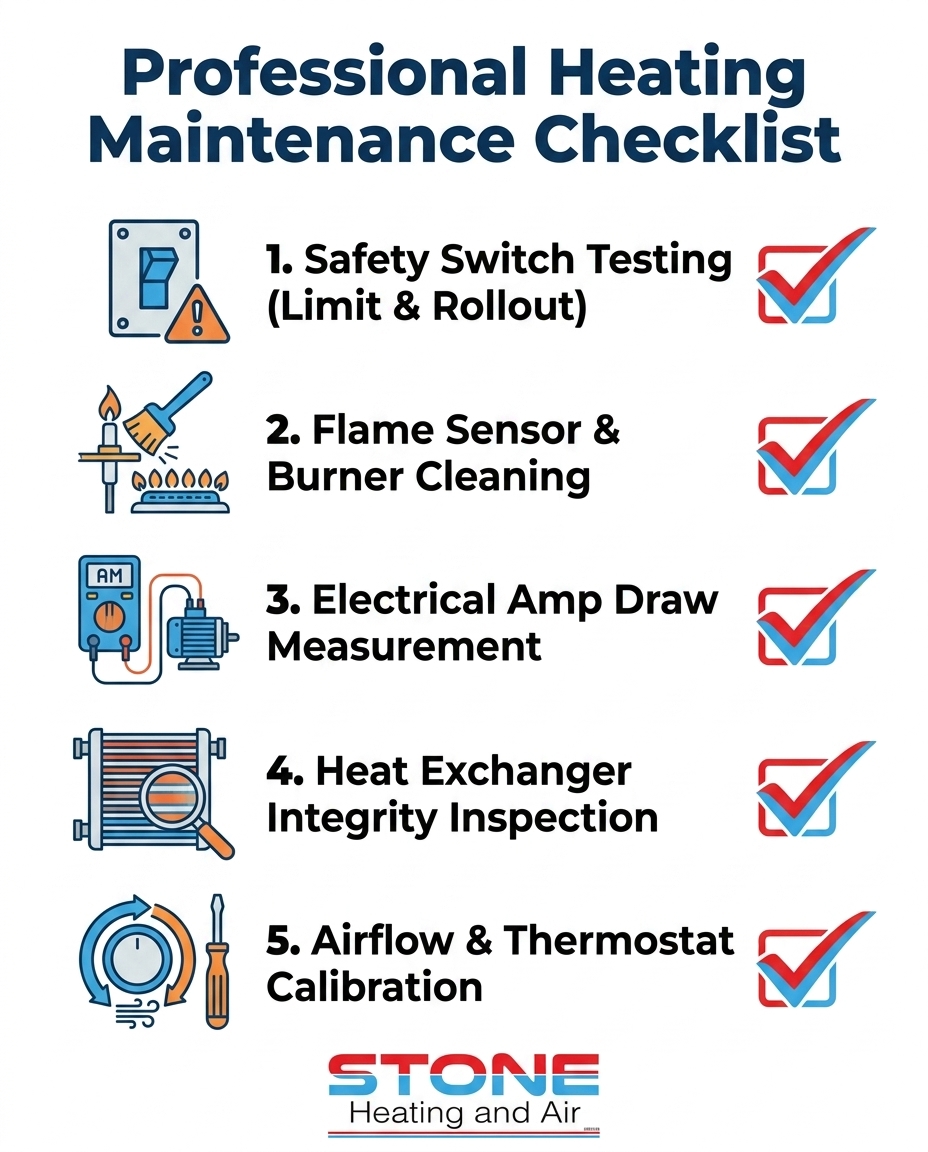
A professional heating maintenance visit is a comprehensive safety and efficiency audit of your furnace. It includes testing all safety switches, cleaning the flame sensor and burners, inspecting the heat exchanger for cracks, measuring electrical amp draws, and calibrating the thermostat. Technicians also check static pressure and ensure the blower motor is operating without excessive friction, providing a full health report upon completion.
Why do furnace safety switches need testing?
Furnace safety switches need testing to prevent catastrophic overheating and potential fire hazards. These switches, such as the high-limit and rollout switches, are designed to shut the system down if internal temperatures exceed safe limits or if flames burn outside the combustion chamber. Professional technicians induce test states to verify these fail-safes trigger exactly when they should, ensuring your home remains safe.
How does a technician clean a flame sensor?
A technician cleans a flame sensor by first isolating the power and gas supply to ensure complete safety. They carefully extract the delicate sensor rod and use specialized abrasive materials to polish away microscopic carbon buildup without scratching the metal surface. Finally, they reinstall the sensor and test the microamp signal to confirm it is accurately detecting the burner flame without triggering a false shutdown.
How long does a comprehensive furnace tune-up take?
A comprehensive furnace tune-up typically takes between one and two hours to complete, depending on the age and condition of the system. This timeframe allows the technician to perform a rigorous, step-by-step audit of the electrical, mechanical, and combustion components. Rushing this process can lead to missed safety checks, which is why professionals take their time to thoroughly document the system's health.
Is an annual heating system inspection actually necessary?
Yes, an annual heating system inspection is necessary to maintain safe operation and peak energy efficiency. Regular maintenance prevents small issues, like a dirty flame sensor or a loose electrical connection, from turning into expensive mid-winter breakdowns. Furthermore, annual inspections are often required by manufacturers to keep your equipment warranty valid and ensure your heat exchanger is free of dangerous carbon monoxide leaks.
Secure Your Winter Comfort With a Comprehensive System Audit
A professional maintenance visit is far more than a basic filter swap; it is a deep-dive safety and efficiency audit designed to protect your home. Proactive care catches failing components early and prevents stressful mid-winter breakdowns when you need your furnace the most. By scheduling your September pre-heating-season tune-up now, you guarantee that your system is ready to handle whatever the colder months bring. Secure your peace of mind by setting up a comprehensive professional heating maintenance plan today.